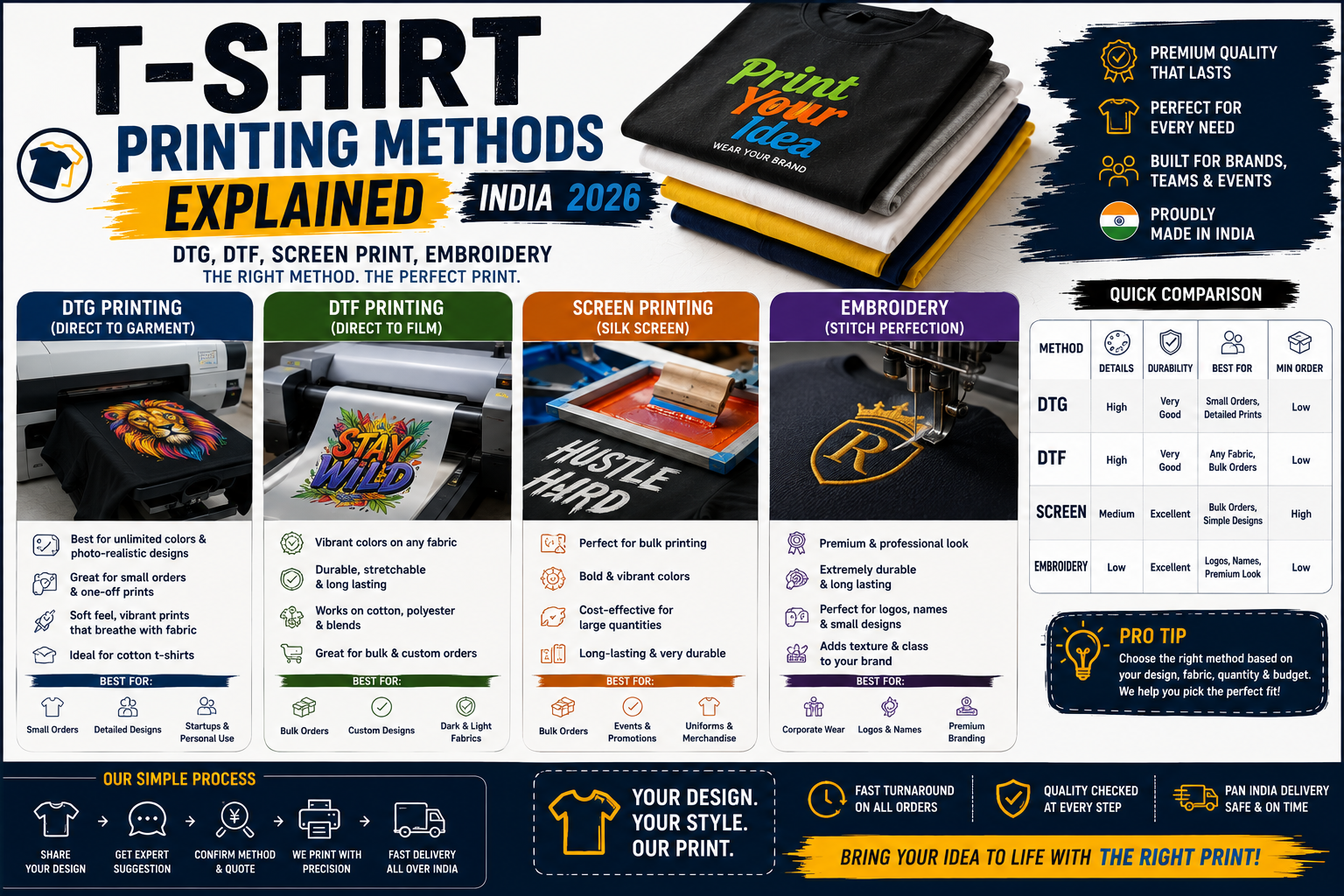
Choosing the right customization method can make a huge difference to the appearance, durability, comfort, and cost of a custom t-shirt.
Whether you’re ordering one personalized t-shirt, launching a clothing brand, creating corporate uniforms, or purchasing 500+ pieces for an event, there are several production methods to consider.
The most common options include DTG (Direct-to-Garment), DTF (Direct-to-Film), screen printing, and embroidery.
But which one is actually best?
The answer depends on your design, quantity, fabric, budget, and the finish you want.
This t-shirt printing methods explained India 2026 guide breaks down each method in simple terms so you can choose the right customization technique for your project.
Quick Comparison: DTG vs DTF vs Screen Printing vs Embroidery
| Method | Best For | Design Detail | Bulk Orders | Finish |
|---|---|---|---|---|
| DTG | Detailed cotton designs | Excellent | Moderate | Soft printed finish |
| DTF | Colourful & detailed designs | Excellent | Good | Smooth transfer |
| Screen Print | Large identical orders | Good | Excellent | Classic print |
| Embroidery | Logos & premium branding | Moderate | Excellent | Raised, textured |
There is no universal winner.
For example, a detailed artwork for a small clothing brand may be better suited to DTF, while 500 identical event t-shirts may be more economical with screen printing.
1. DTG Printing — Direct-to-Garment
DTG stands for Direct-to-Garment.
Instead of transferring artwork onto another material first, a specialized printer applies ink directly onto the garment.
Think of it somewhat like using an inkjet printer, but the surface is a t-shirt.
How DTG Works
The basic process is:
- Prepare the digital artwork.
- Pre-treat the garment when required.
- Place the t-shirt into the DTG printer.
- Print the design directly onto the fabric.
- Cure the ink using the appropriate process.
DTG is particularly useful for detailed artwork and designs containing multiple colours.
Advantages of DTG
Excellent Detail
DTG can reproduce intricate artwork, illustrations, and colour variations.
Great for Small Orders
You don’t necessarily need a large production quantity.
No Traditional Screen Setup
Each design can be printed digitally.
Suitable for Customization
Every t-shirt can potentially have a different design.
Disadvantages of DTG
DTG isn’t ideal for every project.
Potential limitations include:
- Best results often depend on suitable garments.
- Production can be slower for very large orders.
- Dark garments may require additional processing.
- Printing costs can become less attractive for very large identical orders.
For DTG printing India, always ask the supplier what fabrics and garment colours their equipment is optimized for.
2. DTF Printing — Direct-to-Film
DTF has become a popular customization method because it can handle detailed, colourful designs and works across a broad range of garments.
DTF stands for Direct-to-Film.
Instead of printing directly onto the t-shirt, the design is first printed onto a special film.
The printed design is then transferred to the garment using heat and pressure.
How DTF Printing Works
The typical process involves:
- Creating digital artwork.
- Printing the design onto transfer film.
- Applying suitable adhesive powder.
- Curing the transfer.
- Positioning it on the t-shirt.
- Applying heat and pressure.
- Removing the film according to the transfer process.
The result is a printed design bonded to the fabric.
Advantages of DTF
Excellent Colour Reproduction
DTF can handle vibrant, detailed artwork.
Works With Many Designs
It is useful for graphics, illustrations, logos, names, and personalized apparel.
Suitable for Small and Medium Orders
You don’t necessarily need hundreds of identical shirts.
Flexible Garment Options
DTF can be used on various fabrics when the transfer and garment are compatible.
Good for Personalization
Every shirt can feature a different name, number, or graphic.
For DTF printing t-shirts India, it is particularly useful when the artwork is too detailed for simple screen printing or when you need multiple variations.
Disadvantages of DTF
DTF can have a slightly different feel from direct fabric printing.
Depending on the design and garment, the transfer may feel more noticeable than DTG.
Large solid transfers can also reduce breathability in the printed area.
For a premium apparel brand, it is worth testing a sample before committing to a large production run.
3. Screen Printing
Screen printing is one of the most established t-shirt printing techniques.
It uses screens to transfer ink onto the garment.
Each major colour typically requires its own screen or printing setup.
This makes screen printing especially attractive when you are producing a large number of identical designs.
How Screen Printing Works
The general process includes:
- Separating the artwork into printable colours.
- Preparing screens.
- Applying ink through the screens.
- Curing the printed garment.
- Inspecting the finished t-shirt.
Modern screen printing can produce highly durable results when the ink, garment, curing, and production process are appropriate.
Advantages of Screen Printing
Excellent for Bulk Orders
Screen printing becomes increasingly attractive when producing many identical garments.
Strong Print Durability
Properly produced screen prints can withstand regular washing and wear.
Vibrant Results
Screen printing can create bold, solid colours.
Cost-Effective for Large Runs
The setup cost is distributed across a larger number of garments.
For bulk screen printing India, it can be an excellent option for corporate events, college festivals, campaigns, sports groups, and promotional apparel.
Disadvantages of Screen Printing
The setup process makes it less convenient for one-off designs.
It can also become more complicated when:
- The artwork contains many colours.
- Every t-shirt has different personalization.
- You need photographic or highly detailed artwork.
- The order quantity is very small.
For large, identical orders, however, it remains one of the most practical choices.
4. Embroidery
Embroidery is technically not a printing method, but it is one of the most popular alternatives for custom t-shirt branding.
Instead of applying ink, embroidery machines stitch thread directly into the garment.
This creates a raised and textured finish.
How Embroidery Works
The basic process involves:
- Preparing the artwork.
- Digitizing the artwork for embroidery.
- Selecting thread colours.
- Loading the garment.
- Stitching the design.
- Removing excess backing and inspecting the result.
The quality of digitization can have a major impact on the finished design.
Advantages of Embroidery
Premium Appearance
Embroidery creates a dimensional, textured finish.
Excellent for Logos
Company logos and small brand marks can look especially professional.
Long-Lasting
Well-produced embroidery can remain attractive through repeated use when the garment is properly cared for.
Ideal for Corporate Apparel
It works particularly well on polo shirts and structured garments.
For custom embroidery t-shirts India, embroidery is often preferred when the goal is professional branding rather than highly detailed artwork.
Disadvantages of Embroidery
Embroidery isn’t suitable for every design.
It can be less practical for:
- Photographs
- Large gradients
- Highly detailed artwork
- Extremely small text
- Very large designs on lightweight fabric
Dense embroidery can also add weight and stiffness to the garment.
DTG vs DTF: Which Is Better?
Both methods can produce detailed designs, but they work differently.
Choose DTG If:
- You want the artwork printed directly onto suitable fabric.
- Your design contains detailed colour variation.
- You’re working with relatively small quantities.
- You want a printed finish integrated with the garment.
Choose DTF If:
- You need flexible garment options.
- Your artwork contains multiple colours.
- You need personalization.
- You’re producing small-to-medium batches.
The best choice depends on the specific garment and production setup.
DTF vs Screen Printing
This is one of the most common decisions for custom apparel.
DTF
Best for:
- Detailed graphics
- Full-colour designs
- Personalized shirts
- Smaller quantities
Screen Printing
Best for:
- Large orders
- Identical artwork
- Bold designs
- Limited-colour graphics
If you are ordering 500 identical shirts with a simple two-colour logo, screen printing may make more sense.
If you’re ordering 50 shirts with different names and detailed artwork, DTF may offer more flexibility.
Screen Printing vs Embroidery
These methods serve different purposes.
Screen Printing
Best for:
- Large graphics
- Event t-shirts
- Promotional campaigns
- Large quantities
Embroidery
Best for:
- Company logos
- Polo shirts
- Premium branding
- Small chest designs
For a corporate uniform, embroidered branding can provide a more formal appearance.
For a college event where hundreds of participants need the same colourful graphic, screen printing may be more practical.
DTG vs Embroidery
These two methods are particularly different.
DTG
Creates a flat printed image.
Best for detailed artwork.
Embroidery
Creates a raised stitched design.
Best for logos, names, and minimalist branding.
If your artwork contains a photograph, DTG makes more sense.
If your design is a simple company logo, embroidery may provide a more premium appearance.
Which T-Shirt Printing Method Is Best for Bulk Orders?
For bulk production, quantity and design consistency matter.
50 Pieces
DTF, DTG, screen printing, or embroidery may all be possible depending on the artwork.
100 Pieces
Screen printing becomes more attractive for identical designs.
500+ Pieces
Screen printing or embroidery can offer strong production efficiency when the design is standardized.
However, DTF can still be appropriate for detailed artwork or personalized designs.
The best printing method for bulk t-shirts India depends on the exact specifications rather than quantity alone.
Which Method Is Best for Clothing Brands?
Clothing brands often use more than one method.
Minimalist Brand
Embroidery can work well.
Graphic Streetwear
DTF or screen printing can be suitable.
Detailed Artwork
DTG or DTF can provide greater design flexibility.
Premium Polo Collection
Embroidery is often a strong option.
A brand doesn’t need to commit to one production method for every product.
Which Method Is Most Durable?
Durability depends on the quality of the production process, garment, inks or thread, curing, and care.
In general:
Embroidery: Highly durable when properly produced.
Screen Printing: Can be highly durable with appropriate ink and curing.
DTF: Can provide good durability when properly transferred and cared for.
DTG: Can provide good durability when correctly printed, cured, and maintained.
Don’t judge durability based only on the printing method. A poorly produced print can fail faster than a properly produced alternative.
Which Method Is Most Cost-Effective?
There is no universal cheapest method.
Your cost can depend on:
- Quantity
- T-shirt fabric
- GSM
- Design size
- Number of colours
- Number of print locations
- Personalization
- Setup requirements
- Packaging
- Delivery
For custom t-shirt printing price India, always compare complete quotations instead of looking only at the advertised printing charge.
Best Method by Design Type
| Design Type | Recommended Method |
|---|---|
| Company logo | Embroidery |
| Small name | Embroidery or DTF |
| Large colourful artwork | DTF or DTG |
| Simple bulk logo | Screen printing |
| Photograph | DTG or DTF |
| Sports number | DTF or screen printing |
| Minimalist branding | Embroidery |
| Streetwear graphic | DTF or screen printing |
| Personalized designs | DTF |
| 500+ identical shirts | Screen printing |
These are general recommendations. The final choice should be based on the artwork, garment, quantity, and supplier capabilities.
How to Choose the Right Method
Ask yourself five questions:
1. How Many T-Shirts Do I Need?
One shirt and 500 shirts can have very different production economics.
2. What Does the Artwork Look Like?
Simple logos and detailed illustrations require different approaches.
3. Do Shirts Need Individual Personalization?
Names and numbers may favour DTF or embroidery.
4. What Fabric Are You Using?
Not every printing process performs identically on every material.
5. What Finish Do You Want?
Do you want:
- Soft printed?
- Vibrant?
- Textured?
- Premium?
- Raised?
Answering these questions makes the choice much easier.
Tips Before Ordering Custom T-Shirts in India
Request a Sample
Especially for large orders.
Confirm the Fabric
Ask about composition and GSM.
Check Artwork Size
Make sure the final dimensions are correct.
Confirm Print Placement
Chest, centre, sleeve, back, or multiple locations can affect pricing.
Ask About Washing
Understand the recommended care instructions.
Compare Complete Quotes
Include printing, garment, taxes, packaging, and delivery where applicable.
Check Size Measurements
Don’t rely only on S, M, L, or XL labels.
Frequently Asked Questions
What is the best t-shirt printing method in India in 2026?
There is no single best method. Screen printing is strong for large identical orders, DTF is flexible for detailed and personalized designs, DTG is useful for detailed direct printing, and embroidery is excellent for premium logos and branding.
Is DTF better than screen printing?
Not universally. DTF is more flexible for detailed and personalized designs, while screen printing can be more efficient for large quantities of identical artwork.
Is DTG better than DTF?
Both can produce detailed designs. DTG prints directly onto suitable garments, while DTF uses a transfer film. The better option depends on the garment, design, quantity, and desired finish.
Is embroidery better than printing?
Embroidery can be better for logos, names, and premium branding. Printing is generally more suitable for detailed artwork, large graphics, and photographs.
Which method is best for 500 t-shirts?
For 500 identical shirts with a simple design, screen printing can be highly practical. Embroidery can also work well for small logos. Detailed or personalized artwork may make DTF more suitable.
Which printing method lasts the longest?
A properly produced embroidery or screen print can be highly durable, but DTF and DTG can also provide good longevity. Production quality and garment care are critical.
Final Verdict
Understanding t-shirt printing methods explained India 2026 doesn’t require choosing one universal winner.
Each technique solves a different customization problem.
DTG is useful for detailed artwork printed directly onto suitable garments. DTF offers excellent flexibility for colourful, detailed, and personalized designs. Screen printing remains a strong choice for large quantities of identical designs. Embroidery provides a premium, textured finish that works particularly well for logos, names, polos, and corporate apparel.
If you’re ordering custom t-shirts, start with the design and quantity, then choose the production method—not the other way around.
For a 500-piece event order with a simple logo, screen printing may be the practical choice. For 30 personalized shirts with different names, DTF may make more sense. For company polos, embroidery can provide a professional finish. For a detailed artistic graphic, DTG or DTF may offer better results.
The smartest approach is to compare fabric, GSM, artwork, quantity, customization, durability, total cost, and intended use before placing your order.
A good printing method isn’t simply the cheapest one. It’s the method that delivers the right combination of appearance, durability, comfort, customization, production efficiency, and value for your specific t-shirt project.
Leave a Reply