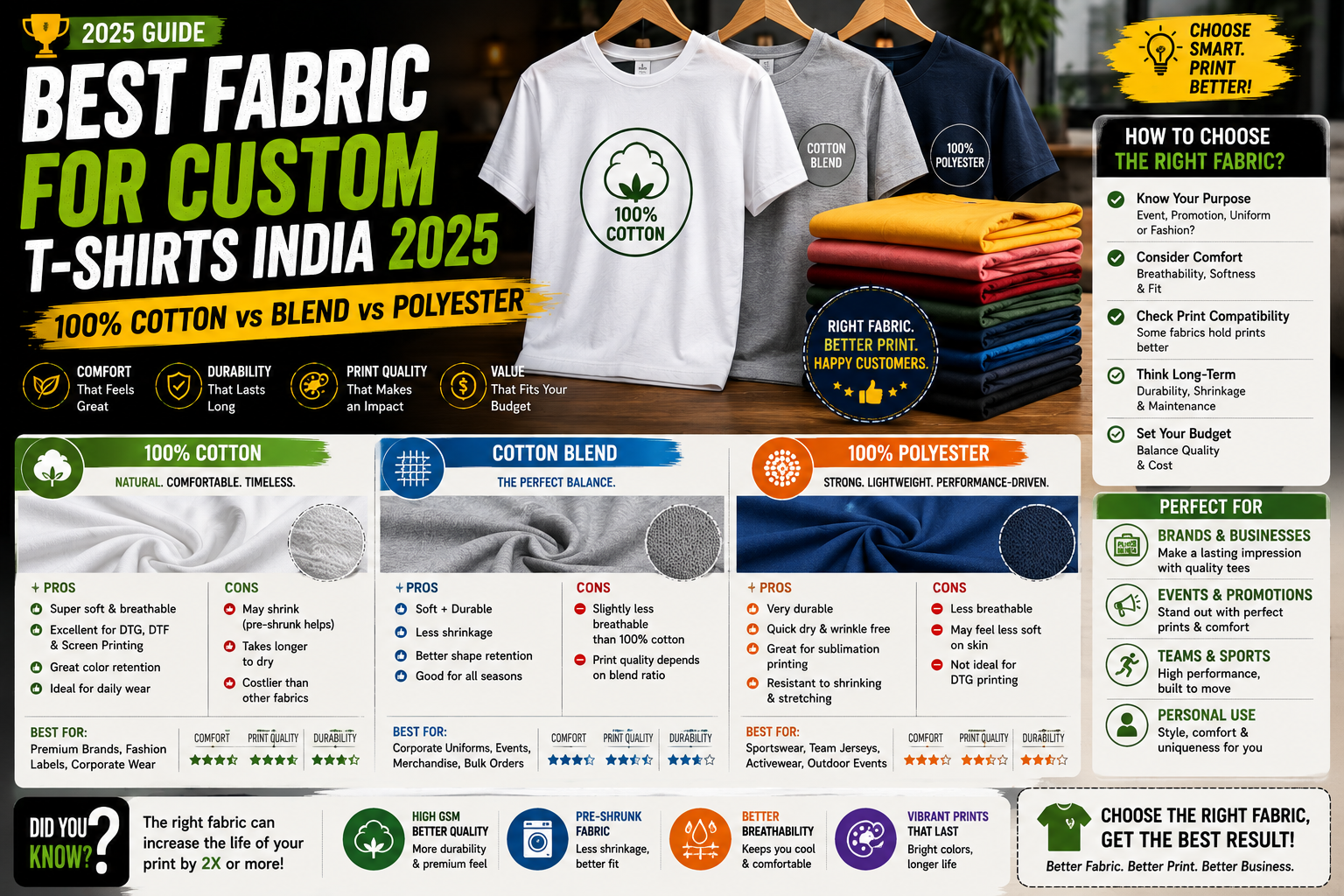
Choosing the right fabric is one of the most important decisions when ordering a custom t-shirt. A great design can look impressive online, but if the fabric feels uncomfortable, shrinks after washing, or doesn’t hold the print properly, the final product may disappoint.
For Indian customers, fabric selection is even more important because weather conditions vary significantly across the country. A t-shirt suitable for a hot summer day in Delhi or Mumbai may not be the same choice for a winter corporate event in North India.
So, what is the best fabric custom t-shirt India cotton buyers should choose?
The answer depends on how you plan to use the t-shirt.
In this guide, we’ll compare 100% cotton, cotton blends, and polyester, explain GSM, discuss printing and embroidery compatibility, and help you choose the right fabric for corporate uniforms, events, sportswear, fashion brands, and everyday use.
Quick Answer: Which Fabric Is Best?
For most everyday custom t-shirts in India, 100% cotton—particularly good-quality 180 GSM cotton—is an excellent all-round choice.
However, each fabric has specific advantages:
- 100% Cotton: Best for comfort, casual wear, and everyday use
- Cotton Blend: Best for durability, affordability, and uniforms
- Polyester: Best for sportswear, moisture management, and sublimation
- Heavyweight Cotton: Best for premium and oversized fashion
The right choice depends on your design, budget, climate, and intended use.
100% Cotton T-Shirts
Cotton remains one of the most popular materials for custom apparel in India.
A 100% cotton t-shirt is made entirely from cotton fibres and is generally valued for its natural feel and breathability.
Advantages of 100% Cotton
- Soft and comfortable
- Breathable
- Suitable for everyday wear
- Good for casual clothing
- Available in many GSM options
- Works well with several printing methods
It’s particularly suitable for customers looking for custom printed t-shirts India for events, gifts, casual clothing, and merchandise.
Potential Drawbacks
Cotton can:
- Shrink depending on fabric and finishing
- Hold moisture longer than polyester
- Require more care in some situations
- Become less suitable for intense sports activity
Choosing pre-shrunk or properly finished cotton can help reduce shrinkage concerns.
180 GSM Cotton: The Everyday Favourite
If you’re unsure which cotton weight to choose, 180 GSM is a practical starting point.
It offers a balance between:
- Comfort
- Durability
- Breathability
- Cost
- Print quality
This makes it suitable for:
- Company t-shirts
- College events
- Promotional apparel
- Casual wear
- Startup merchandise
- Personalized gifts
For many buyers searching for 180 GSM cotton t-shirts India, this weight provides a versatile middle ground.
220 GSM Cotton: Premium & Oversized
Want a heavier, more structured t-shirt?
Consider 220 GSM cotton.
It’s particularly popular for:
- Oversized t-shirts
- Streetwear
- Premium merchandise
- Fashion brands
- D2C clothing labels
The heavier fabric creates a more substantial feel and can provide a premium appearance.
However, it may feel warmer than lighter fabrics, making it less suitable for extremely hot conditions.
If you’re researching 220 GSM oversized t-shirts, consider the climate and intended use before choosing heavyweight fabric.
Cotton Blended T-Shirts
Cotton blends combine cotton with another fibre, commonly polyester.
The exact composition can vary, such as a cotton-polyester blend.
The goal is often to combine some of cotton’s comfort with characteristics such as improved durability, shape retention, or faster drying.
Advantages
- Durable
- Often more resistant to wrinkles
- Can dry faster than pure cotton
- Suitable for uniforms
- Often cost-effective
- Good for frequent use
Cotton blends can be a practical choice for companies that need corporate uniform t-shirts for employees who wear them regularly.
Potential Drawbacks
The fabric may not provide the same natural feel as high-quality 100% cotton.
The exact performance depends heavily on the fibre ratio and manufacturing quality.
Polyester T-Shirts
Polyester is a synthetic fibre widely used for sportswear and performance apparel.
It’s particularly useful when the t-shirt needs to handle:
- Physical activity
- Sweat
- Outdoor use
- Frequent washing
- Sports events
Advantages
- Lightweight options available
- Quick-drying
- Durable
- Suitable for sportswear
- Excellent for sublimation printing
This makes polyester particularly suitable for custom sports jerseys India.
Potential Drawbacks
Some people prefer cotton because polyester can feel less natural against the skin.
Polyester may also retain odours under certain conditions, depending on the fabric construction and garment care.
Cotton vs Blend vs Polyester
| Feature | 100% Cotton | Cotton Blend | Polyester |
|---|---|---|---|
| Comfort | Excellent | Very Good | Good |
| Breathability | Excellent | Good | Depends on construction |
| Durability | Good | Very Good | Excellent |
| Quick Drying | Lower | Moderate | Excellent |
| Everyday Wear | Excellent | Excellent | Good |
| Sportswear | Moderate | Good | Excellent |
| Corporate Uniforms | Excellent | Excellent | Very Good |
| Sublimation | Not suitable | Usually limited | Excellent |
| Premium Casual Wear | Excellent | Good | Moderate |
There isn’t one universally “best” fabric. The best option depends on the purpose of your custom t-shirt.
Best Fabric for Custom Printing
The printing method should influence your fabric choice.
DTF Printing
DTF works across many commonly used garment fabrics and is suitable for:
- Detailed artwork
- Logos
- Text
- Colourful designs
- Small and medium orders
Screen Printing
Screen printing is commonly used for:
- Bulk orders
- Simple graphics
- Corporate events
- Promotional campaigns
Cotton is particularly popular for screen-printed apparel.
Sublimation
Sublimation is especially suitable for polyester garments.
It’s widely used for:
- Sports jerseys
- Team uniforms
- All-over designs
The dye becomes integrated into the suitable polyester fabric rather than sitting as a conventional surface print.
Best Fabric for Embroidery
Embroidery requires a stable fabric that can support stitching.
Good options include:
- 180 GSM cotton
- 200 GSM cotton
- Cotton-poly blends
- Polo fabrics
- Certain heavyweight cotton garments
For businesses, logo embroidery polo t-shirts are particularly popular because polo fabric provides a structured appearance suitable for professional uniforms.
Very thin fabrics may not always be ideal for larger or dense embroidery designs because heavy stitching can affect the garment’s appearance.
Best Fabric for Indian Weather
India has diverse climates, so consider where and when the t-shirt will be worn.
Hot & Humid Conditions
Consider:
Lightweight cotton
It offers a comfortable, breathable feel for everyday casual wear.
Outdoor Work
Consider:
Cotton blends or suitable performance fabrics
These can provide better durability and faster drying.
Sports & Fitness
Consider:
Polyester performance fabric
Especially when sweat management and quick drying are priorities.
Cooler Weather
Consider:
Heavier cotton
A 220 GSM or similar heavyweight garment can provide a more substantial feel.
Best Fabric for Corporate T-Shirts
For office teams, the most practical options are usually:
180–200 GSM Cotton
Best for:
- Startups
- Office teams
- Events
- Casual corporate uniforms
Cotton-Poly Blend
Best for:
- Field teams
- Service staff
- Frequent washing
- Long working hours
Polo Fabric
Best for:
- Hotels
- Restaurants
- Retail stores
- Sales teams
- Customer-facing employees
If you’re creating branded apparel, custom embroidered t-shirts India can provide a professional alternative to large printed designs.
How GSM Affects Your Choice
GSM means grams per square metre and indicates fabric weight.
Generally:
- 160 GSM: Lightweight
- 180 GSM: Medium and versatile
- 200 GSM: Medium-heavy
- 220 GSM: Heavyweight
- 240 GSM+: Very heavyweight
GSM isn’t a direct measure of quality. A well-made 180 GSM t-shirt can be better than a poorly constructed 220 GSM garment.
Always consider fibre quality, knitting, finishing, stitching, and garment construction—not just GSM.
How Much Does Fabric Choice Affect Price?
Generally, fabric quality is one of several factors affecting the final custom t-shirt price.
Other factors include:
- GSM
- Printing method
- Embroidery
- Design size
- Number of print locations
- Quantity
- Personalization
- Packaging
- Delivery
A premium heavyweight cotton t-shirt will typically cost more than a basic promotional garment, while a performance polyester jersey may have a different price structure.
For bulk orders, always compare the complete per-piece quotation, not just the base garment price.
How to Choose the Right Fabric
Use this simple guide:
Choose 100% Cotton If:
You want maximum everyday comfort and a natural fabric feel.
Choose Cotton Blend If:
You need a durable, practical uniform for regular use.
Choose Polyester If:
You’re creating sportswear or need quick-drying performance.
Choose 220 GSM Cotton If:
You’re building a premium oversized or streetwear collection.
Choose 180 GSM Cotton If:
You want an affordable, versatile option for events, companies, and everyday apparel.
5 Mistakes to Avoid
1. Choosing GSM Alone
Higher GSM doesn’t automatically mean better quality.
2. Ignoring the Printing Method
Always make sure your chosen fabric works well with your customization technique.
3. Buying Only Based on Price
Very cheap fabric may compromise comfort and durability.
4. Ignoring Climate
A heavyweight t-shirt may not be the most practical choice for hot and humid conditions.
5. Skipping a Sample
For large corporate or event orders, test the fabric and customization before approving the full production run.
Frequently Asked Questions
Which fabric is best for custom t-shirts in India?
For general everyday use, 100% cotton—especially around 180 GSM—is a strong all-round choice. However, polyester is often better for sportswear, while blends can be practical for uniforms.
Is 100% cotton better than polyester?
Not universally. Cotton generally prioritizes natural comfort, while polyester offers advantages for performance apparel, quick drying, and sublimation printing.
Is 180 GSM good for custom t-shirts?
Yes. 180 GSM is a versatile weight for everyday t-shirts, corporate apparel, events, and promotional clothing.
Is 220 GSM too thick for India?
Not necessarily. It can work well for premium and oversized clothing, but it may feel warmer than lighter fabrics, particularly in hot weather.
Which fabric is best for embroidery?
Medium-weight cotton, polo fabrics, and suitable cotton blends can work well for embroidery. The design’s size and stitch density should also be considered.
Which fabric is best for sports t-shirts?
Polyester performance fabrics are commonly chosen for sportswear because they can dry quickly and work well with sublimation.
Final Verdict: Best Fabric Custom T-Shirt India Cotton
When choosing the best fabric custom t-shirt India cotton buyers should focus on the purpose of the garment rather than simply choosing the heaviest or cheapest material.
For everyday wear, events, personalized gifts, and many corporate applications, 180 GSM cotton is a reliable and versatile option. For premium oversized fashion, 220 GSM cotton provides a heavier structure. Cotton blends can be useful for uniforms requiring durability and easy maintenance, while polyester remains a strong choice for sportswear and sublimation printing.
The best custom t-shirt is ultimately the combination of the right fabric, appropriate GSM, suitable customization method, and quality construction.
Before placing a bulk order, request a sample whenever possible. Check the fabric feel, sizing, colour, print or embroidery quality, and wash performance. A little planning upfront can help you create custom apparel that looks good, feels comfortable, and delivers better value over time.
Leave a Reply