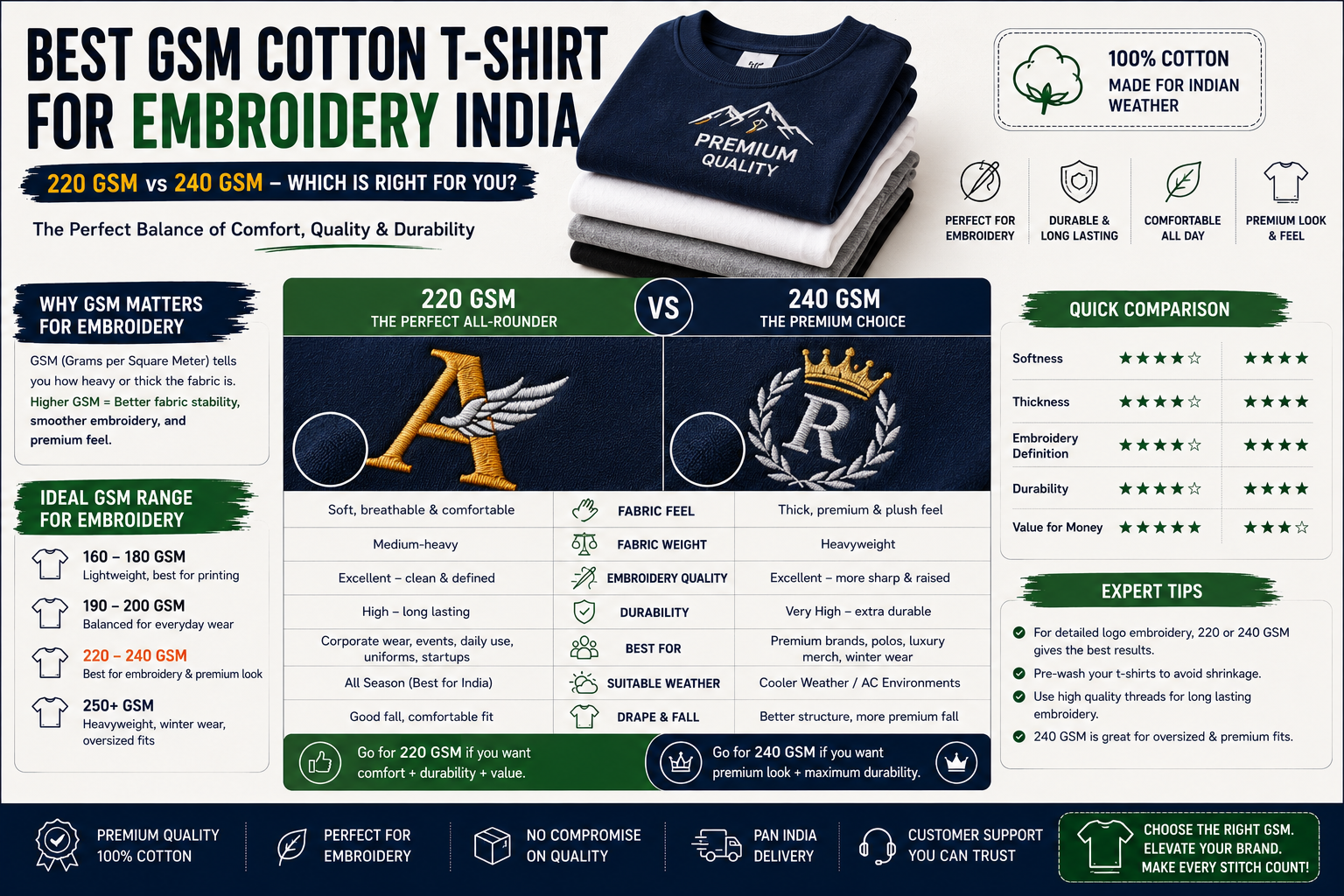
Choosing the right fabric is one of the most important decisions when ordering a custom embroidered t-shirt. The embroidery itself may get most of the attention, but the GSM, cotton quality, fabric construction, fit, and stitching all influence how the finished garment looks and feels.
Among heavyweight options, 220 GSM and 240 GSM cotton t-shirts are particularly popular for premium custom apparel and oversized styles. A 220 GSM tee generally offers a balance between substantial fabric and everyday comfort, while 240 GSM provides a heavier, more structured feel. Current Indian apparel guides also place 220–240 GSM in the heavyweight/premium range.
So, which is the best GSM cotton t-shirt for embroidery in India: 220 or 240 GSM?
The answer depends on your logo, embroidery size, climate, t-shirt fit, and how you plan to use the garment.
What Does GSM Mean in a T-Shirt?
GSM stands for Grams per Square Metre.
It measures the weight of the fabric per square metre. Generally, increasing GSM means the fabric becomes heavier and often feels thicker and more structured. However, GSM is not a complete measurement of quality. Cotton type, yarn, knitting, finishing, stitching, and garment construction also matter.
For example:
- 160 GSM: Lightweight
- 180 GSM: Light-to-midweight
- 200 GSM: Midweight
- 220 GSM: Heavyweight
- 240 GSM: Heavyweight/premium
- 260+ GSM: Very heavyweight
This means both 220 and 240 GSM can be excellent choices for embroidery, but they create different results.
220 GSM vs 240 GSM: Quick Comparison
| Feature | 220 GSM Cotton | 240 GSM Cotton |
|---|---|---|
| Fabric weight | Heavyweight | Heavier heavyweight |
| Feel | Substantial but flexible | Thick and structured |
| Breathability | Generally better | Generally lower |
| Structure | Strong | Stronger |
| Embroidery suitability | Excellent | Excellent |
| Oversized fit | Very good | Excellent |
| Premium feel | High | Very high |
| Hot-weather comfort | Better of the two | Better for moderate/cooler conditions |
| Best use | Everyday premium tees | Premium/streetwear tees |
| Typical preference | Versatile | Maximum structure |
A higher GSM isn’t automatically “better.” The right choice depends on what you want from the finished t-shirt.
Is 220 GSM Good for Embroidery?
Yes. 220 GSM is an excellent weight for many embroidered cotton t-shirts.
It provides enough body for the fabric to support embroidery while remaining more flexible and breathable than a heavier garment.
A 220 GSM t-shirt can work particularly well for:
- Company logo embroidery
- Startup merchandise
- College groups
- Team apparel
- Event t-shirts
- Small chest logos
- Personalised names
- Premium everyday wear
Heavyweight fabrics around 220 GSM and above are generally better at holding their shape than lightweight tees, which can be useful when adding embroidery.
Advantages of 220 GSM
Good balance: You get a substantial fabric without going as heavy as 240 GSM.
Comfortable for everyday use: Particularly useful when the t-shirt needs to be worn for several hours.
Good structure: Helps the garment maintain its shape.
Excellent for embroidery: Suitable for small and medium-sized embroidered designs.
Versatile: Works across corporate, casual, event, and lifestyle applications.
For many Indian buyers, 220 GSM can be the sweet spot between premium feel and everyday practicality.
Is 240 GSM Good for Embroidery?
Yes. 240 GSM is also an excellent choice, especially for premium and oversized embroidered t-shirts.
Because the fabric is heavier, it can create a more structured silhouette.
This makes 240 GSM particularly attractive for:
- Oversized t-shirts
- Drop-shoulder designs
- Streetwear
- Premium brand merchandise
- Large embroidered motifs
- Fashion collections
- Heavyweight corporate merchandise
Indian apparel guides commonly position 240 GSM as a heavyweight choice for structured and oversized garments.
Advantages of 240 GSM
More structure: The garment can maintain a stronger silhouette.
Premium hand feel: The additional fabric weight gives the shirt a more substantial feel.
Good embroidery base: A well-constructed heavyweight cotton tee can provide a stable foundation for embroidery.
Excellent for oversized styles: The fabric can help prevent a loose silhouette from looking too limp.
Durable feel: Heavier fabric can feel more robust, although durability depends on the complete garment—not GSM alone.
220 GSM vs 240 GSM for Embroidery
If embroidery is your primary concern, both weights can work well.
The bigger question is:
How large and dense is your embroidery?
A small left-chest logo doesn’t necessarily require 240 GSM.
For example:
Small Company Logo
220 GSM: Excellent
240 GSM: Excellent
Medium Logo
220 GSM: Very good
240 GSM: Excellent
Large/Dense Embroidery
220 GSM: Depends on fabric construction and backing
240 GSM: Potentially better suited to a structured garment
The embroidery supplier should evaluate the design before deciding the exact garment specification.
Does Higher GSM Make Embroidery Better?
Not automatically.
This is an important point for anyone searching for the best GSM cotton t-shirt embroidery India 220 240.
A 240 GSM t-shirt isn’t automatically better than a 220 GSM t-shirt simply because it weighs more.
Other factors include:
- Cotton quality
- Yarn quality
- Knit construction
- Fabric stability
- Stretch
- Embroidery density
- Thread type
- Backing
- Stitching quality
- Garment construction
GSM should therefore be treated as one specification among several, rather than the sole measure of quality.
Which Is Better for Logo Embroidery?
For a standard company logo, both can work.
Choose 220 GSM if:
- The t-shirt will be worn regularly
- You want a balance between weight and comfort
- The logo is relatively small
- The garment will be used in warmer conditions
- You want a premium feel without maximum heaviness
Choose 240 GSM if:
- You want a heavyweight premium appearance
- The shirt is oversized
- You want stronger structure
- The garment is fashion-focused
- You prefer a thicker fabric
For <mark>logo embroidery t-shirt India</mark>, the design itself should be considered before selecting the final fabric.
Which GSM Is Better for Indian Summers?
This is where 220 GSM has an advantage over 240 GSM.
India has many hot and humid regions, so fabric weight needs to be considered alongside:
- Cotton type
- Knit construction
- Fit
- Breathability
- Colour
- Humidity
- Activity level
A breathable 220 GSM cotton t-shirt may feel more comfortable than a 240 GSM garment during hot outdoor conditions.
A 240 GSM tee can still work in warm weather, but the heavier construction may feel less comfortable during prolonged outdoor activity.
For <mark>best GSM cotton t-shirt for summer India</mark>, don’t choose based on GSM alone.
Which Is Better for Oversized T-Shirts?
For oversized and drop-shoulder designs, 240 GSM is often the stronger choice.
Why?
An oversized silhouette contains more fabric and benefits from structure.
A heavier material can create:
- Better drape
- Stronger shoulders
- More defined shape
- A premium streetwear appearance
Current Indian apparel guides commonly associate 240 GSM with oversized and structured streetwear silhouettes.
However, 220 GSM can also work extremely well when you want an oversized fit that’s somewhat lighter and more flexible.
220 GSM vs 240 GSM for Corporate T-Shirts
For corporate apparel, think about how employees will actually use the shirts.
If the t-shirt is intended for:
- Office events
- Team outings
- Conferences
- Promotional campaigns
- Regular staff wear
220 GSM can be a practical choice.
It offers a premium appearance without making the garment unnecessarily heavy.
For a premium branded merchandise collection where appearance matters more than lightweight comfort, 240 GSM may be more appropriate.
220 GSM vs 240 GSM for Startups and D2C Brands
For fashion-focused brands, fabric weight can become part of the product positioning.
220 GSM
Good for:
- Everyday premium tees
- Relaxed fits
- Lightweight heavyweight styles
- Versatile collections
240 GSM
Good for:
- Oversized collections
- Streetwear
- Premium drops
- Structured silhouettes
- Statement pieces
For <mark>custom t-shirts for startups India</mark>, 220 GSM may offer greater everyday versatility, while 240 GSM can help create a more heavyweight premium identity.
Cotton Type Matters More Than Many Buyers Realize
Two t-shirts can both be labeled 240 GSM cotton and still feel completely different.
Why?
Because GSM doesn’t tell you everything about the fabric.
Check whether the supplier specifies:
- Combed cotton
- Ring-spun cotton
- Organic cotton
- Single jersey
- French terry
- Cotton blend
- Pre-shrunk fabric
Also consider:
- Fabric softness
- Stitching
- Collar construction
- Shrinkage
- Colourfastness
- Fit consistency
This is why ordering a sample is particularly useful before a large custom embroidery order.
Single Jersey vs French Terry
The fabric construction can significantly change how a heavyweight t-shirt feels.
Single Jersey
Usually provides a classic t-shirt construction.
It can work well for:
- Regular t-shirts
- Oversized tees
- Casual apparel
- Embroidery
French Terry
Has a different looped construction and can feel more substantial.
It’s often associated with heavier fashion garments and streetwear.
Don’t assume that 240 GSM single jersey and 240 GSM French terry will feel identical.
They won’t.
What About 180 GSM?
If you’re wondering whether you actually need 220 or 240 GSM, consider the application.
A 180 GSM cotton t-shirt can be perfectly suitable for:
- Hot weather
- Large group orders
- Promotional events
- Everyday casual wear
- Budget-conscious projects
Indian manufacturing guides commonly describe 180 GSM as a versatile everyday weight, while 220–240 GSM moves toward heavier and streetwear-oriented garments.
So don’t automatically upgrade to 240 GSM simply because you’re adding embroidery.
Best GSM Based on Use Case
Corporate Logo T-Shirts
Recommended: 180–220 GSM
Premium Corporate Merchandise
Recommended: 220 GSM
Startup Brand Merchandise
Recommended: 200–240 GSM
Oversized Streetwear
Recommended: 220–240 GSM
Heavyweight Premium Collection
Recommended: 240 GSM+
Hot Outdoor Events
Recommended: 160–220 GSM, depending on fabric and climate
Small Embroidered Personalised T-Shirts
Recommended: 180–220 GSM
Large/Dense Embroidery
Recommended: 220–240 GSM, subject to design testing
How to Choose Between 220 and 240 GSM
Use this simple decision guide.
Choose 220 GSM if:
Comfort is your priority.
You want a premium shirt but don’t want excessive weight.
Choose 240 GSM if:
Structure is your priority.
You want a heavier, more substantial garment.
Choose 220 GSM if:
You’re ordering shirts for a hot outdoor event.
Choose 240 GSM if:
You’re creating heavyweight oversized streetwear.
Choose either if:
You are adding a small embroidered company logo.
The final choice should depend on the fabric construction and embroidery design, not simply the GSM number.
How to Order the Best Embroidered Cotton T-Shirt
Before placing your order, ask the supplier for these details:
Fabric
- Exact GSM
- Cotton composition
- Knit construction
- Fabric finish
Embroidery
- Logo dimensions
- Stitch count
- Thread colours
- Backing
- Placement
Garment
- Size chart
- Shrinkage information
- Colour availability
- Sample availability
Production
- MOQ
- Production time
- Quality-control process
- Delivery timeline
This information gives you a much better picture of the final product than GSM alone.
Why You Should Order a Sample
A sample can reveal things that specifications cannot.
Check:
- Fabric thickness
- Softness
- Fit
- Logo placement
- Embroidery density
- Thread appearance
- Inside backing
- Collar quality
- Stitching
This is especially important when ordering 50, 100, or 500+ custom embroidered t-shirts.
A sample also lets you compare 220 GSM and 240 GSM side by side.
Care Tips for Heavyweight Embroidered T-Shirts
Once you have selected a good garment, proper care can help maintain its appearance.
Wash Inside Out
This can reduce direct friction against the embroidery.
Use a Gentle Cycle
Avoid unnecessarily aggressive washing.
Use Appropriate Water Temperature
Follow the garment’s care label, particularly because cotton can shrink.
Avoid Excessive Heat
High heat can affect cotton and certain embroidery components.
Don’t Iron Directly Over the Embroidery
If ironing is allowed by the care label, protect the embroidered area appropriately.
Air Dry When Possible
Follow the manufacturer’s instructions and avoid unnecessary high heat.
Common Mistakes When Choosing GSM for Embroidery
Mistake 1: Assuming Higher GSM Always Means Better
A 240 GSM shirt isn’t automatically superior to a good 220 GSM shirt.
Mistake 2: Ignoring Cotton Quality
The same GSM can feel very different depending on construction and yarn.
Mistake 3: Choosing Heavyweight Fabric for Every Climate
A heavyweight shirt may not be the most comfortable choice for hot outdoor conditions.
Mistake 4: Ignoring the Embroidery Design
Large and dense embroidery needs different consideration from a tiny logo.
Mistake 5: Skipping the Sample
Always test before placing a large order when quality matters.
Frequently Asked Questions
Is 220 GSM cotton good for embroidery?
Yes. 220 GSM cotton can provide a strong, substantial base for embroidered logos while remaining relatively versatile for everyday wear.
Is 240 GSM better than 220 GSM for embroidery?
Not automatically. 240 GSM offers greater weight and structure, while 220 GSM can provide a better balance of comfort and structure.
What is the best GSM cotton t-shirt for embroidery in India?
For many applications, 220 GSM is a strong all-round option, while 240 GSM is better for heavyweight, oversized, and premium applications.
Is 240 GSM too hot for India?
It can feel warmer than 220 GSM, particularly outdoors in hot and humid conditions. Breathability also depends on cotton quality and fabric construction.
Is 220 GSM good for oversized t-shirts?
Yes. It can provide a structured oversized fit while remaining somewhat lighter than 240 GSM.
Is 240 GSM good for oversized t-shirts?
Yes. 240 GSM is particularly suitable when you want a more structured, heavyweight streetwear silhouette.
Does higher GSM make t-shirts more durable?
Higher GSM can contribute to a more substantial and robust fabric, but durability also depends on fiber quality, knitting, stitching, finishing, washing, and construction.
What is better for a company logo: 220 or 240 GSM?
For a standard small-to-medium company logo, either can work. 220 GSM is usually the more versatile choice, while 240 GSM makes more sense if you specifically want a heavyweight premium garment.
Final Verdict: 220 GSM or 240 GSM?
If you’re choosing between 220 GSM vs 240 GSM cotton t-shirts for embroidery in India, there isn’t one universal winner.
🏆 Best All-Round Choice: 220 GSM
Choose 220 GSM when you want:
- Premium fabric
- Good embroidery support
- Better everyday comfort
- Versatility
- A balance between weight and structure
🏆 Best Premium Heavyweight Choice: 240 GSM
Choose 240 GSM when you want:
- Maximum structure between these two options
- Oversized styling
- Heavyweight streetwear
- A more substantial hand feel
- Premium fashion positioning
For most corporate and everyday custom embroidery orders, I’d start with 220 GSM. For oversized, streetwear, and premium merchandise, 240 GSM is the stronger choice.
And remember: GSM is only one part of the equation. Cotton quality, fabric construction, embroidery density, garment fit, stitching, and finishing can matter just as much.
If you’re ordering in bulk, the safest approach is simple: get both a 220 GSM and 240 GSM sample, embroider the actual logo on each, wash-test them, and then choose the one that looks and feels right.
Leave a Reply