Category: Blog

Your blog category

  • Custom Embroidery T-Shirt Delivery Time in India: What to Expect & How to Order Fast

    Custom Embroidery T-Shirt Delivery Time in India: What to Expect & How to Order Fast

    yuWhether you’re ordering embroidered T-shirts for your startup, corporate event, college fest, sports team, promotional campaign, or clothing brand, one of the first questions you’ll ask is:

    “How long will it take to receive my custom embroidered T-shirts?”

    The answer depends on several factors, including the order quantity, embroidery complexity, garment availability, artwork approval, and shipping location.

    In India, custom embroidery T-shirt delivery typically takes between 5 and 15 business days, although urgent orders can often be completed in as little as 48–72 hours when the design is ready and stock is available.

    In this guide, we’ll explain everything you need to know about custom tshirt delivery time India embroidery, the factors that affect turnaround, and how to get your order delivered faster without compromising quality.

    Quick Answer

    The average custom embroidered T-shirt delivery time in India is 7–10 business days after design approval. Small orders may be completed within 3–5 days, while bulk corporate or promotional orders usually require 10–15 business days. Rush delivery is available from many manufacturers for urgent requirements.

    Typical Embroidered T-Shirt Delivery Timeline in India

    Order TypeEstimated Delivery Time
    1–20 T-Shirts3–5 Business Days
    20–100 Pieces5–7 Business Days
    100–500 Pieces7–10 Business Days
    500–2,000 Pieces10–15 Business Days
    2,000+ Pieces15–25 Business Days

    Timelines may vary depending on stock availability, embroidery complexity, and shipping location.

    What Happens After You Place an Order?

    Many customers think embroidery starts immediately after placing an order, but several production steps happen before stitching begins.

    Step 1: Design Submission

    You provide:

    • Company logo
    • Artwork
    • Text
    • Brand guidelines
    • Placement instructions

    Preferred file formats include:

    • AI
    • EPS
    • PDF
    • SVG
    • High-resolution PNG

    Vector artwork speeds up production because it requires less editing.

    Step 2: Logo Digitization

    Unlike printing, embroidery machines cannot use image files directly.

    Your logo must be converted into a digital stitch file through a process called digitization.

    Typical Time

    • 6–24 hours

    Complex logos with gradients, tiny text, or intricate details may take longer.

    Step 3: Sample Approval

    Most professional embroidery companies provide a digital proof or sample for approval.

    Check:

    • Logo size
    • Placement
    • Thread colors
    • Font accuracy
    • Overall appearance

    Approving the sample quickly helps keep the project on schedule.

    Step 4: Embroidery Production

    Once approved, production begins.

    The time required depends on:

    • Number of T-shirts
    • Stitch count
    • Number of logo locations
    • Machine capacity

    A simple left-chest logo can be completed much faster than large back embroidery or multiple logo placements.

    Step 5: Quality Inspection

    Every order should undergo quality checks before shipping.

    Typical inspections include:

    • Stitch consistency
    • Thread trimming
    • Color matching
    • Garment quality
    • Size verification
    • Packaging

    Skipping quality control can lead to costly mistakes.

    Step 6: Shipping

    Delivery time depends on your location.

    Metro Cities

    Usually:

    • 1–3 days

    Tier 2 Cities

    Typically:

    • 2–5 days

    Remote Locations

    May require:

    • 4–7 days

    Factors That Affect Custom T-Shirt Delivery Time

    1. Order Quantity

    Larger orders naturally take longer.

    Example:

    • 20 T-shirts → 3–5 days
    • 500 T-shirts → 8–12 days
    • 2,000 T-shirts → 15–20 days

    2. Embroidery Complexity

    Simple logos stitch faster.

    Complex designs with:

    • High stitch counts
    • Fine lettering
    • Multiple colors
    • Dense fills

    increase machine time.

    3. Garment Availability

    If your chosen T-shirt color or size is in stock, production starts sooner.

    Special fabric requests or custom manufacturing can add several days.

    4. Artwork Quality

    Low-resolution images often require redesigning.

    Providing vector artwork helps avoid unnecessary delays.

    5. Seasonal Demand

    Production times may increase during:

    • Corporate gifting season
    • College festivals
    • Marathon events
    • Election campaigns
    • Trade exhibitions
    • Year-end celebrations
    • Cricket tournaments
    • Festival seasons like Diwali

    Ordering early is the best way to avoid delays.

    Can You Get Embroidered T-Shirts Delivered Faster?

    Yes.

    Many suppliers offer express production for urgent orders.

    Rush services often include:

    • Priority digitization
    • Faster artwork approval
    • Dedicated production slots
    • Express shipping

    Additional charges may apply.

    Tips to Get Your Order Delivered Faster

    Send Ready-to-Use Artwork

    Provide:

    • AI
    • EPS
    • SVG
    • PDF

    instead of screenshots or low-quality images.

    Approve Designs Quickly

    Production usually begins only after your approval.

    Responding promptly can save one or two days.

    Confirm Sizes Early

    Last-minute size changes often delay production.

    Prepare a complete size chart before placing your order.

    Choose In-Stock T-Shirts

    Custom colors or premium fabrics may require additional sourcing time.

    Selecting readily available stock speeds up delivery.

    Order Early

    If you have an event date, place your order at least 2–3 weeks in advance whenever possible.

    This allows time for production, shipping, and any unexpected changes.

    Delivery Time by Order Type

    Corporate Uniforms

    Typical Delivery: 7–12 Business Days

    May require logo approvals and multiple size variations.

    Startup Merchandise

    Typical Delivery: 5–8 Business Days

    Often features simple embroidered logos.

    College Fest T-Shirts

    Typical Delivery: 7–10 Business Days

    Large quantities are common, so early planning helps.

    Sports Team Apparel

    Typical Delivery: 7–12 Business Days

    Personalized names or numbers can increase production time.

    Promotional Events

    Typical Delivery: 5–10 Business Days

    Rush options are frequently available for exhibitions and product launches.

    Common Reasons Orders Get Delayed

    Many delays are avoidable.

    Frequent Causes

    • Artwork revisions
    • Missing logo files
    • Waiting for customer approval
    • Out-of-stock garments
    • Last-minute quantity changes
    • Incorrect shipping address
    • Peak seasonal demand
    • Courier disruptions

    Planning ahead minimizes these risks.

    How to Choose a Fast and Reliable Embroidery Supplier

    When comparing suppliers, ask:

    • What is your standard turnaround time?
    • Do you offer rush production?
    • Is digitization included?
    • Can you share production updates?
    • Which courier partners do you use?
    • What happens if my event date changes?

    A transparent supplier will provide clear timelines and realistic expectations.

    Embroidery vs. Printing: Which Is Faster?

    FeatureEmbroideryScreen Printing
    Setup TimeModerateModerate to High
    Small OrdersFastFast
    Large OrdersModerateOften Faster
    DurabilityExcellentVery Good
    Premium AppearanceExcellentGood

    For premium branding, embroidery is often worth the slightly longer production time.

    Frequently Asked Questions (FAQ)

    How long does custom embroidery take in India?

    Most orders are completed within 5–10 business days, depending on quantity and design complexity.

    Can I get embroidered T-shirts in 2–3 days?

    Yes. Some suppliers offer express services for urgent orders if garments are in stock and artwork is approved quickly.

    Why does embroidery take longer than printing?

    Embroidery involves digitizing the logo, stitching each design thread by thread, quality checks, and finishing.

    Does logo complexity affect delivery time?

    Yes. Larger logos with higher stitch counts require more machine time.

    When should I place my order before an event?

    Ideally, place your order 2–3 weeks in advance to allow enough time for production and delivery.

    Can delivery delays be avoided?

    Most delays can be minimized by providing vector artwork, approving designs promptly, confirming sizes early, and ordering before peak seasons.

    Final Thoughts

    Understanding custom tshirt delivery time India embroidery helps you plan confidently for business events, promotional campaigns, team uniforms, or merchandise launches. While most orders are delivered within 5–10 business days, factors such as design complexity, order size, stock availability, and shipping location can influence the timeline.

    If your deadline is tight, choose a supplier that offers express production, communicate your event date clearly, and submit complete artwork and sizing details from the start. Good planning not only speeds up delivery but also helps ensure a high-quality finished product.

  • How to Pick the Right Embroidery Thread Count for Your Logo on T-Shirts India (2025 Guide)

    How to Pick the Right Embroidery Thread Count for Your Logo on T-Shirts India (2025 Guide)

    Custom embroidered t-shirts are one of the most professional and durable branding solutions for businesses, startups, schools, colleges, sports teams, hospitality brands, and corporate organizations. While most buyers focus on the logo design and fabric quality, one important factor is often overlooked—embroidery thread count, also known as stitch count.

    The thread count determines how many stitches are required to recreate your logo on the fabric. It directly affects the appearance, durability, production time, and overall cost of embroidery. A logo with too few stitches may look incomplete, while an unnecessarily high stitch count can increase costs and make the garment feel heavy.

    If you’re searching for embroidery thread count logo tshirt India, this complete guide explains everything you need to know about stitch count, logo sizing, thread types, fabric compatibility, pricing, and best practices for creating premium embroidered t-shirts in 2025.

    What Is Embroidery Thread Count?

    In machine embroidery, thread count generally refers to the total number of stitches used to create a logo or design—not the thickness of the thread itself.

    The stitch count depends on factors such as:

    • Logo size
    • Design complexity
    • Lettering
    • Number of colours
    • Fill areas
    • Outline details
    • Stitch density

    A simple logo may require only a few thousand stitches, while a detailed emblem can require tens of thousands.

    Why Thread Count Matters

    The right stitch count helps achieve:

    • Clean logo definition
    • Professional appearance
    • Long-lasting durability
    • Comfortable wear
    • Better fabric performance
    • Cost-efficient production

    Using the correct stitch count ensures the logo looks sharp without adding unnecessary weight or stiffness.

    Typical Stitch Count by Logo Size

    The values below are general industry estimates. Actual stitch counts vary depending on the logo’s shape, density, lettering, and digitization.

    Logo SizeApproximate Stitch Count
    Small Left Chest Logo5,000–8,000 stitches
    Medium Logo8,000–12,000 stitches
    Large Chest Logo12,000–20,000 stitches
    Large Back Design20,000–40,000+ stitches

    A skilled digitizer will determine the optimal stitch count based on the artwork rather than simply increasing the number of stitches.

    What Affects Stitch Count?

    1. Logo Complexity

    A simple icon uses fewer stitches than a detailed illustration.

    Low Stitch Count

    • Text logos
    • Lettermarks
    • Monograms
    • Minimal icons

    High Stitch Count

    • Detailed illustrations
    • Mascots
    • Badges
    • Complex crests
    • Multi-layered graphics

    Keeping a logo clean and uncluttered often produces better embroidery.

    2. Logo Size

    Larger logos naturally require more stitches.

    For example:

    • A 3-inch chest logo may require around 6,000–8,000 stitches.
    • A larger back logo could require three to five times more, depending on the design.

    Oversized embroidery should be planned carefully to maintain comfort.

    3. Stitch Density

    Stitch density determines how closely the stitches are placed together.

    Lower Density

    • Lighter embroidery
    • More flexible fabric
    • Faster production

    Higher Density

    • Richer appearance
    • Better coverage
    • Increased thread usage
    • Higher production cost

    Excessive density can make the logo stiff and may affect fabric drape.

    4. Number of Thread Colours

    Each additional colour usually requires:

    • Machine stops
    • Thread changes
    • Additional production time

    Using fewer colours can simplify production and reduce costs while maintaining a clean brand identity.

    Best Thread Types for Custom T-Shirts

    Choosing the right embroidery thread is just as important as stitch count.

    Polyester Thread

    Most commonly used for custom t-shirts because it offers:

    • High durability
    • Fade resistance
    • Strong colour retention
    • Good wash performance

    Ideal for:

    • Corporate uniforms
    • Sports apparel
    • Hospitality
    • Daily wear

    Rayon Thread

    Rayon is valued for its smooth, glossy finish.

    Best For

    • Premium fashion
    • Luxury branding
    • Retail merchandise

    Consideration

    It may require more careful handling than polyester in demanding environments.

    Cotton Thread

    Cotton thread is occasionally selected for vintage or natural-looking designs.

    It is less common for everyday corporate apparel but may suit specific aesthetic preferences.

    Best Logo Size for T-Shirts

    The logo should remain clear without overpowering the garment.

    PlacementRecommended Size
    Left ChestApproximately 7–10 cm (3–4 inches) wide
    SleeveApproximately 5–7 cm (2–3 inches) wide
    Back NeckApproximately 5–8 cm (2–3 inches) wide
    Full BackVaries depending on the artwork and garment

    Well-proportioned logos generally produce better embroidery results than oversized designs.

    Best Fabric for Embroidery

    Fabric stability influences stitch quality.

    FabricEmbroidery Performance
    180 GSM Biowash Cotton⭐⭐⭐⭐⭐
    200 GSM Cotton⭐⭐⭐⭐⭐
    220 GSM Cotton⭐⭐⭐⭐⭐
    240 GSM Cotton⭐⭐⭐⭐⭐
    Polyester⭐⭐⭐⭐☆

    Many businesses searching for <mark>best GSM cotton tshirt India custom</mark> prefer 180–220 GSM cotton because it balances comfort, durability, and embroidery performance.

    How Stitch Count Affects Cost

    Embroidery pricing often depends on:

    • Total stitch count
    • Logo size
    • Number of thread colours
    • Fabric type
    • Order quantity
    • Digitization requirements

    In general:

    • Lower stitch counts cost less.
    • Higher stitch counts require more thread, more machine time, and therefore higher production costs.

    Requesting a quotation based on your actual logo is the most accurate way to estimate embroidery costs.

    Common Embroidery Mistakes

    Avoid these frequent errors:

    • Using low-resolution logo files.
    • Making text too small to stitch clearly.
    • Overcomplicating the artwork.
    • Increasing stitch density unnecessarily.
    • Choosing poor colour contrast.
    • Skipping sample approval.

    Professional digitization is often more important than simply increasing the stitch count.

    Which Industries Benefit Most from Embroidery?

    High-quality embroidered t-shirts are popular with:

    • Startups
    • IT companies
    • Hotels
    • Restaurants
    • Retail chains
    • Healthcare providers
    • Manufacturing businesses
    • Educational institutions
    • Sports clubs
    • Corporate offices

    Embroidery provides a durable, premium finish suitable for long-term uniforms and branded apparel.

    Tips for Better Embroidery Results

    To achieve the best outcome:

    • Provide vector artwork (AI, EPS, SVG, or high-resolution PDF when possible).
    • Keep the logo simple and readable.
    • Use high-quality embroidery thread.
    • Match thread colours to your brand guidelines.
    • Choose 180–220 GSM cotton for most applications.
    • Approve a stitched sample before bulk production.

    Attention to these details helps ensure a clean, professional finish.

    Trends in Embroidery for 2025

    Current trends include:

    • Minimalist logo embroidery
    • Tone-on-tone thread colours
    • Matte finish embroidery
    • Heavyweight cotton garments
    • Organic cotton apparel
    • Personalized employee names
    • Hybrid embroidery and print designs
    • Sustainable production methods

    Brands are increasingly favouring subtle, premium embroidery over oversized graphics.

    Frequently Asked Questions (FAQs)

    What is embroidery thread count?

    Embroidery thread count, often called stitch count, is the total number of stitches used to create an embroidered logo. It influences the appearance, production time, and cost of the finished design.

    Does a higher stitch count mean better quality?

    Not necessarily. The ideal stitch count depends on the logo’s design and fabric. Too many stitches can make the embroidery stiff without improving its appearance.

    Which thread is best for embroidered t-shirts?

    Polyester embroidery thread is the most popular choice because it offers excellent durability, colour retention, and wash resistance. Rayon thread is often selected for a more luxurious sheen.

    Which fabric is best for embroidery?

    180 GSM and 220 GSM cotton are among the best choices because they provide a stable surface while remaining comfortable for everyday wear.

    Why does embroidery cost vary between logos?

    Embroidery pricing depends on factors such as stitch count, logo size, complexity, number of thread colours, garment type, and order quantity.

    Final Verdict: Embroidery Thread Count Logo TShirt India

    Choosing the right embroidery thread count logo tshirt India is about finding the ideal balance between appearance, durability, comfort, and cost. More stitches do not automatically mean better embroidery—in fact, excessive stitch density can increase costs and reduce garment comfort without improving quality.

    For most businesses, startups, schools, and corporate teams, a simple left-chest logo with a professionally digitized stitch count on a 180–220 GSM cotton t-shirt delivers the best overall results. Pairing high-quality polyester thread with clean artwork and experienced digitization ensures your logo remains sharp, durable, and professional even after repeated washing.

    By focusing on logo simplicity, proper stitch density, premium thread, and quality fabric rather than chasing the highest stitch count, you’ll create custom embroidered t-shirts that strengthen your brand image, last longer, and provide outstanding value for years to come.

  • Best Custom T-Shirt Websites in India 2025: Compared & Ranked (Honest Review)

    Best Custom T-Shirt Websites in India 2025: Compared & Ranked (Honest Review)

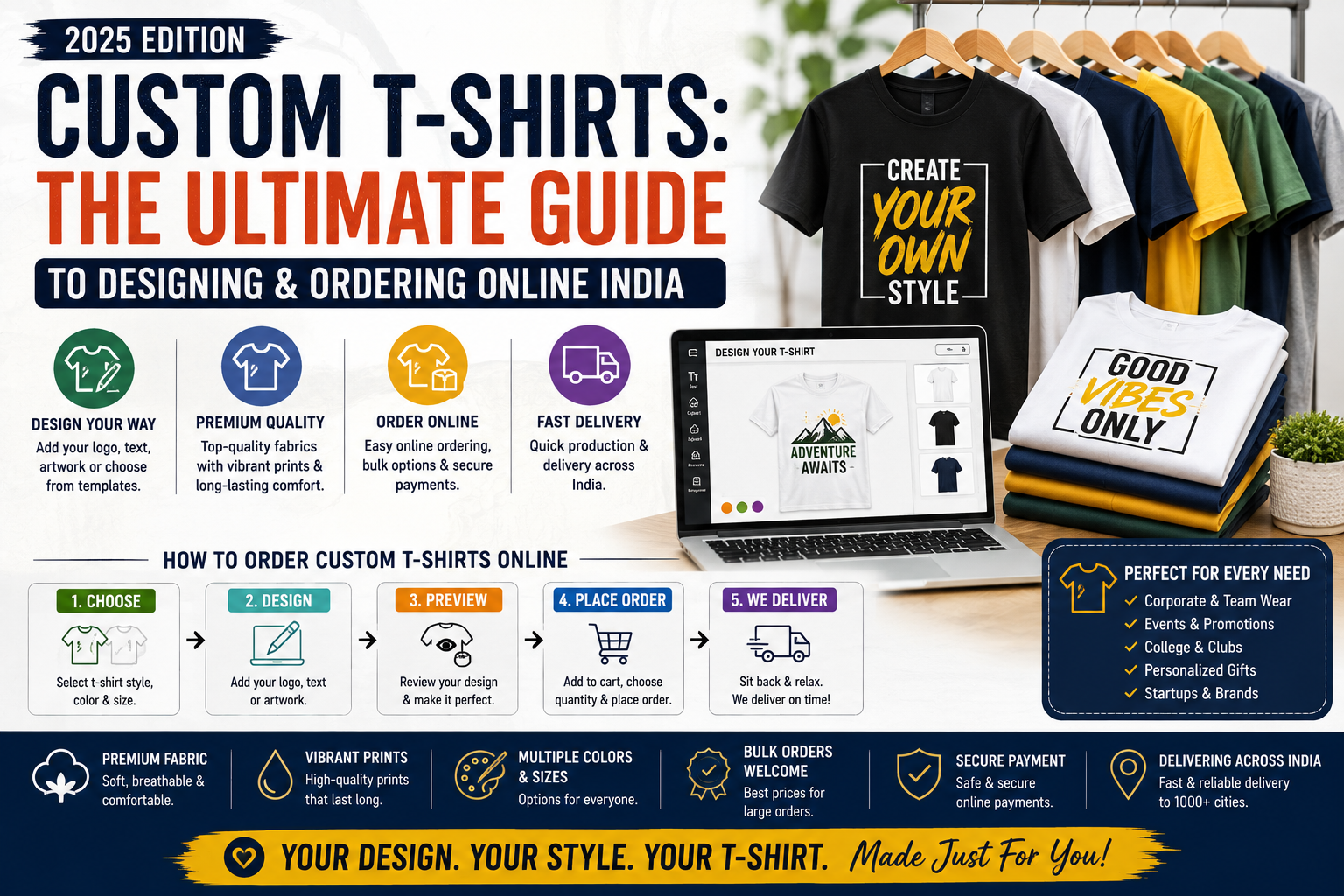
    The demand for custom t-shirts in India has grown rapidly over the past few years. From startups and corporate offices to colleges, sports teams, influencers, and e-commerce brands, businesses and individuals are increasingly ordering customized apparel online for branding, merchandise, uniforms, and events.

    With so many platforms offering custom printing and embroidery services, choosing the right provider can be challenging. Some specialize in bulk corporate orders, while others focus on print-on-demand, personalized gifts, or premium embroidered apparel.

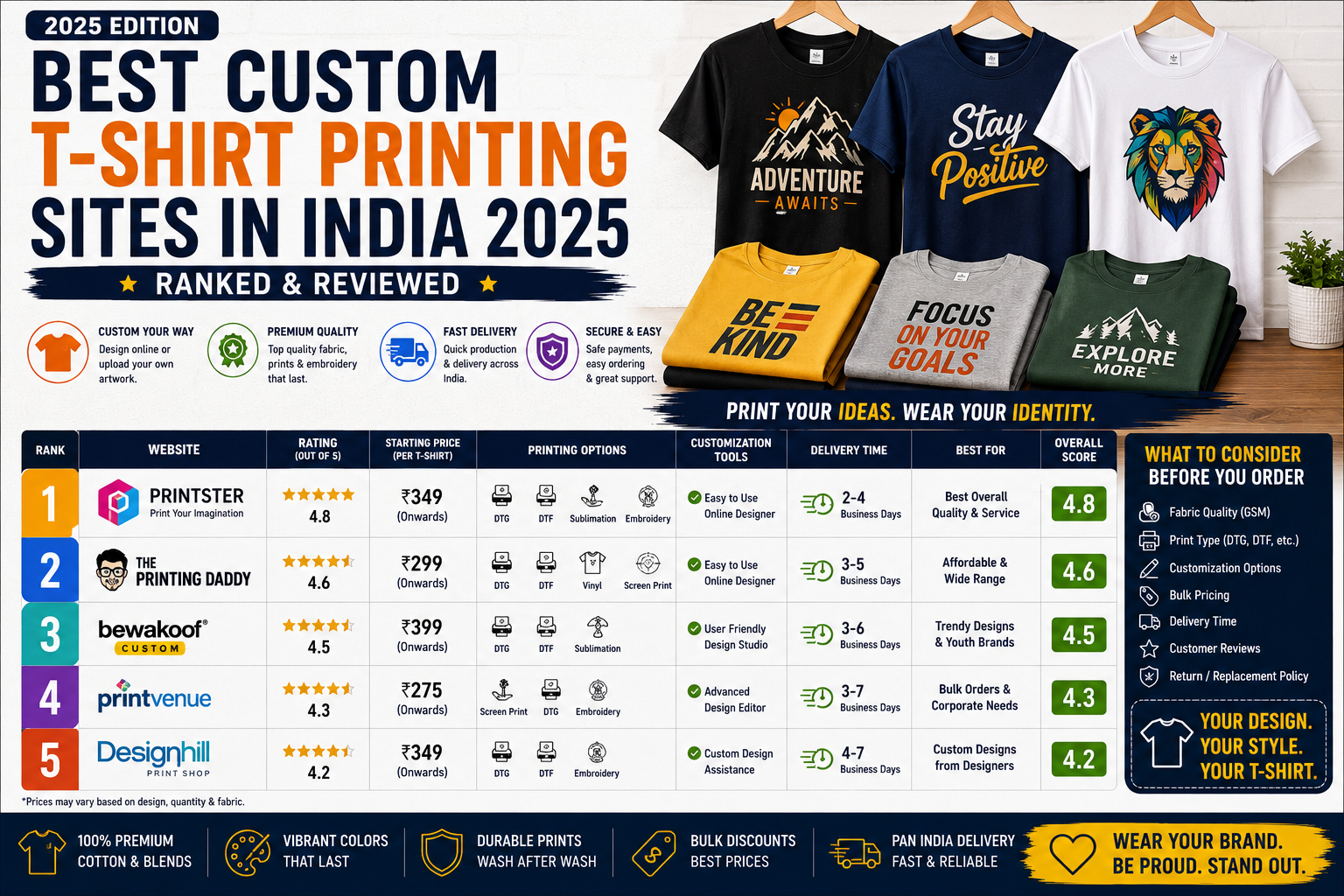
    If you’re searching for the best custom tshirt website India 2025, this guide compares some of the leading platforms based on product quality, customization options, minimum order quantity (MOQ), delivery, pricing transparency, customer experience, and ideal use cases. The rankings below are based on publicly available features and services rather than paid endorsements.

    How We Compared These Websites

    To keep this comparison fair, we evaluated each platform using these criteria:

    • Product quality
    • Fabric options
    • Printing and embroidery capabilities
    • Design customization tools
    • Minimum order quantity
    • Bulk order support
    • Delivery coverage
    • Corporate services
    • Customer support
    • Value for money

    Top Custom T-Shirt Websites in India (2025)

    RankWebsiteBest ForOverall Rating
    ⭐ 1PrintoCorporate orders & business branding⭐⭐⭐⭐⭐
    ⭐ 2Vistaprint IndiaSmall businesses & promotional apparel⭐⭐⭐⭐⭐
    ⭐ 3Alma MaterColleges, startups & company merchandise⭐⭐⭐⭐☆
    ⭐ 4PrintrovePrint-on-demand businesses⭐⭐⭐⭐☆
    ⭐ 5BlinkstoreCreator merchandise⭐⭐⭐⭐☆
    ⭐ 6QikinkPrint-on-demand startups⭐⭐⭐⭐☆
    ⭐ 7PrintWearBulk custom apparel⭐⭐⭐⭐☆

    Note: Rankings reflect overall suitability for Indian buyers based on publicly available offerings, customization features, and business use cases—not a universal measure of quality. Different providers excel in different categories.

    1. Printo – Best Overall for Corporate Orders

    Printo is one of India’s well-known providers for business printing and customized merchandise. It offers custom t-shirts for companies, events, schools, and promotional campaigns with online design and ordering tools.

    Best For

    • Corporate uniforms
    • Employee onboarding kits
    • Event merchandise
    • Promotional campaigns
    • Educational institutions

    Pros

    • Multiple t-shirt styles
    • Business-friendly ordering
    • Branding support
    • Nationwide delivery
    • Suitable for bulk orders

    Cons

    • Premium options may cost more than budget suppliers.

    2. Vistaprint India – Best for Small Businesses

    Vistaprint is a trusted name for customized business products and offers personalized t-shirts with logo upload, text customization, and low-order options.

    Best For

    • Small businesses
    • Local brands
    • Promotional apparel
    • Startup merchandise

    Advantages

    • Easy online customization
    • Strong brand reputation
    • Supports small order quantities
    • Good integration with other marketing materials

    3. Alma Mater – Best for Colleges & Startups

    Alma Mater focuses heavily on custom apparel for educational institutions, startups, and corporate teams. The company also highlights current custom apparel trends such as premium fabrics and modern branding.

    Best For

    • College merchandise
    • Team apparel
    • Company swag
    • Startup branding

    Highlights

    • Trend-focused designs
    • Premium garment options
    • Bulk ordering support

    4. Printrove – Best for Print-on-Demand

    Printrove is a popular choice for entrepreneurs launching clothing brands without maintaining inventory.

    Best For

    • E-commerce brands
    • Dropshipping
    • Small fashion labels
    • Online sellers

    Advantages

    • No inventory management
    • Order fulfillment
    • Marketplace integrations
    • Suitable for growing brands

    5. Blinkstore – Best for Creator Merchandise

    Blinkstore enables creators, influencers, and communities to launch merchandise with minimal upfront investment.

    Ideal For

    • YouTubers
    • Content creators
    • Fan communities
    • Student organizations

    Features

    • Merchandise storefronts
    • Print-on-demand
    • Creator-focused workflow

    6. Qikink – Best for Print-on-Demand Startups

    Qikink provides print-on-demand services designed for entrepreneurs looking to sell customized apparel online.

    Best For

    • Shopify sellers
    • D2C brands
    • Online clothing businesses
    • Small apparel startups

    Benefits

    • Low inventory risk
    • Automated fulfillment
    • Wide product catalog

    7. PrintWear – Best for Bulk Apparel

    PrintWear specializes in customized garments for businesses, schools, sports teams, and organizations requiring large orders.

    Best For

    • Bulk uniforms
    • Corporate events
    • Promotional campaigns
    • Sports teams

    Which Website Is Best for Different Needs?

    RequirementRecommended Choice
    Corporate uniformsPrinto
    Startup merchandiseAlma Mater
    Small business brandingVistaprint India
    Print-on-demandPrintrove or Qikink
    Creator merchandiseBlinkstore
    Bulk event ordersPrintWear
    College merchandiseAlma Mater

    Features to Look for Before Ordering

    Before choosing a custom t-shirt website, consider the following:

    Fabric Quality

    Look for:

    • 180 GSM Biowash Cotton
    • 200 GSM Cotton
    • 220 GSM Premium Cotton
    • Organic cotton options for sustainability

    Many buyers searching for <mark>premium custom t-shirts India</mark> prefer heavier GSM fabrics because they offer better durability and comfort.

    Printing Options

    Choose a provider that supports:

    • DTF Printing
    • Screen Printing
    • Heat Transfer
    • Sublimation (for polyester)
    • Embroidery

    Different techniques are suitable for different order sizes and designs.

    Minimum Order Quantity (MOQ)

    Depending on your needs, look for providers that offer:

    • No MOQ for single pieces
    • Low MOQ for startups
    • Bulk discounts for corporate orders

    Delivery Coverage

    A reliable supplier should provide:

    • Pan-India shipping
    • Order tracking
    • Estimated delivery timelines
    • Responsive customer support

    Questions to Ask Before Placing a Bulk Order

    Before confirming your purchase:

    • Is a sample available?
    • Which fabric GSM is used?
    • What printing or embroidery method is recommended?
    • Are bulk discounts available?
    • What is the estimated production time?
    • Is artwork approval included?
    • What is the replacement policy for manufacturing defects?

    Clarifying these details helps reduce the risk of production issues.

    Common Mistakes to Avoid

    Many buyers make avoidable mistakes, such as:

    • Choosing the lowest price without checking quality
    • Ignoring fabric GSM
    • Uploading low-resolution logos
    • Skipping sample approval
    • Ordering incorrect sizes
    • Not reviewing delivery timelines

    A slightly higher investment in quality often results in better long-term value and stronger brand perception.

    Trends in Custom T-Shirt Websites for 2025

    The Indian custom apparel industry is evolving with features such as:

    • Online design tools
    • AI-assisted artwork previews
    • Print-on-demand fulfillment
    • Premium embroidery
    • Sustainable fabrics
    • Organic cotton collections
    • Personalized apparel
    • Faster nationwide shipping

    Businesses are increasingly seeking platforms that combine quality, convenience, and scalable ordering options.

    Frequently Asked Questions (FAQs)

    Which is the best custom t-shirt website in India in 2025?

    The best platform depends on your needs. Printo is a strong option for corporate and bulk orders, Vistaprint India is well suited to small businesses, and Printrove or Qikink are popular for print-on-demand businesses.

    Which website is best for startup merchandise?

    Platforms such as Alma Mater, Printrove, and Qikink are commonly used by startups because they support branded merchandise and flexible order quantities.

    Can I order just one custom t-shirt?

    Yes. Several providers, including Vistaprint India, support low or single-item orders, though minimum quantities vary by product.

    Which website offers embroidery?

    Many Indian custom apparel providers offer embroidery services for corporate uniforms, polo shirts, and premium merchandise. It’s best to verify embroidery availability for your chosen garment before ordering.

    Which fabric is best for custom t-shirts?

    For most business and branding purposes, 180–220 GSM cotton is a popular choice because it offers a balance of comfort, durability, and premium appearance.

    Final Verdict: Best Custom TShirt Website India 2025

    Finding the best custom tshirt website India 2025 depends on your goals rather than a single “perfect” provider. Businesses ordering corporate uniforms may prioritize embroidery quality and bulk pricing, while startups may prefer print-on-demand platforms with no inventory requirements. Creators often value integrated online stores, and event organizers may focus on fast production and nationwide delivery.

    Before placing an order, compare fabric quality, GSM, printing and embroidery options, minimum order quantities, delivery timelines, and customer support. Requesting a sample and reviewing previous work can also help ensure the final product meets your expectations.

    By choosing a provider that aligns with your specific needs instead of relying solely on price, you’ll be more likely to receive custom apparel that represents your brand professionally and delivers long-term value.

  • Custom Printed T-Shirt vs Embroidered T-Shirt: Which is Worth the Price in India? (2025 Guide)

    Custom Printed T-Shirt vs Embroidered T-Shirt: Which is Worth the Price in India? (2025 Guide)

    Custom t-shirts have become an essential branding tool for businesses, startups, schools, colleges, sports teams, NGOs, restaurants, retail stores, and event organizers across India. Whether you’re creating employee uniforms, promotional merchandise, or branded apparel for customers, one important question always comes up:

    Should you choose a custom printed t-shirt or an embroidered t-shirt?

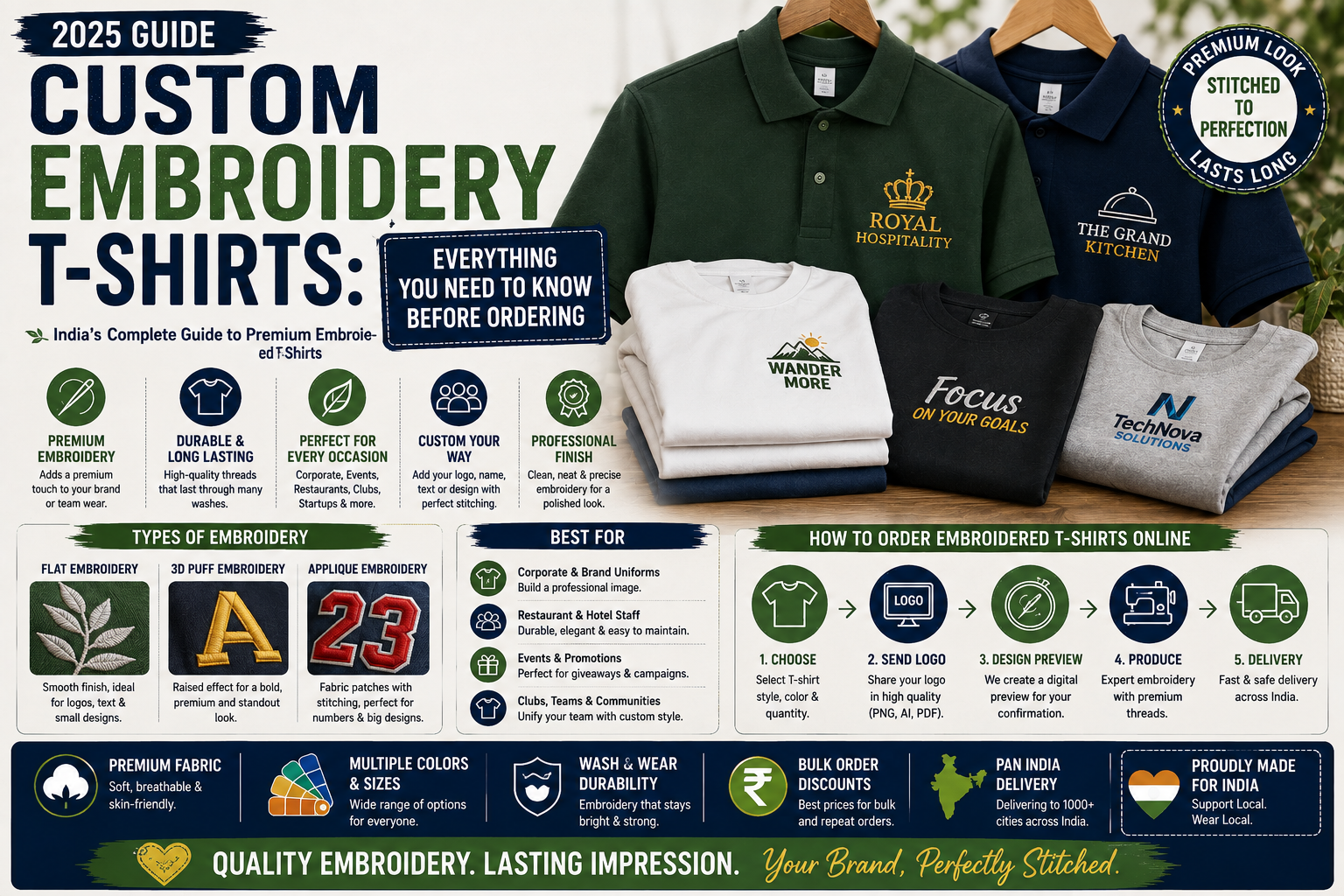
    While both options allow you to showcase your logo and brand identity, they differ significantly in appearance, durability, pricing, comfort, maintenance, and long-term value. A printed t-shirt may be the right choice for vibrant artwork and promotional campaigns, whereas embroidery is often preferred for premium corporate branding and uniforms.

    If you’re searching for custom print vs embroidery tshirt worth India, this comprehensive guide compares both customization methods to help you choose the option that offers the best return on your investment in 2025.

    Quick Comparison

    FeatureCustom Printed T-ShirtEmbroidered T-Shirt
    Initial CostLowerHigher
    Premium Appearance⭐⭐⭐⭐☆⭐⭐⭐⭐⭐
    Durability⭐⭐⭐⭐☆⭐⭐⭐⭐⭐
    Full-Colour ArtworkExcellentLimited
    Corporate BrandingVery GoodExcellent
    Fashion DesignsExcellentGood
    Wash ResistanceGoodExcellent
    Bulk OrdersExcellentExcellent
    Long-Term ValueGoodExcellent

    What Is a Custom Printed T-Shirt?

    A printed t-shirt uses ink or transfer technology to apply artwork directly onto the fabric.

    Popular printing methods include:

    • DTF (Direct-to-Film)
    • Screen Printing
    • Heat Transfer
    • Sublimation (for polyester)
    • DTG (Direct-to-Garment)

    Printed t-shirts are widely used because they allow detailed, colourful, and creative designs.

    Advantages of Printed T-Shirts

    Unlimited Design Possibilities

    Printing can reproduce:

    • Photographs
    • Gradients
    • Detailed illustrations
    • Multi-colour artwork
    • Complex graphics

    This makes it ideal for creative campaigns and fashion brands.

    Cost-Effective for Bulk Orders

    Screen printing becomes increasingly economical as order quantities increase.

    Lightweight Feel

    The fabric remains flexible, especially with modern printing techniques.

    Best Uses for Printed T-Shirts

    Printed apparel is ideal for:

    • College festivals
    • Marketing campaigns
    • Promotional giveaways
    • Brand merchandise
    • Influencer collections
    • Startup launches
    • Sports events

    Many businesses investing in <mark>custom printed t-shirts India</mark> choose printing for bold, eye-catching designs.

    What Is an Embroidered T-Shirt?

    Embroidery uses computerized machines to stitch a logo directly into the fabric using coloured thread.

    Instead of ink sitting on the surface, the design becomes a permanent part of the garment.

    Advantages of Embroidered T-Shirts

    Premium Appearance

    Embroidery gives apparel a textured, sophisticated finish that reflects professionalism.

    Exceptional Durability

    Unlike many printed designs, embroidered logos generally do not crack, peel, or fade with proper care.

    Strong Brand Perception

    Many businesses associate embroidery with higher quality, making it a popular choice for uniforms and executive apparel.

    Best Uses for Embroidered T-Shirts

    Embroidery is commonly selected for:

    • Corporate uniforms
    • Hospitality staff
    • Hotels
    • Restaurants
    • Healthcare professionals
    • Retail teams
    • Executive merchandise
    • Employee onboarding kits

    Businesses searching for <mark>custom embroidered t-shirts India</mark> often prioritize embroidery for its premium look and longevity.

    Cost Comparison

    Pricing depends on factors such as garment quality, design complexity, and order quantity.

    Printed T-Shirts

    Generally more affordable for:

    • Large graphics
    • Promotional campaigns
    • High-volume orders

    Embroidered T-Shirts

    Usually cost more because pricing is influenced by:

    • Stitch count
    • Logo size
    • Thread colours
    • Digitization

    Although the initial investment is higher, embroidery often provides greater long-term value due to its durability.

    Durability Comparison

    FeaturePrintingEmbroidery
    Fade ResistanceGoodExcellent
    Crack ResistanceDepends on Print MethodExcellent
    PeelingPossible with Some MethodsNot Applicable
    Wash LifeGoodExcellent
    Long-Term AppearanceGoodExcellent

    For garments that will be washed frequently over several years, embroidery is generally the more durable choice.

    Which Looks More Premium?

    When it comes to premium branding:

    Printed T-Shirts

    Ideal for:

    • Modern artwork
    • Fashion graphics
    • Creative branding
    • Promotional visuals

    Embroidered T-Shirts

    Best for:

    • Corporate logos
    • Luxury brands
    • Business uniforms
    • Professional teams

    Embroidery creates a refined appearance that is difficult to replicate with printing alone.

    Which Fabric Works Best?

    Both methods perform well on quality fabrics.

    Recommended options include:

    FabricPrintingEmbroidery
    180 GSM Biowash Cotton⭐⭐⭐⭐⭐⭐⭐⭐⭐⭐
    200 GSM Cotton⭐⭐⭐⭐⭐⭐⭐⭐⭐⭐
    220 GSM Cotton⭐⭐⭐⭐☆⭐⭐⭐⭐⭐
    Polyester⭐⭐⭐⭐⭐⭐⭐⭐⭐☆

    Many businesses searching for <mark>best GSM cotton t-shirt India custom</mark> prefer 180–220 GSM cotton for its balance of comfort, durability, and premium feel.

    Which Industries Should Choose Printing?

    Printing is a great choice for:

    • Fashion brands
    • D2C businesses
    • Influencers
    • Schools
    • Colleges
    • NGOs
    • Sports tournaments
    • Promotional campaigns

    Its flexibility makes it ideal for creative and high-impact designs.

    Which Industries Should Choose Embroidery?

    Embroidery is often preferred by:

    • IT companies
    • Hospitality businesses
    • Healthcare providers
    • Banks
    • Retail chains
    • Manufacturing firms
    • Luxury brands
    • Corporate offices

    These organizations benefit from the professional image that embroidery conveys.

    Can You Combine Both?

    Yes.

    Many brands use a hybrid approach, such as:

    • Embroidered logo on the left chest
    • Printed graphic on the back
    • Printed slogan on the sleeve
    • Embroidered company initials near the cuff

    This combination provides a premium appearance while maintaining creative flexibility.

    Common Buying Mistakes

    Avoid these common errors:

    • Choosing based only on price.
    • Ignoring fabric quality.
    • Using low-resolution artwork.
    • Selecting embroidery for very large graphics.
    • Choosing printing for intricate small logos.
    • Not requesting a sample.
    • Overlooking garment GSM.

    Selecting the right customization method for your specific design is often more important than choosing the cheapest option.

    Trends in Custom Apparel for 2025

    The Indian custom apparel industry is evolving with trends such as:

    • Minimalist embroidery
    • DTF printing for short runs
    • Heavyweight 220 GSM cotton
    • Organic cotton garments
    • Tone-on-tone embroidery
    • Personalized employee uniforms
    • Hybrid embroidery + print designs
    • Sustainable packaging

    Businesses are increasingly investing in apparel that reflects their brand identity while offering long-term durability.

    Tips Before Placing Your Order

    To get the best value:

    • Define your branding goals.
    • Choose the appropriate fabric GSM.
    • Match the customization method to your artwork.
    • Request a production sample.
    • Compare quotations beyond just the headline price.
    • Work with an experienced customization provider.

    A well-planned order reduces production issues and ensures consistent results.

    Frequently Asked Questions (FAQs)

    Which is better: printed or embroidered t-shirts?

    It depends on your needs. Printed t-shirts are ideal for colourful graphics, promotional campaigns, and creative merchandise, while embroidered t-shirts are better suited for corporate uniforms and premium branding.

    Is embroidery worth the extra cost?

    Yes, for many businesses. Embroidery generally offers greater durability, a premium appearance, and a longer lifespan, making it a worthwhile investment for uniforms and executive apparel.

    Which option lasts longer?

    High-quality embroidery typically lasts longer than most printing methods because the design is stitched directly into the fabric rather than applied to its surface.

    Which is more affordable?

    Printing is usually less expensive, particularly for large graphics and bulk promotional orders. Embroidery has a higher upfront cost but may provide better long-term value.

    Can I combine printing and embroidery?

    Yes. Many businesses combine an embroidered logo with printed graphics to create apparel that is both professional and visually engaging.

    Final Verdict: Custom Print vs Embroidery TShirt Worth India

    When comparing custom print vs embroidery tshirt worth India, the right choice depends on your branding objectives, budget, and intended use.

    Choose custom printed t-shirts if you need vibrant full-colour graphics, promotional merchandise, event apparel, or cost-effective bulk orders with creative designs. Printing is especially well suited to fashion brands, startups, colleges, and marketing campaigns.

    Choose embroidered t-shirts if your priority is premium branding, long-term durability, and a professional appearance. Embroidery is the preferred option for corporate uniforms, hospitality teams, executive merchandise, and organizations that want apparel to maintain its quality through frequent wear and washing.

    For many businesses, the best solution is a hybrid approach—using embroidery for logos and printing for larger graphics or campaign artwork. Paired with 180–220 GSM premium cotton, this combination offers an excellent balance of style, durability, comfort, and brand impact, ensuring your custom apparel delivers lasting value well beyond its initial cost.

  • Best Cotton GSM for Custom T-Shirts India: 160, 180, 220 & 240 GSM – Full Guide (2025)

    Best Cotton GSM for Custom T-Shirts India: 160, 180, 220 & 240 GSM – Full Guide (2025)

    Choosing the right fabric is one of the most important decisions when ordering custom t-shirts. While design, printing, and embroidery often receive the most attention, the fabric GSM (Grams per Square Meter) has a direct impact on comfort, durability, appearance, print quality, and overall value.

    Whether you’re ordering t-shirts for a startup, corporate team, school, college, sports club, retail brand, or promotional event, selecting the right GSM ensures your custom apparel looks professional and lasts longer.

    The Indian custom apparel market offers a wide range of fabric weights, but the most commonly used options are 160 GSM, 180 GSM, 220 GSM, and 240 GSM. Each serves a different purpose, from lightweight promotional t-shirts to premium heavyweight merchandise.

    If you’re searching for the best GSM cotton tshirt India custom, this comprehensive guide compares all four GSM options, explains their advantages and limitations, and helps you choose the ideal fabric for your customization needs in 2025.

    What Does GSM Mean?

    GSM (Grams per Square Meter) measures the weight of the fabric.

    Generally:

    • Lower GSM = Lighter and more breathable.
    • Higher GSM = Thicker, heavier, and more structured.

    However, GSM is only one aspect of fabric quality. Cotton type, yarn quality, knitting, stitching, and finishing processes also play a significant role.

    Quick Comparison: 160 vs 180 vs 220 vs 240 GSM

    Feature160 GSM180 GSM220 GSM240 GSM
    WeightLightMediumHeavyExtra Heavy
    Comfort⭐⭐⭐⭐⭐⭐⭐⭐⭐⭐⭐⭐⭐⭐☆⭐⭐⭐⭐☆
    BreathabilityExcellentExcellentVery GoodGood
    DurabilityGoodExcellentExcellentOutstanding
    Printing QualityExcellentExcellentVery GoodGood
    Embroidery QualityGoodExcellentExcellentExcellent
    Premium FeelModerateHighPremiumLuxury
    PriceLowestModeratePremiumHighest

    160 GSM Cotton T-Shirts

    160 GSM is one of the lightest cotton fabrics commonly used for custom t-shirts.

    Best For

    • Promotional giveaways
    • Awareness campaigns
    • Political events
    • Marathons
    • Temporary uniforms
    • Budget-friendly bulk orders

    Advantages

    • Lightweight and breathable
    • Comfortable in hot weather
    • Lower production cost
    • Easy to wear for long outdoor events

    Limitations

    • Less structured appearance
    • Lower durability compared to heavier fabrics
    • May not provide the premium feel expected for executive branding

    160 GSM works well for one-time events and cost-sensitive campaigns but may not be ideal for long-term daily uniforms.

    180 GSM Cotton T-Shirts

    180 GSM biowash cotton is widely regarded as the industry standard for premium custom t-shirts in India.

    It offers an excellent balance of:

    • Comfort
    • Durability
    • Appearance
    • Affordability

    Many businesses investing in <mark>custom embroidered t-shirts India</mark> and <mark>custom printed t-shirts India</mark> choose 180 GSM because it supports both embroidery and printing exceptionally well.

    Best For

    • Corporate uniforms
    • Startup teams
    • Employee apparel
    • School uniforms
    • Promotional merchandise
    • Retail staff

    Advantages

    • Excellent comfort
    • Suitable for India’s climate
    • Strong fabric durability
    • Professional appearance
    • Great value for money

    For most businesses, 180 GSM offers the best all-round performance.

    220 GSM Cotton T-Shirts

    220 GSM is designed for premium branding and heavyweight apparel.

    Best For

    • Luxury brands
    • Fashion labels
    • Executive uniforms
    • Premium merchandise
    • Hospitality businesses
    • D2C apparel

    Advantages

    • Rich, structured feel
    • Premium drape
    • Excellent support for embroidery
    • Better shape retention
    • Long-lasting performance

    Many brands searching for <mark>premium custom t-shirts India</mark> choose 220 GSM to create a high-end customer experience.

    240 GSM Cotton T-Shirts

    240 GSM represents the heavyweight end of the market.

    Best For

    • Oversized fashion
    • Streetwear brands
    • Luxury merchandise
    • High-end retail collections
    • Winter apparel

    Advantages

    • Extremely durable
    • Premium appearance
    • Thick, substantial fabric
    • Excellent longevity

    Limitations

    • Higher cost
    • Warmer to wear
    • May not be ideal for India’s hottest regions

    240 GSM is most suitable for fashion and premium retail rather than everyday corporate uniforms.

    Which GSM Is Best for Printing?

    Printing quality depends on both the printing method and the fabric.

    GSMPrinting Performance
    160 GSMExcellent
    180 GSMExcellent
    220 GSMVery Good
    240 GSMGood

    For DTF, screen printing, and DTG, 180 GSM often provides the best balance of print quality and comfort.

    Which GSM Is Best for Embroidery?

    Embroidery requires fabric that is stable enough to support stitching without distortion.

    GSMEmbroidery Performance
    160 GSMGood
    180 GSMExcellent
    220 GSMExcellent
    240 GSMExcellent

    Heavier fabrics provide additional support for larger embroidered logos, but 180 GSM remains the most versatile option for everyday business use.

    Which GSM Is Best for Different Industries?

    Startups

    Recommended: 180 GSM

    • Comfortable
    • Affordable
    • Professional

    Corporate Offices

    Recommended: 180 GSM or 220 GSM

    Choose 180 GSM for daily wear and 220 GSM for executive teams or premium branding.

    Schools & Colleges

    Recommended: 180 GSM

    Provides a balance of durability and comfort for regular use.

    Hospitality

    Recommended: 220 GSM Polo T-Shirts

    Offers a premium appearance suitable for customer-facing staff.

    Fashion Brands

    Recommended: 220 GSM or 240 GSM

    Heavyweight fabrics align well with current fashion trends and premium positioning.

    Events & Promotions

    Recommended: 160 GSM or 180 GSM

    Select based on budget, expected usage, and desired quality.

    Price Comparison

    In general:

    • 160 GSM: Most economical.
    • 180 GSM: Best value.
    • 220 GSM: Premium pricing.
    • 240 GSM: Highest investment.

    Remember that the final cost also depends on cotton quality, garment construction, customization method, and order quantity.

    Climate Considerations

    India’s climate varies significantly.

    Hot & Humid Regions

    Best Choice:

    • 160 GSM
    • 180 GSM

    Moderate Climate

    Best Choice:

    • 180 GSM
    • 220 GSM

    Cooler Regions

    Best Choice:

    • 220 GSM
    • 240 GSM

    Choosing a fabric appropriate for the environment improves wearer comfort.

    Common Mistakes When Choosing GSM

    Avoid these common errors:

    • Assuming higher GSM always means better quality.
    • Ignoring cotton quality and yarn count.
    • Selecting heavyweight fabric for outdoor summer use.
    • Choosing lightweight fabric for premium executive uniforms.
    • Focusing only on price instead of long-term value.

    A well-made 180 GSM t-shirt can outperform a poorly manufactured 240 GSM garment.

    Trends in Custom Cotton T-Shirts for 2025

    The custom apparel market in India continues to evolve with trends such as:

    • 180 GSM biowash cotton
    • Heavyweight 220 GSM collections
    • Oversized 240 GSM streetwear
    • Organic cotton fabrics
    • Sustainable production
    • Minimalist embroidery
    • Premium corporate merchandise
    • Personalized employee apparel

    Businesses are increasingly choosing higher-quality fabrics to strengthen their brand image and improve customer perception.

    Tips for Choosing the Right GSM

    Before placing an order, ask yourself:

    • Who will wear the t-shirts?
    • Will they be used daily or occasionally?
    • Is comfort more important than structure?
    • Are the garments for printing or embroidery?
    • What is your budget?
    • Will they be worn indoors or outdoors?

    Answering these questions will help you select the most appropriate GSM for your specific use case.

    Frequently Asked Questions (FAQs)

    Which GSM is best for custom t-shirts in India?

    For most applications, 180 GSM biowash cotton is considered the best all-round choice because it combines comfort, durability, affordability, and excellent compatibility with both printing and embroidery.

    Is 220 GSM better than 180 GSM?

    Not necessarily. 220 GSM offers a heavier, more premium feel, while 180 GSM is lighter, more breathable, and often better suited to everyday wear in India’s climate.

    Is 160 GSM good for printing?

    Yes. 160 GSM is suitable for promotional and event t-shirts, especially when lightweight comfort and lower costs are priorities.

    Which GSM lasts the longest?

    Higher GSM fabrics such as 220 GSM and 240 GSM generally offer greater durability and shape retention, provided they are made from high-quality cotton and cared for properly.

    Which GSM should startups choose?

    For most startups, 180 GSM biowash cotton provides the ideal balance of quality, comfort, professional appearance, and cost-effectiveness.

    Final Verdict: Best GSM Cotton TShirt India Custom

    Finding the best GSM cotton tshirt India custom depends on your intended use, branding goals, and budget rather than choosing the heaviest fabric available.

    • 160 GSM is a practical option for promotional campaigns, awareness events, and budget-conscious bulk orders where lightweight comfort is important.
    • 180 GSM biowash cotton remains the best all-round choice for most businesses, offering an excellent combination of comfort, durability, print quality, embroidery performance, and value.
    • 220 GSM is ideal for premium corporate apparel, hospitality uniforms, executive merchandise, and brands seeking a more substantial, high-end feel.
    • 240 GSM is best suited to luxury fashion, oversized streetwear, and premium retail collections where heavyweight construction is part of the design aesthetic.

    For the majority of custom t-shirt orders in India, 180 GSM biowash cotton continues to be the recommended choice. It delivers professional results for both printing and embroidery while ensuring all-day comfort and long-lasting performance, making it a smart investment for startups, corporate teams, schools, events, and growing brands.

  • Top 10 Custom Embroidery T-Shirt Designs for Indian Startups & D2C Brands (2025 Guide)

    Top 10 Custom Embroidery T-Shirt Designs for Indian Startups & D2C Brands (2025 Guide)

    India’s startup ecosystem continues to grow rapidly, with thousands of new businesses launching every year across technology, eCommerce, fintech, food delivery, healthcare, fashion, education, and direct-to-consumer (D2C) brands. As competition increases, building a memorable brand identity has become more important than ever.

    One of the simplest yet most effective branding tools is a custom embroidered t-shirt. Unlike printed designs that may fade over time, embroidery gives apparel a premium, professional, and long-lasting appearance. Whether you’re onboarding new employees, attending investor meetings, participating in exhibitions, or shipping merchandise to customers, embroidered apparel reinforces your brand wherever it’s worn.

    If you’re searching for the best embroidery tshirt design startup India, this guide showcases the Top 10 embroidery design ideas for startups and D2C brands, along with design tips, fabric recommendations, colour combinations, and branding strategies that help create a lasting impression in 2025.

    Why Startups Choose Embroidered T-Shirts

    Custom embroidered apparel has become a preferred branding choice because it offers:

    • Premium brand perception
    • Long-lasting durability
    • Professional appearance
    • Better employee identity
    • Consistent team branding
    • High-quality merchandise
    • Excellent event visibility

    Many businesses investing in <mark>custom embroidered t-shirts India</mark> see apparel as a long-term branding asset rather than just a uniform.

    What Makes a Great Embroidery Design?

    An effective embroidered logo should be:

    • Simple and recognizable
    • Easy to read
    • Scalable
    • Suitable for stitching
    • Consistent with brand guidelines
    • Balanced in size and placement

    Overly detailed artwork can lose clarity when embroidered, so clean, minimal designs usually produce the best results.

    Top 10 Custom Embroidery T-Shirt Design Ideas

    1. Classic Left Chest Logo

    The left chest logo remains the most popular choice for startups.

    Best For

    • Tech companies
    • SaaS startups
    • Corporate offices
    • D2C brands
    • Agencies

    Why It Works

    • Professional appearance
    • Timeless design
    • Suitable for everyday wear
    • Easy brand recognition

    This style works equally well on round neck and polo t-shirts.

    2. Minimal Logo + Company Name

    Instead of using only an icon, combine:

    • Logo
    • Company name
    • Simple typography

    This creates stronger brand recognition, particularly for newer startups.

    3. Tone-on-Tone Embroidery

    One of the fastest-growing premium trends.

    Examples:

    • Black logo on black t-shirt
    • Navy logo on navy polo
    • Grey embroidery on charcoal fabric

    The subtle effect creates a sophisticated, luxury look.

    Many premium <mark>startup merchandise India</mark> collections now feature tone-on-tone branding.

    4. Sleeve Logo Embroidery

    A small embroidered logo on the sleeve adds a unique branding element without dominating the garment.

    Ideal for:

    • Startup merchandise
    • Fashion brands
    • Sportswear
    • Premium uniforms

    5. Back Neck Embroidery

    A discreet logo or brand name below the back collar gives the t-shirt a premium retail finish.

    Popular for:

    • Employee apparel
    • Merchandise
    • Founder collections

    6. Monogram Design

    Instead of the full company name, use:

    • Initials
    • Lettermark
    • Brand icon

    Examples:

    • AB
    • NX
    • TC

    Monograms are particularly effective for fashion, luxury, and lifestyle brands.

    7. Founder Signature Collection

    Some startups create limited-edition merchandise featuring:

    • Founder signature
    • Launch year
    • Inspirational tagline
    • Company mission

    This adds exclusivity and storytelling to the apparel.

    8. Large Back Embroidery (Minimal Style)

    While embroidery is generally used for smaller logos, a carefully designed medium-sized back logo or wordmark can create a distinctive premium look.

    Keep the design simple to avoid excessive stitch density and maintain wearer comfort.

    9. Employee Name + Company Logo

    Personalized uniforms featuring:

    • Employee name
    • Company logo
    • Department

    These are widely used by:

    • Hotels
    • Restaurants
    • Retail stores
    • Customer support teams
    • Healthcare organizations

    Personalization also helps improve team identity.

    10. Hybrid Embroidery + Printing

    One of the biggest trends in 2025.

    Example:

    • Embroidered chest logo
    • Printed back graphic
    • Embroidered sleeve
    • Printed campaign slogan

    This combination delivers a premium appearance while allowing creative, full-colour artwork.

    Best Colour Combinations

    The right colours make embroidery stand out.

    T-Shirt ColourThread Colour
    BlackWhite
    Navy BlueWhite
    WhiteBlack
    Bottle GreenGold
    Charcoal GreyWhite
    MaroonCream
    BeigeDark Brown
    Olive GreenSand

    High contrast generally improves visibility, while tone-on-tone embroidery offers a more subtle premium aesthetic.

    Best Fabrics for Startup Apparel

    The fabric quality directly influences comfort and the appearance of embroidery.

    FabricBest Use
    180 GSM Biowash CottonEveryday startup uniforms
    200 GSM CottonTeam merchandise
    220 GSM CottonPremium branding
    Organic CottonSustainable brands
    Cotton PoloClient-facing teams

    Many businesses searching for <mark>premium embroidered t-shirts India</mark> prefer 180–220 GSM cotton because it combines durability with a refined look.

    Where to Place the Logo

    Strategic placement enhances branding.

    Most Popular Locations

    • Left chest
    • Right sleeve
    • Left sleeve
    • Back collar
    • Front centre (small)
    • Back shoulder

    Avoid oversized embroidery unless it has been specifically designed for that purpose.

    Industries That Benefit Most

    Custom embroidered apparel is especially effective for:

    • SaaS companies
    • D2C brands
    • Fashion startups
    • Marketing agencies
    • Hospitality businesses
    • Healthcare providers
    • Fintech firms
    • Educational startups
    • Logistics companies
    • Retail chains

    Each industry can tailor embroidery style to its brand personality and audience.

    Common Design Mistakes to Avoid

    Avoid these frequent errors:

    • Overly detailed logos
    • Very small text that becomes unreadable
    • Too many thread colours
    • Poor colour contrast
    • Oversized embroidery
    • Low-quality digitization
    • Inconsistent branding across garments

    Requesting a stitched sample before mass production helps identify potential issues early.

    Trends in Startup Merchandise for 2025

    Current trends include:

    • Minimalist logo embroidery
    • Heavyweight 220 GSM apparel
    • Oversized t-shirts
    • Tone-on-tone branding
    • Organic cotton fabrics
    • Personalized employee apparel
    • Limited-edition merchandise
    • Sustainable packaging

    Many startups are creating merchandise that employees and customers genuinely enjoy wearing, increasing long-term brand exposure.

    Tips for Designing an Embroidered Startup T-Shirt

    To achieve the best results:

    • Use vector artwork (AI, EPS, SVG, or high-resolution PDF where possible).
    • Keep logos clean and uncluttered.
    • Choose premium thread colours that align with your brand.
    • Match the garment style to your audience.
    • Test embroidery on a sample before placing a bulk order.
    • Maintain consistent branding across all apparel.

    Thoughtful design choices improve both appearance and durability.

    Frequently Asked Questions (FAQs)

    Which embroidery design is best for startups?

    A left chest embroidered logo is the most popular option because it looks professional, is suitable for everyday wear, and reinforces brand recognition.

    Which fabric works best for embroidered startup t-shirts?

    180 GSM biowash cotton is an excellent all-round choice, while 220 GSM cotton is ideal for premium merchandise and executive apparel.

    Is embroidery better than printing for startup branding?

    Embroidery is generally preferred for corporate uniforms and premium merchandise because it offers a refined appearance and excellent durability. Printing may be better for large, colourful graphics or photographic artwork.

    Can startups order small quantities?

    Yes. Many custom apparel providers now offer low or no minimum order quantities, making embroidered t-shirts accessible for early-stage startups.

    How large should an embroidered logo be?

    For most applications, a logo width of approximately 7–10 cm (about 3–4 inches) on the left chest provides a balanced and professional look. The ideal size depends on the logo’s shape and level of detail.

    Final Verdict: Best Embroidery TShirt Design Startup India

    Choosing the best embroidery tshirt design startup India is about more than creating attractive apparel—it’s about building a consistent and memorable brand identity. A well-designed embroidered t-shirt reflects professionalism, strengthens team culture, and helps your business stand out at client meetings, trade shows, product launches, and everyday workplace interactions.

    For most startups and D2C brands, a minimal left chest logo on a 180–220 GSM cotton t-shirt remains the most versatile and effective choice. Businesses looking to create a premium impression can elevate their apparel further with tone-on-tone embroidery, personalized employee names, or a hybrid embroidery-and-print design.

    As India’s startup ecosystem continues to evolve in 2025, investing in high-quality embroidered apparel is more than a branding decision—it’s a long-term investment in visibility, credibility, and the everyday experience of both employees and customers.

  • 220 GSM vs 180 GSM T-Shirt: Which Fabric is Best for Embroidery India? (2025 Guide)

    220 GSM vs 180 GSM T-Shirt: Which Fabric is Best for Embroidery India? (2025 Guide)

    Choosing the right fabric is one of the most important decisions when ordering custom embroidered t-shirts. While logo design and embroidery quality are essential, the fabric itself determines how the finished garment looks, feels, and lasts over time.

    Two of the most popular options in India are 180 GSM and 220 GSM cotton t-shirts. Both are excellent choices, but they are designed for different purposes. A 180 GSM t-shirt is lightweight, breathable, and ideal for daily wear, while a 220 GSM t-shirt offers a heavier, more structured feel that many premium brands prefer.

    If you’re searching for 220 GSM vs 180 GSM tshirt India embroidery, this complete guide compares both fabrics based on embroidery quality, durability, comfort, pricing, shrinkage, wash performance, and the best use cases for businesses, startups, schools, and corporate uniforms in 2025.

    What Does GSM Mean?

    GSM stands for Grams per Square Meter, which measures the weight of the fabric.

    A higher GSM generally means:

    • Thicker fabric
    • More structure
    • Greater durability
    • Heavier feel

    A lower GSM usually means:

    • Lighter weight
    • Better breathability
    • Softer drape
    • More comfort in hot weather

    It’s important to remember that higher GSM does not automatically mean better quality. The cotton quality, yarn, knitting, and finishing processes are equally important.

    Quick Comparison: 180 GSM vs 220 GSM

    Feature180 GSM220 GSM
    Fabric WeightMediumHeavy
    Comfort⭐⭐⭐⭐⭐⭐⭐⭐⭐☆
    BreathabilityExcellentVery Good
    Premium FeelVery GoodExcellent
    Embroidery SupportExcellentExcellent
    Summer WearBestGood
    Winter WearGoodBetter
    DurabilityHighVery High
    PriceMore AffordablePremium

    What Is a 180 GSM T-Shirt?

    A 180 GSM cotton t-shirt is considered the industry standard for premium everyday wear in India.

    It offers an excellent balance of:

    • Comfort
    • Durability
    • Breathability
    • Cost-effectiveness

    Many businesses ordering <mark>custom embroidered t-shirts India</mark> choose 180 GSM because it performs well for both embroidery and printing while remaining comfortable throughout the day.

    Advantages of 180 GSM

    Comfortable for Daily Wear

    The fabric feels light enough for long working hours without sacrificing durability.

    Excellent for India’s Climate

    Its breathability makes it especially suitable for warm and humid conditions.

    Great Value

    It provides a premium look without significantly increasing costs.

    Versatile

    Suitable for:

    • Corporate uniforms
    • Event t-shirts
    • Startup merchandise
    • Employee onboarding kits
    • Promotional apparel

    What Is a 220 GSM T-Shirt?

    A 220 GSM t-shirt is a heavier-weight garment designed for premium branding and long-term durability.

    It has a thicker construction that gives it a structured, luxurious appearance.

    Advantages of 220 GSM

    Premium Appearance

    The heavier fabric often creates a more substantial, high-end look.

    Better Structure

    The t-shirt holds its shape well, making embroidered logos stand out prominently.

    Enhanced Durability

    Ideal for garments expected to withstand frequent use.

    Luxury Branding

    Many premium brands use 220 GSM fabric for:

    • Merchandise
    • Retail apparel
    • Fashion collections
    • Executive uniforms

    Which Fabric Is Better for Embroidery?

    Both fabrics support embroidery well, but they offer slightly different results.

    180 GSM

    Best for:

    • Small to medium logos
    • Everyday employee uniforms
    • Casual branding
    • High-volume corporate orders

    Benefits

    • Comfortable
    • Breathable
    • Cost-effective

    220 GSM

    Best for:

    • Premium embroidered logos
    • Luxury merchandise
    • Polo t-shirts
    • Executive apparel
    • High-end branding

    Benefits

    • Stable embroidery surface
    • Richer appearance
    • Better fabric structure

    For intricate logos or garments intended to convey a premium image, 220 GSM can provide a more substantial base, though 180 GSM remains an excellent choice for most business applications.

    Embroidery Quality Comparison

    Feature180 GSM220 GSM
    Small Logo EmbroideryExcellentExcellent
    Large Embroidered LogoVery GoodExcellent
    Stitch StabilityExcellentExcellent
    Premium FinishVery GoodExcellent
    Long-Term AppearanceExcellentExcellent

    In practice, the quality of the embroidery machine, digitization, and thread is just as important as the fabric weight.

    Comfort Comparison

    180 GSM

    Ideal for:

    • Daily office wear
    • Outdoor events
    • Summer use
    • Delivery staff
    • Retail employees

    220 GSM

    Better suited for:

    • Air-conditioned workplaces
    • Premium fashion
    • Executive merchandise
    • Cooler weather

    If employees spend long hours outdoors in hot weather, 180 GSM may provide greater comfort.

    Durability Comparison

    Both fabrics are durable when made from high-quality cotton.

    However:

    180 GSM

    • Long-lasting
    • Excellent for everyday use
    • Handles repeated washing well

    220 GSM

    • Greater resistance to stretching
    • Better shape retention
    • Premium feel over time

    Proper garment care remains essential regardless of GSM.

    Price Comparison

    In general:

    • 180 GSM is more economical.
    • 220 GSM costs more due to the additional fabric and premium positioning.

    Pricing varies based on cotton quality, brand, order quantity, and customization method.

    Which Industries Should Choose 180 GSM?

    180 GSM is commonly selected by:

    • IT companies
    • Schools
    • Colleges
    • NGOs
    • Event organizers
    • Retail businesses
    • Delivery teams
    • Startups

    Its balance of comfort and durability makes it a practical choice for large teams.

    Which Industries Should Choose 220 GSM?

    220 GSM is often preferred by:

    • Luxury brands
    • Hospitality businesses
    • Premium retailers
    • Corporate leadership teams
    • Fashion labels
    • High-end merchandise sellers

    These organizations may value the structured appearance and premium feel.

    Round Neck vs Polo

    180 GSM Round Neck

    Perfect for:

    • Corporate events
    • Team-building activities
    • Casual uniforms
    • Promotional campaigns

    220 GSM Polo

    Ideal for:

    • Executive uniforms
    • Client-facing staff
    • Hotels
    • Restaurants
    • Premium brand representation

    Tips for Choosing the Right Fabric

    Ask yourself:

    • Will employees wear the t-shirt every day?
    • Is comfort more important than structure?
    • Is the apparel for promotions or premium branding?
    • Will it be worn mostly indoors or outdoors?
    • What is your budget?

    Your answers will help determine whether 180 GSM or 220 GSM is the better fit.

    Common Buying Mistakes

    Avoid these common errors:

    • Assuming higher GSM always means higher quality.
    • Ignoring cotton quality and fabric finish.
    • Choosing fabric based only on price.
    • Not requesting a production sample.
    • Overlooking the climate in which the garments will be worn.
    • Focusing only on GSM instead of overall construction.

    A well-made 180 GSM t-shirt can outperform a poorly manufactured 220 GSM garment.

    Trends in Premium Embroidered Apparel for 2025

    Current trends include:

    • Heavyweight cotton collections
    • Organic cotton fabrics
    • Minimalist embroidered logos
    • Oversized premium t-shirts
    • Sustainable manufacturing
    • Tone-on-tone embroidery
    • Personalized employee apparel

    Businesses are increasingly investing in higher-quality garments that employees enjoy wearing.

    Frequently Asked Questions (FAQs)

    Which is better for embroidery: 180 GSM or 220 GSM?

    Both work very well for embroidery. 180 GSM is ideal for comfortable daily wear and bulk corporate orders, while 220 GSM offers a more premium, structured appearance that suits luxury branding and executive apparel.

    Is 220 GSM too heavy for Indian summers?

    It depends on the climate and use case. For outdoor work in hot weather, 180 GSM is generally more comfortable. For indoor office environments or premium merchandise, 220 GSM can still be a good option.

    Does 220 GSM last longer?

    A higher GSM can contribute to greater durability and shape retention, but overall longevity also depends on the cotton quality, stitching, and garment care.

    Which GSM is best for corporate uniforms?

    180 GSM biowash cotton is one of the most popular choices because it combines comfort, durability, and value. Organizations seeking a more premium presentation may opt for 220 GSM, particularly for executive or client-facing teams.

    Is embroidery affected by GSM?

    Not directly. High-quality embroidery depends on proper digitization, thread, machine settings, and fabric stability. Both 180 GSM and 220 GSM provide excellent bases for embroidery when manufactured to a high standard.

    Final Verdict: 220 GSM vs 180 GSM TShirt India Embroidery

    When comparing 220 GSM vs 180 GSM tshirt India embroidery, there isn’t a single “best” option—it depends on your goals.

    Choose 180 GSM if you need a lightweight, breathable, and cost-effective t-shirt for everyday corporate wear, events, startup teams, schools, or promotional campaigns. It delivers excellent comfort while still supporting high-quality embroidery.

    Choose 220 GSM if your priority is a premium look, enhanced structure, and long-lasting executive or retail apparel. The heavier fabric gives embroidered logos a more substantial appearance and is well suited to luxury merchandise and client-facing uniforms.

    For most businesses in India, 180 GSM biowash cotton remains the best overall balance of comfort, durability, embroidery quality, and value. However, brands aiming for a more premium image may find that 220 GSM cotton provides the elevated feel and presentation they’re looking for.

  • Custom T-Shirt Price Guide India 2025: How Much Should You Pay Per Piece?

    Custom T-Shirt Price Guide India 2025: How Much Should You Pay Per Piece?

    Custom t-shirts have become one of the most effective branding tools for businesses, startups, schools, colleges, sports teams, NGOs, influencers, and eCommerce brands across India. Whether you’re ordering a single personalized t-shirt or placing a bulk corporate order of 5,000 pieces, one question always comes first:

    “How much should a custom t-shirt cost per piece in India?”

    The answer depends on multiple factors, including the fabric quality, GSM, printing or embroidery method, order quantity, garment style, design complexity, and delivery location.

    In 2025, the Indian custom apparel industry offers more choices than ever—from affordable promotional t-shirts to premium embroidered corporate uniforms and sustainable organic cotton apparel.

    If you’re searching for custom tshirt price India 2025 per piece, this detailed guide breaks down current pricing, explains what influences the final cost, compares customization methods, and helps you determine whether you’re getting good value for your money.

    Average Custom T-Shirt Price in India (2025)

    The table below provides typical market price ranges. Actual prices vary by supplier, fabric quality, branding method, order quantity, and customization requirements.

    Order TypeApproximate Price Per Piece
    Plain Cotton T-Shirt₹180–₹350
    Printed T-Shirt (Single Piece)₹300–₹700
    DTF Printed T-Shirt₹350–₹750
    Screen Printed Bulk Order₹220–₹500
    Embroidered Round Neck T-Shirt₹350–₹800
    Embroidered Polo T-Shirt₹500–₹1,200+
    Organic Cotton Custom T-Shirt₹450–₹1,000+

    These ranges are intended as a planning guide rather than fixed market rates.

    What Determines the Price of a Custom T-Shirt?

    Several factors influence the final cost.

    1. Fabric Quality

    The fabric is usually the biggest contributor to price.

    Common options include:

    FabricTypical Price Impact
    160 GSM CottonLowest Cost
    180 GSM Biowash CottonBest Value
    200 GSM CottonPremium
    220 GSM CottonHigh-End
    Organic CottonPremium Pricing

    Many businesses ordering <mark>premium custom t-shirts India</mark> prefer 180 GSM biowash cotton because it balances quality, comfort, and affordability.

    2. GSM (Fabric Thickness)

    GSM (Grams per Square Meter) measures fabric weight.

    GSMBest For
    160 GSMPromotional campaigns
    180 GSMCorporate uniforms
    200 GSMPremium merchandise
    220 GSMLuxury apparel
    240 GSMHeavyweight fashion

    Higher GSM fabrics generally cost more because they use more material and often provide greater durability.

    3. Printing Method

    Different decoration techniques affect pricing.

    Screen Printing

    Best for:

    • Bulk corporate orders
    • Events
    • Schools
    • Promotional campaigns

    Cost

    Lowest per-piece cost for large quantities because setup costs are spread across many garments.

    DTF (Direct-to-Film)

    Best for:

    • Small orders
    • Full-colour artwork
    • Personalized apparel
    • Startup merchandise

    Cost

    Moderately priced with no need for expensive screen setup.

    Embroidery

    Best for:

    • Corporate uniforms
    • Polo t-shirts
    • Hospitality
    • Executive apparel

    Cost

    Usually more expensive than printing because pricing depends on stitch count, logo size, and thread colours.

    Many companies investing in <mark>custom embroidered t-shirts India</mark> choose embroidery for its premium appearance and long-lasting durability.

    4. Order Quantity

    Bulk orders reduce the price per piece.

    QuantityExpected Price Trend
    1–10Highest cost per piece
    25–50Moderate savings
    100–500Significant savings
    500–1,000Better wholesale pricing
    1,000+Lowest per-piece cost

    Ordering larger quantities often provides better value, especially for screen printing.

    5. Garment Style

    Different t-shirt styles have different production costs.

    Round Neck

    • Most affordable
    • Popular for events and startups

    Polo T-Shirts

    • Higher cost
    • Premium appearance
    • Ideal for corporate uniforms

    Oversized T-Shirts

    • Increasingly popular
    • Slightly higher fabric cost

    Custom Printing vs Embroidery Price Comparison

    FeatureScreen PrintDTFEmbroidery
    Initial CostLowMediumHigh
    Bulk SavingsExcellentGoodModerate
    Premium LookGoodGoodExcellent
    DurabilityHighHighExcellent
    Corporate BrandingGoodGoodBest

    Hidden Costs to Consider

    When comparing quotations, ask whether these are included:

    • Logo digitization (for embroidery)
    • Screen setup charges
    • Artwork modifications
    • GST
    • Shipping
    • Packaging
    • Sample production
    • Express delivery
    • Name personalization

    A lower advertised price may not include these additional charges.

    Which Fabric Gives the Best Value?

    For most buyers:

    180 GSM Biowash Cotton

    ✔ Comfortable

    ✔ Durable

    ✔ Suitable for printing and embroidery

    ✔ Excellent value

    220 GSM Cotton

    Ideal for:

    • Premium brands
    • High-end merchandise
    • Luxury uniforms

    Which Businesses Buy Custom T-Shirts?

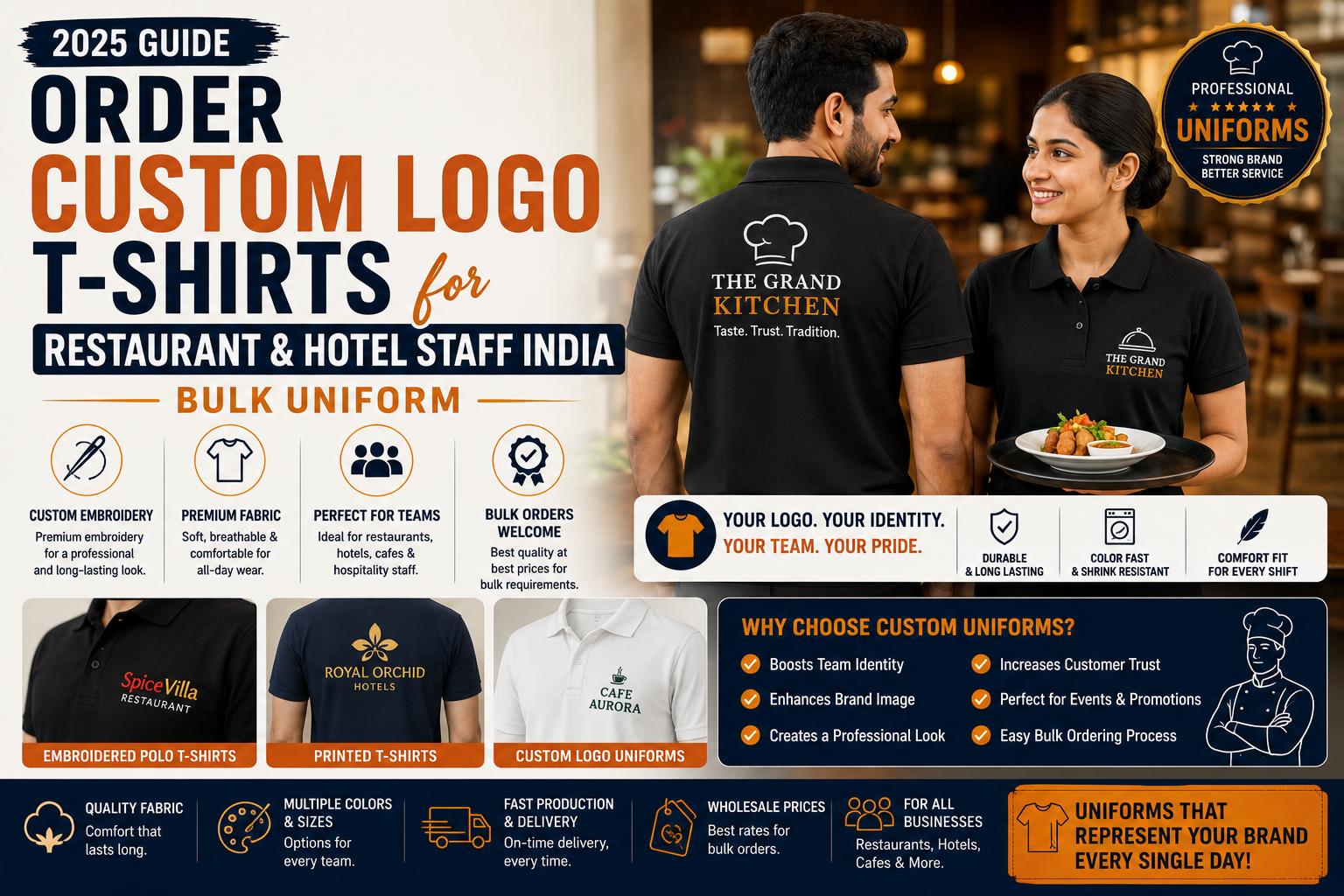
    Custom apparel is widely used by:

    • Startups
    • IT companies
    • Schools
    • Colleges
    • NGOs
    • Hotels
    • Restaurants
    • Gyms
    • Retail stores
    • Event management companies

    Each industry has different priorities, but quality and durability remain important across the board.

    How to Save Money on Bulk Orders

    Reduce costs without compromising quality by:

    • Ordering in larger quantities.
    • Choosing standard garment colours.
    • Limiting the number of print colours.
    • Using the same logo placement across all garments.
    • Planning orders well in advance.
    • Selecting the most suitable printing method for your design.

    Efficient planning often delivers better value than simply choosing the cheapest supplier.

    Should You Choose Printing or Embroidery?

    Choose Embroidery If You Need:

    • Corporate uniforms
    • Hospitality apparel
    • Executive merchandise
    • Long-lasting logos
    • Premium branding

    Choose DTF Printing If You Need:

    • Full-colour artwork
    • Small order quantities
    • Personalized t-shirts
    • Fashion merchandise

    Choose Screen Printing If You Need:

    • Bulk event t-shirts
    • Promotional campaigns
    • School or college apparel
    • Cost-effective large orders

    Common Pricing Mistakes to Avoid

    Many buyers make these mistakes:

    • Choosing the lowest quote without checking fabric quality
    • Ignoring GSM specifications
    • Not requesting a production sample
    • Comparing prices without considering customization methods
    • Forgetting to include shipping and taxes
    • Ordering too few pieces when bulk discounts are available

    A transparent quotation is often more valuable than the cheapest headline price.

    Custom T-Shirt Trends Influencing Pricing in 2025

    Several industry trends are shaping pricing this year:

    • Premium heavyweight cotton
    • Organic cotton garments
    • Sustainable packaging
    • DTF printing for short runs
    • Personalized employee apparel
    • Minimalist embroidery
    • Print-on-demand production
    • AI-assisted design previews

    As demand for higher-quality apparel grows, many businesses are prioritizing durability and brand image over the lowest possible cost.

    Frequently Asked Questions (FAQs)

    What is the average custom t-shirt price in India in 2025?

    For most orders, prices typically range from ₹300 to ₹700 per piece, depending on fabric quality, customization method, and quantity. Bulk orders may reduce the per-piece cost, while premium embroidered or organic cotton garments may cost more.

    Why are embroidered t-shirts more expensive?

    Embroidery requires specialized digitization, thread, and machine stitching. Pricing depends on factors such as logo size, stitch count, and garment type.

    Which printing method is the most affordable?

    For large quantities with simple artwork, screen printing generally offers the lowest cost per piece.

    Which GSM offers the best value?

    180 GSM biowash cotton is widely regarded as the best balance of comfort, durability, and affordability for both printing and embroidery.

    Can I order just one custom t-shirt?

    Yes. Many suppliers offer no minimum order quantity (MOQ) for DTF printing and personalized t-shirts, though single-piece pricing is usually higher than bulk pricing.

    Final Verdict: Custom TShirt Price India 2025 Per Piece

    Understanding the custom tshirt price India 2025 per piece requires looking beyond the headline price. The true value of a custom t-shirt depends on its fabric quality, GSM, customization method, durability, and overall finish.

    For most businesses and organizations, 180 GSM biowash cotton paired with the right decoration method offers the best balance of cost and quality. Choose screen printing for high-volume promotional campaigns, DTF printing for detailed designs and smaller orders, and embroidery for premium corporate uniforms and long-term brand visibility.

    Before placing an order, compare quotations carefully, confirm what’s included in the price, request a sample, and prioritize suppliers that provide transparent pricing and consistent quality. A well-made custom t-shirt is more than just apparel—it’s an investment in your brand, helping your business make a professional and lasting impression every time it’s worn.

  • Embroidery vs DTF vs Screen Print: Which is Best for Bulk T-Shirt Orders in India? (2025 Guide)

    Embroidery vs DTF vs Screen Print: Which is Best for Bulk T-Shirt Orders in India? (2025 Guide)

    Ordering custom t-shirts in bulk is one of the most effective ways for businesses, startups, schools, colleges, NGOs, sports teams, and event organizers to build a professional brand identity. However, one of the biggest questions buyers face is:

    Should you choose embroidery, DTF printing, or screen printing?

    Each customization method has its own strengths. While embroidery delivers a premium and long-lasting finish, DTF (Direct-to-Film) printing excels at detailed full-colour designs and low minimum orders. Screen printing remains one of the most economical solutions for large-volume production with simple artwork.

    If you’re searching for embroidery vs DTF vs screen print India bulk, this comprehensive guide compares all three techniques based on quality, durability, pricing, production speed, maintenance, and the best use cases so you can make the right decision for your next bulk t-shirt order.

    Quick Comparison Table

    FeatureEmbroideryDTF PrintingScreen Printing
    Premium Appearance⭐⭐⭐⭐⭐⭐⭐⭐⭐⭐⭐⭐⭐
    Durability⭐⭐⭐⭐⭐⭐⭐⭐⭐⭐⭐⭐⭐
    Full-Colour ArtworkLimitedExcellentGood
    Small Text & LogosExcellentVery GoodGood
    Bulk Cost EfficiencyModerateModerateExcellent
    Low MOQYesYesUsually No
    Large OrdersExcellentGoodExcellent
    Corporate UniformsBest ChoiceGoodGood
    Promotional EventsGoodExcellentExcellent
    Luxury BrandingExcellentModerateModerate

    What Is Embroidery?

    Embroidery uses specialized machines to stitch your logo or artwork directly onto the fabric using high-quality threads.

    Instead of applying ink, the design becomes part of the garment itself.

    Best For

    • Corporate uniforms
    • Polo t-shirts
    • Hospitality staff
    • Hotels
    • Restaurants
    • Educational institutions
    • Premium merchandise
    • Executive gifts

    Many businesses investing in <mark>custom embroidered t-shirts India</mark> choose embroidery because it offers exceptional durability and a premium appearance.

    Advantages of Embroidery

    Premium Look

    Embroidery creates a textured, professional finish that enhances brand perception.

    Exceptional Durability

    Unlike many printed designs, embroidered logos generally do not crack, peel, or fade when cared for properly.

    Professional Branding

    Ideal for companies wanting a polished corporate identity.

    Long Product Life

    The stitched design often lasts as long as the garment itself.

    Limitations of Embroidery

    Embroidery may not be ideal when:

    • Large full-front artwork is required.
    • Highly detailed photo-quality graphics are needed.
    • Extremely large logos would make the garment heavy or less comfortable.
    • Very high stitch counts increase production cost.

    What Is DTF Printing?

    DTF (Direct-to-Film) printing transfers a digitally printed design onto fabric using heat and adhesive powder.

    It has become increasingly popular because it combines vibrant colours with flexibility for small and medium-sized orders.

    Best For

    • Startup brands
    • Creator merchandise
    • Event t-shirts
    • Personalized apparel
    • Fashion collections
    • Small businesses

    Businesses searching for <mark>DTF printing t-shirts India</mark> often prefer it because it supports complex artwork without requiring large order quantities.

    Advantages of DTF Printing

    Unlimited Colours

    Excellent for gradients, illustrations, and detailed graphics.

    No Minimum Order Quantity

    Perfect for one-off or short-run production.

    Fast Setup

    No screens need to be created before printing.

    Works on Multiple Fabrics

    Suitable for cotton, polyester, and blended garments.

    Limitations of DTF Printing

    DTF may be less suitable when:

    • Ultra-premium corporate branding is required.
    • Extremely large production runs demand the lowest possible cost per unit.
    • A stitched or textured finish is preferred.

    What Is Screen Printing?

    Screen printing uses mesh screens to apply layers of ink directly onto the garment.

    It has been the industry standard for bulk apparel production for decades.

    Best For

    • Corporate events
    • College festivals
    • Promotional campaigns
    • Political campaigns
    • Marathons
    • NGO awareness drives
    • Bulk merchandise

    For large quantities with simple artwork, screen printing remains one of the most economical choices.

    Advantages of Screen Printing

    Low Cost for High Volumes

    The cost per t-shirt decreases significantly as order quantities increase.

    Excellent Colour Vibrancy

    Solid colours appear bold and consistent.

    Long-Lasting Prints

    High-quality screen printing can withstand repeated washing when proper inks and curing processes are used.

    Fast Production

    Ideal for large event orders once screens are prepared.

    Limitations of Screen Printing

    Screen printing may not be the best choice for:

    • Small order quantities
    • Highly detailed photographic designs
    • Frequent artwork changes
    • Personalized names on every shirt

    Which Method Is Best for Different Order Sizes?

    Order SizeRecommended Method
    1–25 PiecesDTF Printing
    25–100 PiecesDTF or Embroidery
    100–500 PiecesScreen Printing or Embroidery
    500+ PiecesScreen Printing
    Executive UniformsEmbroidery
    Corporate MerchandiseEmbroidery + Screen Print Combination

    Cost Comparison

    Pricing varies depending on garment quality, logo size, stitch count, colours, and supplier. In general:

    • Embroidery: Higher upfront cost due to stitching but excellent long-term value.
    • DTF Printing: Moderate cost with flexibility for small quantities and full-colour designs.
    • Screen Printing: Most cost-effective for large bulk orders with simple artwork.

    Always request quotations based on your exact artwork and quantity before making a decision.

    Which Method Lasts the Longest?

    1. Embroidery ⭐⭐⭐⭐⭐

    High-quality embroidery offers exceptional longevity because the logo is stitched directly into the fabric.

    2. Screen Printing ⭐⭐⭐⭐☆

    With proper inks and curing, screen-printed designs can remain vibrant through many washes.

    3. DTF Printing ⭐⭐⭐⭐☆

    Modern DTF prints are durable, but lifespan depends on garment quality and proper washing practices.

    Best Fabric Choices

    The quality of the fabric influences the final result regardless of the customization method.

    FabricEmbroideryDTFScreen Print
    180 GSM Biowash Cotton⭐⭐⭐⭐⭐⭐⭐⭐⭐⭐⭐⭐⭐⭐⭐
    200 GSM Cotton⭐⭐⭐⭐⭐⭐⭐⭐⭐⭐⭐⭐⭐⭐⭐
    220 GSM Cotton⭐⭐⭐⭐⭐⭐⭐⭐⭐☆⭐⭐⭐⭐☆
    Polyester⭐⭐⭐⭐☆⭐⭐⭐⭐⭐⭐⭐⭐⭐⭐

    Many businesses ordering <mark>best GSM cotton t-shirts India custom</mark> prefer 180–220 GSM cotton for its durability and premium feel.

    Which Industries Should Choose Which Method?

    Embroidery

    Best for:

    • IT companies
    • Hospitality
    • Healthcare
    • Banks
    • Corporate offices
    • Luxury retail

    DTF Printing

    Ideal for:

    • Fashion brands
    • Influencers
    • Startups
    • Personalized gifts
    • Creator merchandise

    Screen Printing

    Recommended for:

    • Schools
    • Colleges
    • NGOs
    • Political campaigns
    • Marathons
    • Corporate events

    Can You Combine Embroidery and Printing?

    Absolutely.

    Many premium brands combine techniques to achieve the best of both worlds.

    Example:

    • Small embroidered logo on the left chest
    • Large screen-printed or DTF graphic on the back
    • Embroidered sleeves
    • Printed event slogan

    This hybrid approach delivers a premium appearance while allowing creative, eye-catching graphics.

    Common Mistakes to Avoid

    Avoid these common errors when placing bulk orders:

    • Choosing the cheapest option without considering quality.
    • Using low-resolution artwork.
    • Ignoring fabric GSM.
    • Selecting embroidery for very large artwork.
    • Using screen printing for highly detailed photo designs.
    • Skipping sample approval.
    • Not planning enough production time.

    A sample garment can help confirm colours, positioning, and overall quality before full production.

    Future Trends in Bulk T-Shirt Customization

    The custom apparel industry continues to evolve with trends such as:

    • Premium logo embroidery
    • Hybrid embroidery + DTF designs
    • Sustainable inks and fabrics
    • Organic cotton garments
    • Print-on-demand production
    • Personalized employee apparel
    • AI-assisted design previews

    Businesses are increasingly choosing customization methods based on brand positioning rather than price alone.

    Frequently Asked Questions (FAQs)

    Which is better for corporate uniforms: embroidery or printing?

    Embroidery is generally the preferred choice for corporate uniforms because it creates a professional, durable, and premium appearance.

    Is DTF better than screen printing?

    It depends on the order size. DTF is excellent for small orders and detailed, full-colour artwork, while screen printing is usually more economical for large quantities with simpler designs.

    Which method lasts the longest?

    High-quality embroidery typically offers the greatest durability because the design is stitched into the fabric rather than printed on the surface.

    Which option is most affordable for bulk orders?

    For large quantities, screen printing often provides the lowest cost per unit due to its efficient production process.

    Can I combine embroidery and printing on the same t-shirt?

    Yes. Many businesses combine an embroidered chest logo with a printed back design to achieve both a premium appearance and bold visual impact.

    Final Verdict: Embroidery vs DTF vs Screen Print India Bulk

    Choosing between embroidery vs DTF vs screen print India bulk depends on your branding goals, artwork, order quantity, and budget—not on a single “best” method.

    • Choose embroidery if you want a premium, long-lasting finish for corporate uniforms, hospitality teams, executive merchandise, or professional branding.
    • Choose DTF printing for small to medium orders, vibrant full-colour graphics, personalized apparel, or startup merchandise where flexibility and detailed designs matter.
    • Choose screen printing for large-scale event t-shirts, promotional campaigns, school or college apparel, and other bulk orders where cost efficiency is the priority.

    For many businesses, the most effective solution is a hybrid approach—using embroidery for logos and DTF or screen printing for larger graphics. Combined with 180–220 GSM premium cotton, high-quality artwork, and a trusted customization partner, this strategy delivers apparel that looks professional, lasts longer, and represents your brand with confidence.

  • How Embroidered Apparel Builds 3X More Brand Recall Than Printed T-Shirts in India (2025 Guide)

    How Embroidered Apparel Builds 3X More Brand Recall Than Printed T-Shirts in India (2025 Guide)

    In today’s competitive business environment, simply putting your company logo on a t-shirt isn’t enough. Every interaction with customers, employees, clients, or event attendees is an opportunity to reinforce your brand. That’s why more Indian businesses are moving beyond standard printed t-shirts and investing in premium embroidered apparel.

    Whether it’s a startup onboarding new employees, a hotel welcoming guests, a retail chain outfitting its staff, or a technology company attending an industry conference, embroidered logos consistently create a stronger impression than standard printed graphics.

    Many marketers claim that embroidery delivers “3X more brand recall”, but it’s important to understand that this figure is a marketing estimate rather than a universally established research benchmark. While there isn’t a single study proving a fixed “3X” increase across all industries, numerous branding and consumer perception studies consistently show that premium-quality branded merchandise, tactile materials, and durable apparel improve brand recognition, perceived value, and long-term recall compared to lower-quality promotional products.

    If you’re searching for embroidery brand recall tshirt India data, this guide explains why embroidered apparel performs so well, the psychology behind premium branding, industry use cases, and how businesses in India can maximize their return on branded clothing.

    Why Brand Recall Matters

    Brand recall measures how easily people remember your business when they think about a product, service, or industry.

    For example:

    • A customer remembers your company after meeting your team.
    • An event attendee recalls your brand weeks after a conference.
    • Employees feel a stronger connection to the organization through consistent branding.

    Higher brand recall often contributes to:

    • Increased customer trust
    • Better word-of-mouth marketing
    • Improved repeat business
    • Stronger employer branding
    • Greater visibility at events

    Branded apparel plays a significant role in creating these repeated visual impressions.

    Why Embroidery Feels More Premium

    Unlike printing, embroidery adds texture and dimension to a garment.

    An embroidered logo is:

    • Raised above the fabric
    • Made with durable threads
    • Resistant to fading
    • Visually sophisticated
    • Pleasant to touch

    Research in consumer psychology has shown that tactile experiences and perceived product quality can positively influence how people evaluate brands. A textured embroidered logo naturally communicates craftsmanship and permanence more effectively than a flat printed design.

    Many businesses ordering <mark>custom embroidered t-shirts India</mark> choose embroidery specifically to reinforce a premium brand image.

    The Psychology Behind Better Brand Recall

    People remember brands through repeated exposure and meaningful experiences.

    Embroidered apparel supports this by creating:

    Higher Perceived Quality

    Customers often associate embroidered clothing with professionalism and premium service.

    Stronger Visual Identity

    A clean embroidered logo appears sharper and more refined than many printed alternatives.

    Multi-Sensory Experience

    Embroidery is both seen and felt, giving it an advantage over flat graphics.

    Longer Product Lifespan

    Because embroidery generally lasts longer, the brand remains visible through many more wears and washes.

    Embroidery vs Printed T-Shirts: A Branding Comparison

    FeatureEmbroidered ApparelPrinted T-Shirts
    Premium Appearance⭐⭐⭐⭐⭐⭐⭐⭐
    Professional Image⭐⭐⭐⭐⭐⭐⭐⭐⭐
    DurabilityExcellentGood (depends on print method)
    TextureRaised & tactileFlat
    Long-Term WearHighVaries by print quality
    Executive BrandingExcellentModerate
    Corporate UniformsIdealSuitable for casual use
    Luxury Brand PerceptionHighModerate

    While both methods have their place, embroidery is often preferred for applications where a premium impression matters most.

    Industries That Benefit Most from Embroidery

    Embroidery is widely used across sectors where trust, professionalism, and presentation are essential.

    Examples include:

    • IT companies
    • Financial services
    • Hospitality
    • Healthcare
    • Educational institutions
    • Luxury retail
    • Restaurants
    • Manufacturing
    • Aviation
    • Real estate

    These organizations often prioritize embroidered uniforms because they reflect quality and consistency.

    Corporate Uniforms Build Trust

    Uniforms do more than identify employees—they reinforce brand identity.

    Benefits include:

    • Professional appearance
    • Easy employee recognition
    • Consistent visual branding
    • Improved customer confidence
    • Stronger internal culture

    Many organizations investing in <mark>corporate uniform embroidery India</mark> view apparel as an extension of their brand experience.

    Why Embroidery Lasts Longer

    A printed logo may gradually crack, peel, or fade depending on the printing method, fabric, and care routine.

    High-quality embroidery, however, is stitched directly into the garment using durable polyester or rayon thread.

    Advantages include:

    • Better colour retention
    • Resistance to peeling
    • Excellent wash durability
    • Long-term professional appearance

    The longer the apparel stays in use, the more opportunities it creates for brand exposure.

    Employee Branding Starts with Apparel

    Employees wearing premium embroidered apparel often report feeling more connected to the organization, particularly when uniforms are comfortable and well-designed.

    Branded clothing can support:

    • Team identity
    • Company pride
    • Professional confidence
    • Consistent customer interactions

    When apparel is something employees genuinely enjoy wearing, it naturally increases brand visibility beyond the workplace.

    Events Where Embroidery Makes a Difference

    Premium embroidered apparel performs especially well at:

    • Trade shows
    • Technology conferences
    • Product launches
    • Client meetings
    • Business exhibitions
    • Networking events
    • Corporate training sessions

    A refined embroidered logo helps organizations present a polished and memorable image.

    Choosing the Right Fabric

    Premium embroidery deserves premium fabric.

    Recommended options include:

    FabricBest Use
    180 GSM Biowash CottonDaily corporate wear
    200 GSM CottonStartup merchandise
    220 GSM CottonPremium branding
    Cotton Polo FabricExecutive uniforms

    Many businesses selecting <mark>premium embroidered t-shirts India</mark> pair embroidery with heavyweight cotton to maximize perceived quality.

    Best Logo Placement for Brand Visibility

    Strategic placement improves both aesthetics and recognition.

    Common choices include:

    • Left chest
    • Right sleeve
    • Back collar
    • Sleeve cuff

    The left chest remains the most popular placement because it is professional, visible, and suitable for everyday wear.

    Measuring the ROI of Branded Apparel

    While it’s difficult to assign an exact monetary value to brand recall, businesses can evaluate apparel through metrics such as:

    • Employee adoption rates
    • Repeat event usage
    • Customer feedback
    • Social media mentions
    • Team engagement
    • Brand consistency across locations

    These indicators help assess whether branded apparel is contributing positively to marketing and employer branding efforts.

    Common Mistakes That Reduce Brand Impact

    Avoid these issues:

    • Using low-quality garments
    • Choosing poor thread colours
    • Overly large logos
    • Inconsistent branding across teams
    • Low-resolution embroidery digitization
    • Prioritizing the cheapest supplier over quality

    A premium logo deserves premium execution.

    Future Trends in Premium Corporate Apparel

    The custom apparel industry continues to evolve with trends such as:

    • Minimalist logo embroidery
    • Sustainable cotton fabrics
    • Tone-on-tone branding
    • Personalized employee apparel
    • Premium heavyweight garments
    • Hybrid embroidery and printing techniques

    Businesses are increasingly using apparel as a long-term branding investment rather than a one-time promotional giveaway.

    Frequently Asked Questions (FAQs)

    Does embroidery really create better brand recall than printing?

    Embroidery often creates a stronger premium impression because of its texture, durability, and perceived quality. While marketing materials sometimes mention “3X better brand recall,” there is no universally accepted study that proves a fixed threefold increase across all situations. The actual impact depends on garment quality, design, audience, and how the apparel is used.

    Is embroidery better for corporate branding?

    Yes. Embroidery is widely preferred for corporate uniforms, executive apparel, hospitality, and client-facing roles because it projects professionalism and lasts longer than many printing methods.

    Which industries benefit the most?

    Technology, hospitality, healthcare, finance, education, retail, and manufacturing are among the industries that frequently use embroidered apparel for branding.

    Does embroidery last longer than printing?

    In most cases, yes. High-quality embroidery resists peeling and fading, making it one of the most durable customization methods available.

    Which fabric works best with embroidery?

    180–220 GSM cotton and premium polo fabrics provide excellent support for embroidered logos while maintaining comfort and durability.

    Final Verdict: Embroidery Brand Recall TShirt India Data

    When evaluating embroidery brand recall tshirt India data, the key takeaway is that embroidery consistently supports a stronger premium brand perception, even though claims such as “3X more brand recall” should be treated as marketing estimates rather than universal scientific facts.

    For organizations that want to build trust, strengthen employer branding, and present a polished image, embroidered apparel offers clear advantages. Its textured finish, exceptional durability, refined appearance, and long product lifespan help keep your logo visible and your brand memorable over time.

    Whether you’re outfitting a startup team, corporate workforce, hospitality staff, or event crew, investing in high-quality fabrics, professional embroidery, and consistent branding can deliver lasting value. In an increasingly competitive market, premium embroidered apparel is more than just clothing—it’s a long-term branding asset that reinforces credibility every time it’s worn.

Clothing