Category: Blog

Your blog category

  • 3D Embroidery vs Flat Embroidery on T-Shirts: What Indian Brands Should Know (2025 Guide)

    3D Embroidery vs Flat Embroidery on T-Shirts: What Indian Brands Should Know (2025 Guide)

    Embroidery has become one of the most popular customization methods for premium t-shirts in India. From corporate uniforms and startup merchandise to fashion brands and promotional apparel, embroidered logos create a professional, durable, and premium appearance.

    However, one question many businesses ask before placing an order is:

    Should you choose 3D embroidery or flat embroidery?

    Although both techniques use high-quality embroidery threads, they produce completely different visual effects, costs, and applications. Selecting the wrong style can affect your brand image, logo readability, production cost, and customer experience.

    If you’re searching for 3D embroidery vs flat embroidery tshirt India, this complete guide explains how both techniques work, their advantages and disadvantages, ideal use cases, pricing, durability, and how to choose the right option for your brand in 2025.

    What Is Flat Embroidery?

    Flat embroidery is the traditional embroidery method used on most custom t-shirts, polo shirts, uniforms, and workwear.

    The embroidery stitches are sewn directly onto the fabric surface without additional foam or raised material.

    The result is a clean, smooth, and professional finish.

    Many businesses ordering <mark>custom embroidered t-shirts India</mark> choose flat embroidery because it is versatile and works well with almost every type of logo.

    Features of Flat Embroidery

    Flat embroidery offers:

    • Smooth stitched finish
    • Professional appearance
    • Excellent logo detail
    • High durability
    • Suitable for small logos
    • Cost-effective production

    It remains the most widely used embroidery style for business apparel.

    What Is 3D Embroidery?

    3D embroidery—also known as puff embroidery—creates a raised effect by placing a special foam layer beneath the embroidery stitches.

    After stitching, the excess foam is removed, leaving the design elevated above the fabric.

    This creates a bold, dimensional appearance that stands out visually.

    Many premium <mark>fashion brand t-shirts India</mark> use 3D embroidery to create eye-catching logos.

    Features of 3D Embroidery

    3D embroidery provides:

    • Raised logo effect
    • Premium appearance
    • Strong visual impact
    • Luxury branding
    • Modern fashion appeal

    Because of its structure, it is best suited for simple and bold designs.

    Flat Embroidery vs 3D Embroidery: Quick Comparison

    FeatureFlat Embroidery3D Embroidery
    AppearanceSmoothRaised (Puff)
    Logo DetailExcellentModerate
    Premium FeelHighVery High
    Small TextExcellentNot Recommended
    CostLowerHigher
    Fashion AppealProfessionalBold & Trendy
    Corporate UniformsExcellentLimited
    Startup MerchandiseExcellentGood
    StreetwearGoodExcellent
    Polo ShirtsExcellentGood
    T-ShirtsExcellentGood (Large Logos Only)

    How Flat Embroidery Works

    The embroidery machine stitches directly into the fabric.

    There is:

    • No foam
    • No raised surface
    • No extra thickness

    This allows highly detailed logos, thin lines, and small text to remain sharp and readable.

    How 3D Embroidery Works

    For 3D embroidery:

    1. Foam is placed on the fabric.
    2. The embroidery machine stitches over the foam.
    3. The excess foam is removed.
    4. The logo remains raised.

    The result creates a premium three-dimensional appearance.

    Which Logos Work Best?

    Best Logos for Flat Embroidery

    Flat embroidery is ideal for:

    • Corporate logos
    • School logos
    • Hotel branding
    • Restaurant uniforms
    • Healthcare apparel
    • Educational institutions

    It is especially suitable for logos containing:

    • Fine details
    • Thin lines
    • Small lettering
    • Multiple colours

    Many <mark>corporate uniform embroidery India</mark> projects rely on flat embroidery for its precision.

    Best Logos for 3D Embroidery

    3D embroidery works best with:

    • Bold typography
    • Large initials
    • Fashion logos
    • Sports branding
    • Minimal designs
    • Thick outlines

    Avoid using:

    • Tiny text
    • Thin lines
    • Highly detailed graphics

    These elements may lose clarity due to the raised stitching.

    Which Looks More Premium?

    Both styles can look premium—but in different ways.

    Flat Embroidery

    Creates a refined and elegant appearance.

    Ideal for:

    • Business uniforms
    • Executive apparel
    • Hospitality
    • Schools

    3D Embroidery

    Creates a bold, luxury streetwear look.

    Perfect for:

    • Fashion brands
    • Creator merchandise
    • Sportswear
    • Lifestyle brands

    Your choice should align with your brand identity.

    Which Is More Durable?

    Both methods are highly durable when produced using quality polyester embroidery thread.

    With proper care:

    • Colours remain vibrant
    • Stitches stay secure
    • Logos maintain their appearance for years

    However, flat embroidery generally experiences slightly less wear because it sits flush with the fabric.

    Which Is Better for Indian Summers?

    Comfort matters, especially in warm climates.

    Flat Embroidery

    • Lighter
    • More breathable
    • Less noticeable while wearing

    3D Embroidery

    • Slightly thicker
    • More structured
    • Better suited for premium branding than lightweight comfort

    For daily corporate uniforms, flat embroidery is usually the preferred option.

    Cost Comparison

    Several factors influence embroidery pricing:

    • Logo size
    • Stitch count
    • Number of colours
    • Fabric type
    • Order quantity

    Generally:

    Flat Embroidery

    Lower production cost.

    3D Embroidery

    Higher pricing due to:

    • Foam material
    • Additional setup
    • Longer production time

    Businesses ordering <mark>bulk embroidered t-shirts India</mark> often choose flat embroidery to keep costs manageable.

    Best Fabric Choices

    Embroidery quality also depends on fabric.

    Flat Embroidery

    Works well on:

    • 180 GSM cotton
    • 200 GSM cotton
    • 220 GSM biowash cotton
    • Polo fabrics

    3D Embroidery

    Performs best on:

    • 220 GSM cotton
    • Heavyweight fabrics
    • Sweatshirts
    • Hoodies
    • Caps

    Thicker fabrics provide better support for raised embroidery.

    Which Industries Prefer Flat Embroidery?

    Flat embroidery is widely used by:

    • IT companies
    • Schools
    • Colleges
    • Hotels
    • Restaurants
    • Hospitals
    • Manufacturing firms
    • Corporate offices

    Its professional appearance suits formal environments.

    Which Brands Prefer 3D Embroidery?

    3D embroidery is popular among:

    • Fashion labels
    • Streetwear brands
    • Creator merchandise
    • Sportswear companies
    • Motorcycle clubs
    • Lifestyle brands

    The raised effect helps products stand out in competitive retail markets.

    Common Mistakes to Avoid

    Choosing 3D for Detailed Logos

    Small text may become difficult to read.

    Using Flat Embroidery for Fashion Statements

    Some premium streetwear designs benefit more from a bold raised finish.

    Ignoring Fabric GSM

    Lightweight fabrics may not support heavy embroidery as effectively as thicker materials.

    Selecting the Cheapest Option

    Quality digitization and embroidery matter more than saving a few rupees.

    Skipping Sample Approval

    Always review an embroidered sample before approving bulk production.

    Avoiding these mistakes improves the final appearance of your <mark>custom logo t-shirts India</mark>.

    Future Trends in Embroidered Apparel

    The Indian custom apparel industry is seeing increased demand for:

    • Mixed embroidery techniques
    • Puff embroidery accents
    • Minimalist logo embroidery
    • Sustainable cotton fabrics
    • Premium heavyweight t-shirts
    • Luxury streetwear collections

    Brands are increasingly combining embroidery with high-quality fabrics to create premium merchandise.

    Frequently Asked Questions (FAQs)

    Is 3D embroidery more expensive than flat embroidery?

    Yes. It generally costs more because it requires foam material, additional machine setup, and longer production time.

    Can every logo be converted to 3D embroidery?

    No. Logos with fine details, thin lines, or small text are better suited for flat embroidery.

    Which embroidery is better for corporate uniforms?

    Flat embroidery is the preferred choice because it delivers a clean, professional, and highly readable logo.

    Is 3D embroidery durable?

    Yes. When produced with quality materials and proper digitization, 3D embroidery is highly durable and maintains its raised appearance through regular wear and washing.

    Which fabric works best for 3D embroidery?

    220 GSM cotton, heavyweight t-shirts, hoodies, and structured fabrics provide the best support for raised embroidery.

    Final Verdict: 3D Embroidery vs Flat Embroidery TShirt India

    When comparing 3D embroidery vs flat embroidery tshirt India, there is no single “best” option—only the right choice for your brand and application.

    Flat embroidery remains the top choice for corporate uniforms, schools, hospitality businesses, startups, and organizations that require clean, detailed, and professional logos. It is more versatile, cost-effective, and suitable for intricate designs with small text or fine lines.

    3D embroidery, on the other hand, is ideal for fashion brands, streetwear labels, sportswear, and premium merchandise that aim to make a bold visual statement. Its raised, textured finish adds depth and luxury but works best with simple, bold logos on thicker fabrics.

    For most businesses in India, flat embroidery offers the best balance of durability, affordability, and brand professionalism. If your goal is to create eye-catching fashion apparel or limited-edition merchandise, 3D embroidery can provide the distinctive premium look that helps your products stand out in an increasingly competitive market.

  • How to Create Custom T-Shirts for a School Fundraiser in India: Step-by-Step Guide (2025)

    How to Create Custom T-Shirts for a School Fundraiser in India: Step-by-Step Guide (2025)

    School fundraisers are more than just a way to raise money—they bring together students, teachers, parents, alumni, and the local community for a common cause. Whether you’re raising funds for a new library, sports equipment, classroom upgrades, educational trips, annual functions, or charity initiatives, custom t-shirts can become one of the most effective fundraising products.

    Unlike traditional donation drives, custom t-shirts offer supporters something meaningful in return. They promote school pride, create lasting memories, and continue to advertise your cause long after the event is over.

    If you’re searching for school fundraiser custom tshirt India, this complete step-by-step guide explains how to plan, design, price, print, market, and successfully sell custom fundraiser t-shirts in India during 2025.


    Why Custom T-Shirts Are Perfect for School Fundraisers

    Custom t-shirts are practical, memorable, and easy to sell.

    They help schools:

    • Raise additional funds
    • Build school spirit
    • Increase event participation
    • Promote awareness
    • Create a sense of belonging
    • Provide lasting memorabilia

    Many schools now include <mark>custom school t-shirts India</mark> as part of annual fundraising campaigns because they combine fundraising with branding.


    Benefits of Selling Fundraiser T-Shirts

    Compared to traditional fundraising products, custom t-shirts offer several advantages.

    Long-Term Value

    Supporters continue wearing them long after the fundraiser ends.

    Mobile Promotion

    Every person wearing the t-shirt helps promote your school and cause.

    Higher Perceived Value

    People are often more willing to purchase a quality t-shirt than make a simple donation.

    Community Building

    Matching apparel creates excitement and unity during events.


    Step 1: Define Your Fundraising Goal

    Before designing the t-shirt, determine why you’re raising funds.

    Common fundraising purposes include:

    • Library development
    • Science lab equipment
    • Sports uniforms
    • Educational trips
    • Annual day celebrations
    • Charity initiatives
    • Scholarship programs
    • School infrastructure improvements

    Having a clear goal makes your campaign more compelling and helps supporters understand the impact of their purchase.


    Step 2: Set a Realistic Budget

    Estimate the costs involved before placing an order.

    Typical expenses include:

    • Blank t-shirts
    • Printing or embroidery
    • Packaging
    • Shipping (if applicable)
    • Promotional materials

    For example:

    ExpenseEstimated Cost (Per T-Shirt)
    Cotton T-Shirt₹180
    DTF Printing₹70
    Packaging₹20
    Miscellaneous₹30
    Total Cost₹300

    If you sell each t-shirt for ₹500, your estimated fundraising amount is ₹200 per t-shirt.

    Planning your pricing early helps you reach your fundraising target.

    Step 3: Choose the Right Fabric

    Comfort is essential because supporters are more likely to wear high-quality apparel repeatedly.

    Recommended Options

    FabricBest For
    160 GSM CottonBudget fundraising
    180 GSM Biowash CottonBest overall balance
    200 GSM CottonPremium fundraiser apparel
    220 GSM CottonPremium merchandise

    For most schools, 180 GSM biowash cotton provides excellent comfort, durability, and value.

    Many organizations ordering <mark>custom cotton t-shirts India</mark> choose this option because it appeals to both students and parents.

    Step 4: Create an Attractive Design

    Your design should be simple, memorable, and meaningful.

    Include elements such as:

    • School logo
    • School name
    • Fundraiser slogan
    • Event name
    • Year (e.g., 2025)
    • Inspiring message

    Design Tips

    • Keep the front clean and professional.
    • Use readable fonts.
    • Choose school colors.
    • Avoid overcrowding the artwork.
    • Make sure the design appeals to all age groups.

    A timeless design encourages supporters to wear the t-shirt even after the fundraiser.

    Step 5: Select the Best Printing Method

    The right printing method depends on your design and budget.

    DTF Printing

    Best for:

    • Colorful artwork
    • Small orders
    • Detailed graphics

    Screen Printing

    Best for:

    • Large quantities
    • Simple designs
    • Lower cost per unit

    Embroidery

    Best for:

    • School logos
    • Premium polo t-shirts
    • Staff uniforms

    Many schools ordering <mark>custom printed t-shirts India</mark> choose DTF printing because it offers vibrant colors and low minimum order quantities.

    Step 6: Estimate the Right Quantity

    Order based on expected demand.

    Consider:

    • Students
    • Teachers
    • Parents
    • Alumni
    • Volunteers
    • Staff

    It’s also wise to add 5–10% extra stock for size exchanges and late buyers.

    For example:

    GroupQuantity
    Students250
    Teachers30
    Parents120
    Volunteers20
    Buffer Stock30
    Total Order450 T-Shirts

    Proper planning prevents both shortages and unnecessary leftovers.

    Step 7: Collect Sizes in Advance

    Avoid guesswork whenever possible.

    Use:

    • Registration forms
    • Online surveys
    • School management apps
    • Parent communication groups

    A standard size distribution can work for walk-in sales, but pre-collected sizes significantly reduce waste.

    Step 8: Set the Right Selling Price

    Your selling price should cover costs while remaining affordable.

    Example Pricing

    ItemAmount
    Production Cost₹300
    Selling Price₹500
    Profit Per T-Shirt₹200

    Selling 500 t-shirts could raise approximately ₹1,00,000 before additional campaign expenses.

    Keep pricing transparent so supporters understand how their purchase contributes to the fundraiser.

    Step 9: Promote Your Fundraiser

    Marketing is essential for maximizing participation.

    Promote your fundraiser through:

    • School assemblies
    • Parent WhatsApp groups
    • School website
    • Social media pages
    • Student ambassadors
    • Posters on campus
    • Email newsletters

    Highlight:

    • The fundraising goal
    • Deadline for orders
    • Design preview
    • Pricing
    • Impact of each purchase

    Storytelling often encourages more purchases than simply announcing a sale.

    Step 10: Deliver a Great Customer Experience

    Supporters should enjoy the entire buying process.

    Provide:

    • Accurate size charts
    • Quality fabric
    • Timely delivery
    • Clear communication
    • Easy pickup or distribution

    A positive experience increases participation in future fundraisers.

    Design Ideas for School Fundraiser T-Shirts

    Some popular concepts include:

    • School mascot illustration
    • “Together We Grow”
    • “Proud to Support Our School”
    • Graduation year edition
    • House colors
    • Annual sports day theme
    • Charity awareness graphics
    • Alumni edition

    Unique designs often become keepsakes rather than just event apparel.

    Many schools creating <mark>school event t-shirts India</mark> release limited-edition designs to encourage early purchases.

    Common Mistakes to Avoid

    Avoid these frequent fundraising mistakes:

    • Choosing poor-quality fabric
    • Ordering without collecting sizes
    • Using low-resolution artwork
    • Setting unrealistic prices
    • Underestimating demand
    • Ordering too late
    • Ignoring delivery timelines
    • Working with unreliable suppliers

    Proper planning helps ensure a smooth fundraising campaign.

    Tips to Increase Fundraising Sales

    You can increase participation by:

    • Offering early-bird pricing
    • Creating limited-edition designs
    • Bundling t-shirts with event tickets
    • Rewarding top student sellers
    • Featuring buyers on social media
    • Encouraging group purchases

    Small incentives can significantly improve sales.

    Future Trends in School Fundraiser Apparel

    Indian schools are increasingly adopting:

    • Sustainable cotton fabrics
    • Print-on-demand services
    • Online ordering portals
    • QR code payments
    • Personalized student names
    • Eco-friendly packaging

    These innovations make fundraising campaigns easier to manage while enhancing the buyer experience.

    Frequently Asked Questions (FAQs)

    What is the best fabric for school fundraiser t-shirts?

    180 GSM biowash cotton is the most popular choice because it offers a comfortable balance of softness, durability, and affordability.

    Which printing method is best?

    For colorful designs and smaller quantities, DTF printing works exceptionally well. For larger bulk orders with simple graphics, screen printing is often more economical.

    How many t-shirts should a school order?

    Estimate demand based on students, staff, parents, and alumni, then add 5–10% extra for size exchanges and last-minute buyers.

    Can schools raise significant funds by selling t-shirts?

    Yes. A well-planned campaign with attractive designs, quality apparel, and effective promotion can generate substantial funds while strengthening school spirit.

    Should schools offer multiple sizes?

    Absolutely. Collecting sizes in advance or providing a full range of sizes helps ensure a better fit and reduces exchanges.

    Final Verdict: School Fundraiser Custom TShirt India

    Launching a school fundraiser custom tshirt India campaign is one of the most effective ways to combine fundraising with community engagement. A thoughtfully designed t-shirt not only helps generate financial support but also creates lasting memories, strengthens school identity, and encourages participation from students, parents, teachers, and alumni.

    Success depends on careful planning—choosing quality fabrics, selecting the right printing method, creating meaningful designs, collecting sizes in advance, setting fair pricing, and promoting the campaign effectively. By focusing on quality and transparency, schools can turn a simple t-shirt into a powerful fundraising tool that supporters will proudly wear long after the event has ended.

    In 2025, with affordable customization options and modern printing technologies available across India, creating custom fundraiser t-shirts has never been easier. With the right strategy, your school can raise funds, build stronger community connections, and leave participants with a keepsake that celebrates a meaningful cause.

  • How to Start a Custom T-Shirt Merch Brand in India With No Inventory (2025 Guide)

    How to Start a Custom T-Shirt Merch Brand in India With No Inventory (2025 Guide)

    The Indian creator economy is growing faster than ever. From YouTubers and Instagram creators to startups, artists, colleges, gaming communities, and D2C entrepreneurs, everyone is launching branded merchandise. The best part? You no longer need to invest lakhs of rupees in inventory to start your own t-shirt brand.

    Thanks to Print-on-Demand (POD) and reliable custom apparel manufacturers, anyone can build a profitable clothing business with minimal investment. Instead of buying hundreds of t-shirts upfront, you can produce each order only after a customer makes a purchase.

    If you’re searching for start custom tshirt merch brand India, this detailed guide will walk you through every step—from choosing your niche and creating designs to finding suppliers, pricing your products, marketing your brand, and scaling your business without holding inventory.

    Why Start a No-Inventory T-Shirt Brand?

    Traditional clothing businesses require:

    • Large upfront inventory
    • Warehouse space
    • Inventory management
    • Higher financial risk

    A no-inventory model allows you to:

    • Launch with minimal investment
    • Test multiple designs
    • Sell nationwide
    • Reduce financial risk
    • Scale as orders grow

    Many entrepreneurs entering the <mark>custom t-shirt business India</mark> now choose Print-on-Demand because of its flexibility.

    What Is a Print-on-Demand (POD) Business?

    Print-on-Demand is a business model where products are printed only after an order is placed.

    How It Works

    1. Customer places an order.
    2. The order is sent to your printing partner.
    3. The t-shirt is printed or embroidered.
    4. The supplier ships it directly to your customer.
    5. You earn the profit margin.

    You don’t need to stock inventory or manage packaging in most cases.

    Benefits of Starting Without Inventory

    Launching a no-inventory brand offers several advantages:

    • Low startup costs
    • No unsold stock
    • Easy product testing
    • Faster business launch
    • Flexible design updates
    • Nationwide shipping

    This model is especially suitable for <mark>startup merchandise India</mark> and creator brands.

    Step 1: Choose a Profitable Niche

    Instead of selling generic t-shirts, focus on a specific audience.

    Popular niches include:

    • Fitness
    • Gaming
    • Anime
    • Travel
    • Startups
    • Entrepreneurs
    • Pet lovers
    • Coding
    • College students
    • Coffee enthusiasts
    • Motorcycling
    • Motivational quotes
    • Regional language designs

    A niche helps your brand stand out in a competitive market.

    Step 2: Build Your Brand Identity

    A memorable brand is more than just a logo.

    Define:

    • Brand name
    • Logo
    • Color palette
    • Typography
    • Brand voice
    • Target audience

    Ask yourself:

    • What problem does my brand solve?
    • Why should customers choose my designs?
    • What emotions do I want my products to create?

    Strong branding builds trust and encourages repeat purchases.

    Step 3: Create High-Quality Designs

    Design is the heart of any merch business.

    Popular design categories include:

    • Minimalist graphics
    • Typography
    • Illustrations
    • Pop culture-inspired themes
    • Abstract artwork
    • Vintage styles
    • Humorous quotes

    You don’t have to be a professional designer.

    You can:

    • Hire freelancers
    • Use online design tools
    • Collaborate with artists
    • Purchase commercial design assets

    Many successful <mark>custom graphic t-shirts India</mark> focus on originality rather than complexity.

    Step 4: Choose the Right T-Shirt Fabric

    Fabric quality directly impacts customer satisfaction.

    Common GSM options:

    GSMBest For
    160 GSMPromotional apparel
    180 GSMEveryday custom t-shirts
    200 GSMPremium casual wear
    220 GSMLuxury merchandise
    240 GSMStreetwear collections

    For most new brands, 180 GSM or 220 GSM biowash cotton provides the best balance of comfort and quality.

    Step 5: Select the Right Customization Method

    Your design style determines the best production method.

    DTF Printing

    Best for:

    • Multi-color graphics
    • Small order quantities
    • Detailed artwork

    Screen Printing

    Best for:

    • Large bulk orders
    • Simple designs

    Embroidery

    Best for:

    • Premium logos
    • Polo t-shirts
    • Corporate branding

    Many new brands begin with <mark>DTF printing India</mark> because it supports low minimum order quantities.

    Step 6: Find a Reliable Print Partner

    Your supplier is one of the most important business decisions.

    Look for:

    • Consistent print quality
    • Fast turnaround times
    • No minimum order quantity
    • Nationwide shipping
    • Quality fabrics
    • Responsive customer support

    Before committing, order samples to evaluate:

    • Fabric
    • Printing
    • Packaging
    • Delivery speed

    A dependable supplier becomes a long-term business partner.

    Step 7: Set Up Your Online Store

    You don’t need a physical shop.

    Popular selling channels include:

    • Your own website
    • Online marketplaces
    • Social commerce platforms
    • Messaging-based sales

    Your store should include:

    • Product images
    • Size charts
    • Fabric details
    • Care instructions
    • Return policy
    • Customer reviews

    A professional online presence builds credibility.

    Step 8: Price Your Products Correctly

    Pricing should cover:

    • Product cost
    • Printing cost
    • Packaging
    • Shipping
    • Marketing
    • Platform fees
    • Desired profit

    Example

    ExpenseCost
    Blank T-Shirt₹220
    DTF Printing₹80
    Packaging₹25
    Shipping₹70
    Total Cost₹395

    Selling Price: ₹799

    Estimated Gross Margin: ₹404

    Don’t compete only on price—customers often pay more for unique designs and premium quality.

    Step 9: Build Your Brand Online

    Marketing is essential for growth.

    Effective channels include:

    • Search engine optimization (SEO)
    • Instagram content
    • YouTube Shorts
    • Influencer collaborations
    • Email marketing
    • Community building
    • Referral programs

    Publish valuable content alongside your products to attract organic traffic.

    For example:

    • T-shirt styling tips
    • Behind-the-scenes production
    • Fabric guides
    • Design inspiration
    • Customer stories

    This approach helps establish authority in the <mark>custom apparel India</mark> market.

    Step 10: Focus on Customer Experience

    Happy customers become repeat buyers.

    Deliver:

    • Accurate product descriptions
    • Fast shipping
    • Quality packaging
    • Responsive support
    • Easy exchanges
    • Consistent sizing

    Small improvements in customer experience often generate stronger long-term growth than aggressive advertising.

    Common Mistakes New Merch Brands Make

    Avoid these frequent errors:

    Choosing Generic Designs

    Originality helps your brand stand out.

    Ignoring Fabric Quality

    A great design can’t compensate for poor-quality material.

    Overpricing Without Value

    Premium pricing should be supported by premium products.

    Skipping Sample Orders

    Always verify quality before selling.

    Neglecting Branding

    Customers remember brands—not just products.

    Avoiding these mistakes improves your chances of long-term success.

    How to Scale Your Merch Business

    Once sales become consistent, consider expanding into:

    • Hoodies
    • Sweatshirts
    • Polo t-shirts
    • Oversized t-shirts
    • Caps
    • Tote bags
    • Mugs
    • Stickers

    You can also introduce:

    • Limited editions
    • Seasonal collections
    • Artist collaborations
    • Corporate merchandise

    Scaling gradually reduces risk while increasing revenue opportunities.

    Future Trends in India’s Merch Industry

    The Indian custom apparel market is evolving rapidly.

    Emerging trends include:

    • AI-assisted design creation
    • Sustainable cotton fabrics
    • On-demand manufacturing
    • Premium heavyweight apparel
    • Personalized products
    • Creator-led merchandise brands

    Businesses that combine quality products with strong storytelling are likely to perform best.

    Frequently Asked Questions (FAQs)

    Can I start a t-shirt brand with no inventory?

    Yes. Print-on-Demand allows you to produce t-shirts only after receiving customer orders, eliminating the need for upfront inventory.

    How much money do I need to start?

    Many entrepreneurs begin with ₹10,000–₹50,000, depending on branding, website, marketing, and sample costs.

    Which printing method is best for beginners?

    DTF printing is an excellent choice because it supports low-volume production and detailed designs.

    Is the t-shirt business profitable in India?

    Yes. With quality products, effective marketing, and a defined niche, custom t-shirt brands can achieve healthy profit margins.

    Should I register my brand?

    As your business grows, registering your brand name and trademark can help protect your identity and build long-term value.

    Final Verdict: Start Custom TShirt Merch Brand India

    If you’re planning to start custom tshirt merch brand India, there’s never been a better time. Print-on-Demand and no-inventory business models have made it possible to launch a professional apparel brand with minimal investment and significantly lower financial risk.

    The key to success lies in choosing a profitable niche, building a memorable brand, offering high-quality fabrics, creating original designs, partnering with reliable printing providers, and delivering an excellent customer experience. Rather than competing only on price, focus on creating products that resonate with a specific audience and reflect a consistent brand identity.

    As India’s creator economy and e-commerce ecosystem continue to grow in 2025, entrepreneurs who combine creativity, quality, and smart digital marketing have a strong opportunity to build profitable and scalable custom t-shirt brands—without ever filling a warehouse with unsold inventory.

  • Best GSM T-Shirt for Summer in India: Custom Printing & Embroidery Guide (2025)

    Best GSM T-Shirt for Summer in India: Custom Printing & Embroidery Guide (2025)

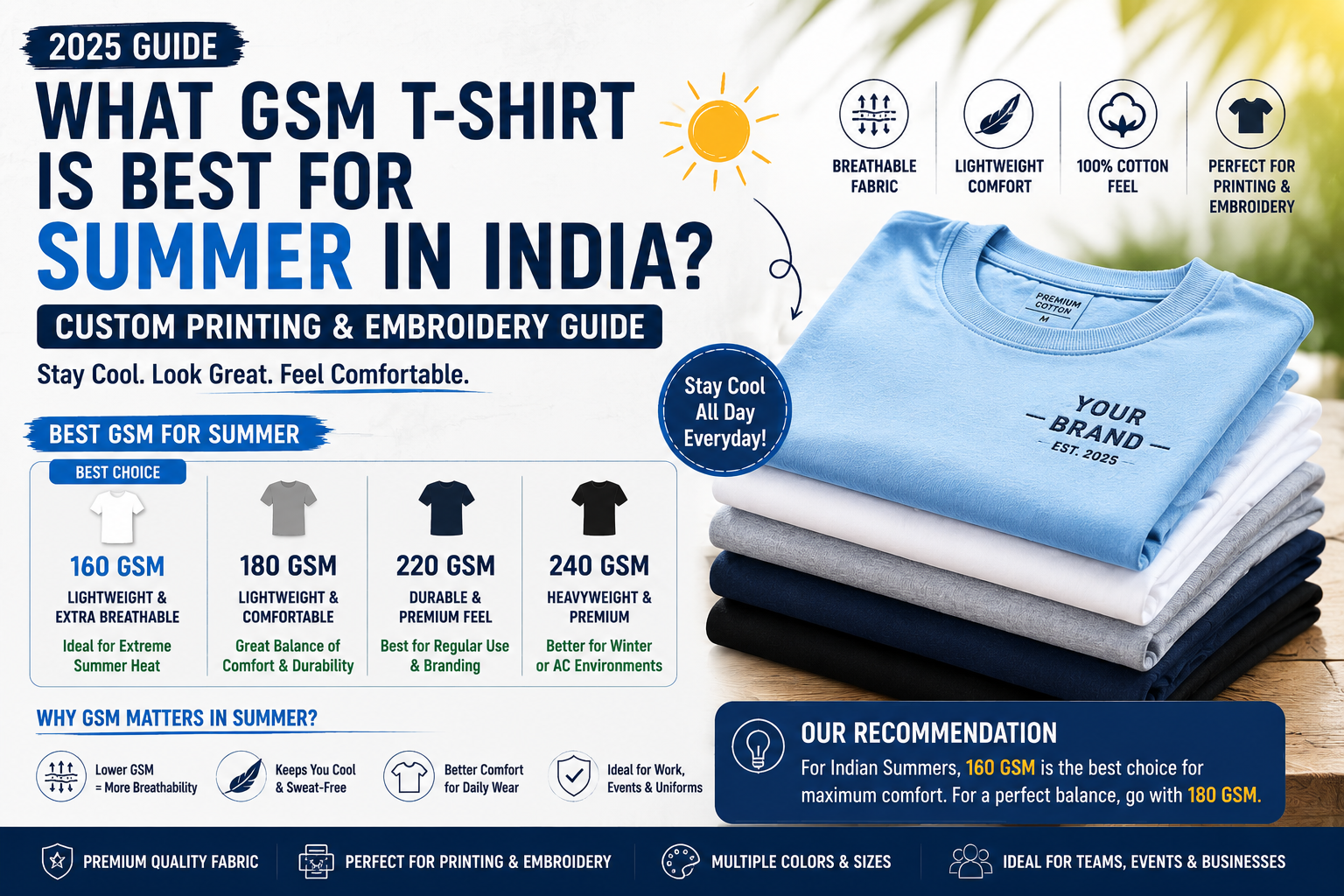
    Choosing the right GSM (Grams per Square Meter) is one of the most important decisions when ordering custom t-shirts in India. Whether you’re designing corporate uniforms, startup merchandise, promotional t-shirts, event apparel, college fest tees, or D2C fashion collections, the GSM directly affects comfort, breathability, durability, print quality, and overall customer satisfaction.

    India experiences long, hot summers with temperatures often exceeding 35–45°C, making fabric weight even more important. A t-shirt that feels premium in winter may become uncomfortable during peak summer, while an ultra-lightweight fabric may not provide the durability needed for daily wear or custom embroidery.

    If you’re searching for best GSM tshirt summer India custom, this comprehensive guide explains the differences between 160 GSM, 180 GSM, 200 GSM, 220 GSM, and 240 GSM t-shirts, helping you choose the ideal fabric for both custom printing and embroidery in 2025.

    What Does GSM Mean in T-Shirts?

    GSM (Grams per Square Meter) measures the weight of fabric.

    Simply put:

    • Lower GSM = Lighter, thinner fabric
    • Higher GSM = Heavier, thicker fabric

    While GSM doesn’t directly indicate fabric quality, it influences:

    • Breathability
    • Softness
    • Durability
    • Structure
    • Printing performance
    • Embroidery support
    • Overall comfort

    Many buyers looking for <mark>custom cotton t-shirts India</mark> mistakenly assume that a higher GSM always means a better t-shirt. In reality, the best GSM depends on how and where the t-shirt will be used.

    Why GSM Is Important for Indian Summers

    Summer conditions in India demand clothing that is:

    • Lightweight
    • Breathable
    • Sweat-friendly
    • Comfortable for extended wear

    However, businesses also need garments that:

    • Hold embroidery well
    • Produce vibrant print results
    • Maintain their shape after repeated washing
    • Reflect a professional brand image

    Choosing the right GSM helps strike the perfect balance between comfort and durability.

    Understanding Popular GSM Options

    GSMFabric FeelBest For
    160 GSMLightweightPromotional events, giveaways
    180 GSMMedium WeightDaily wear, printing, corporate use
    200 GSMPremium MediumPremium printing, casual fashion
    220 GSMHeavyweight PremiumEmbroidery, startup merchandise
    240 GSMLuxury HeavyweightStreetwear, oversized fashion

    Each fabric weight serves a different purpose.

    160 GSM: Best for Hot Weather and Budget Promotions

    160 GSM cotton is one of the lightest options available.

    Advantages

    • Highly breathable
    • Comfortable during extreme heat
    • Budget-friendly
    • Easy to wear for long hours

    Best Applications

    • Promotional campaigns
    • Marathon events
    • Political rallies
    • College festivals
    • Summer giveaways

    Limitations

    • Less durable than heavier fabrics
    • Can lose shape more quickly
    • Not ideal for heavy embroidery

    Many businesses ordering <mark>promotional t-shirts India</mark> prefer 160 GSM because it offers excellent value for bulk orders.

    180 GSM: The Best All-Round GSM for Summer

    For most businesses and organizations, 180 GSM provides the perfect balance.

    Benefits

    • Comfortable in Indian summers
    • Durable enough for regular use
    • Excellent printing results
    • Suitable for embroidery
    • Professional appearance
    • Affordable pricing

    Best Applications

    • Corporate uniforms
    • Employee t-shirts
    • Startup branding
    • College merchandise
    • Event apparel
    • Daily casual wear

    Because of its versatility, many suppliers recommend 180 GSM as the best GSM tshirt summer India custom option.

    200 GSM: A Premium Yet Comfortable Choice

    200 GSM has gained popularity among premium apparel brands.

    Advantages

    • Softer and slightly thicker than 180 GSM
    • Better structure
    • Comfortable even during warmer months
    • Enhanced durability

    Best Applications

    • Premium fashion brands
    • Creator merchandise
    • D2C clothing labels
    • Lifestyle apparel

    For businesses seeking a premium feel without excessive weight, 200 GSM is an excellent middle ground.

    220 GSM: Best for Premium Embroidery

    220 GSM cotton offers a premium feel and excellent durability.

    Advantages

    • Strong fabric structure
    • Premium appearance
    • Excellent embroidery support
    • Better shape retention
    • Luxurious feel

    Best Applications

    • Corporate uniforms
    • Startup merchandise
    • Premium polo t-shirts
    • Employee apparel
    • Luxury branding

    Many suppliers producing <mark>custom embroidered t-shirts India</mark> recommend 220 GSM for logos because thicker fabrics reduce puckering and provide better stitch stability.

    240 GSM: Luxury and Streetwear

    240 GSM is considered heavyweight apparel.

    Advantages

    • Exceptional durability
    • Structured fit
    • Premium fashion appeal
    • Excellent for oversized styles

    Best Applications

    • Streetwear brands
    • Luxury fashion
    • Oversized t-shirts
    • Winter collections

    Drawbacks

    • Less breathable during peak summer
    • Slightly heavier feel
    • Higher production cost

    Unless you’re targeting premium fashion, 240 GSM may be unnecessary for most summer applications.

    Best GSM for Custom Printing

    Printing quality depends on both fabric smoothness and stability.

    160 GSM

    ✔ Suitable for DTF and screen printing

    180 GSM

    ✔ Excellent for DTF, DTG, and screen printing

    200 GSM

    ✔ Premium print finish

    220 GSM

    ✔ High-quality premium prints

    240 GSM

    ✔ Luxury apparel graphics

    Winner for Printing

    180 GSM Cotton

    It offers the best combination of print quality, comfort, and affordability.

    Many companies offering <mark>custom printed t-shirts India</mark> recommend 180 GSM for the majority of printing projects.

    Best GSM for Embroidery

    Embroidery places additional tension on the fabric.

    160 GSM

    Suitable for small logos only.

    180 GSM

    Good for left-chest embroidery.

    200 GSM

    Very good for premium branding.

    220 GSM

    Outstanding embroidery performance.

    240 GSM

    Excellent but often heavier than necessary.

    Winner for Embroidery

    220 GSM Cotton

    The thicker fabric supports embroidery stitches beautifully while maintaining a premium appearance.

    GSM Comparison Table

    Feature160 GSM180 GSM200 GSM220 GSM240 GSM
    Breathability⭐⭐⭐⭐⭐⭐⭐⭐⭐⭐⭐⭐⭐⭐☆⭐⭐⭐⭐☆⭐⭐⭐☆☆
    Comfort⭐⭐⭐⭐⭐⭐⭐⭐⭐⭐⭐⭐⭐⭐☆⭐⭐⭐⭐☆⭐⭐⭐☆☆
    Durability⭐⭐⭐☆☆⭐⭐⭐⭐☆⭐⭐⭐⭐☆⭐⭐⭐⭐⭐⭐⭐⭐⭐⭐
    Printing Quality⭐⭐⭐⭐☆⭐⭐⭐⭐⭐⭐⭐⭐⭐⭐⭐⭐⭐⭐⭐⭐⭐⭐⭐☆
    Embroidery⭐⭐⭐☆☆⭐⭐⭐⭐☆⭐⭐⭐⭐☆⭐⭐⭐⭐⭐⭐⭐⭐⭐⭐
    Premium Feel⭐⭐⭐☆☆⭐⭐⭐⭐☆⭐⭐⭐⭐☆⭐⭐⭐⭐⭐⭐⭐⭐⭐⭐

    Which GSM Should You Choose?

    Corporate Uniforms

    Recommended GSM: 180–220 GSM

    Provides comfort for daily wear while maintaining a professional appearance.

    Startup Merchandise

    Recommended GSM: 220 GSM

    Creates a premium brand image with superior durability.

    College Events

    Recommended GSM: 180 GSM

    Affordable, breathable, and suitable for large groups.

    Promotional Campaigns

    Recommended GSM: 160–180 GSM

    Ideal for budget-conscious bulk orders.

    Fashion Brands

    Recommended GSM: 200–240 GSM

    Offers a premium look and excellent structure.

    Many <mark>startup merchandise t-shirts India</mark> now use 220 GSM biowash cotton to enhance perceived value.

    Does Fabric Quality Matter More Than GSM?

    Absolutely.

    A premium 180 GSM combed biowash cotton t-shirt can feel softer and last longer than a poor-quality 220 GSM fabric.

    Factors influencing quality include:

    • Combed cotton
    • Ringspun yarn
    • Biowash treatment
    • Fabric knitting
    • Stitching quality
    • Shrinkage control

    Always evaluate GSM together with overall fabric construction.

    Biowash Cotton vs Regular Cotton

    For summer custom t-shirts, biowash cotton offers several advantages:

    Benefits

    • Softer texture
    • Better moisture management
    • Reduced pilling
    • Improved print surface
    • Greater comfort

    Many buyers searching for <mark>best cotton t-shirt India custom printing</mark> ultimately choose biowash cotton for its premium feel.

    Common GSM Selection Mistakes

    Avoid these common errors:

    • Choosing the highest GSM without considering climate
    • Buying solely based on price
    • Ignoring the intended use
    • Overlooking fabric quality and finishing
    • Selecting lightweight fabric for heavy embroidery

    Making informed decisions helps ensure successful <mark>custom t-shirt orders India</mark>.

    Frequently Asked Questions (FAQs)

    Is 180 GSM good for Indian summer?

    Yes. It offers an excellent balance of breathability, durability, and comfort, making it one of the best choices for most custom t-shirts.

    Is 220 GSM too hot for summer?

    Not necessarily. A 220 GSM biowash cotton t-shirt remains comfortable for regular wear, especially indoors or for premium corporate uniforms. However, it may feel warmer than 180 GSM during extreme outdoor heat.

    Which GSM is best for DTF printing?

    180 GSM and 200 GSM provide outstanding print quality while maintaining excellent comfort.

    Which GSM is best for embroidery?

    220 GSM is generally considered the best option because the thicker fabric supports embroidery stitches without puckering.

    Which GSM is best for promotional events?

    For large-scale promotional campaigns and giveaways, 160 GSM or 180 GSM cotton offers the best value.

    Final Verdict: Best GSM TShirt Summer India Custom

    If you’re looking for the best GSM tshirt summer India custom, 180 GSM cotton is the clear winner for most applications. It provides the ideal balance of breathability, comfort, durability, affordability, and compatibility with modern printing methods like DTF, DTG, and screen printing.

    For premium branding, embroidered logos, and startup merchandise, 220 GSM biowash cotton delivers a richer feel and superior durability while still offering reasonable comfort in Indian weather. Meanwhile, 160 GSM remains an excellent option for promotional events and large-volume campaigns where lightweight comfort and budget are top priorities.

    Ultimately, the best summer custom t-shirt isn’t simply the lightest or heaviest—it is the one that matches your purpose, budget, customization method, and audience. By selecting the right GSM and high-quality cotton fabric, you can create custom t-shirts that not only look professional but also keep people comfortable throughout India’s long summer season.

  • Custom T-Shirt Trends in India 2025: What’s Selling Right Now

    Custom T-Shirt Trends in India 2025: What’s Selling Right Now

    The Indian custom apparel industry is evolving faster than ever. Driven by startups, D2C brands, corporate gifting, creator merchandise, college festivals, sports events, and the booming e-commerce market, custom t-shirts have become one of the fastest-growing promotional and fashion products in the country.

    In 2025, customers are no longer looking for basic printed t-shirts. They expect premium fabrics, unique customization techniques, sustainable materials, and designs that reflect their personality or brand identity. Businesses, influencers, schools, and entrepreneurs are increasingly investing in high-quality custom apparel that combines style, comfort, and durability.

    If you’re searching for custom tshirt trends India 2025, this comprehensive guide explores the biggest trends shaping the custom t-shirt market, helping businesses and individuals stay ahead of the competition.

    Why the Custom T-Shirt Industry Is Growing in India

    India’s custom t-shirt market continues to expand due to increasing demand for personalized fashion, corporate branding, promotional merchandise, and online customization platforms. Industry forecasts also project strong long-term growth, supported by rising e-commerce adoption and improved printing technologies.

    Major growth drivers include:

    • Startup ecosystem expansion
    • Creator economy growth
    • Corporate branding
    • College merchandise
    • Print-on-demand businesses
    • Premium fashion brands
    • Small business marketing

    This demand is changing what customers expect from custom apparel.

    Trend #1: Oversized T-Shirts Continue to Dominate

    Oversized t-shirts remain one of the strongest fashion trends in India.

    Both fashion brands and corporate merchandise providers are moving away from traditional slim-fit garments toward relaxed silhouettes. Industry trend reports also highlight oversized fits as one of the biggest customization trends for businesses in 2025.

    Why Customers Love Them

    • Modern appearance
    • Comfortable fit
    • Unisex appeal
    • Better branding space
    • Popular with Gen Z

    Many <mark>oversized custom t-shirts India</mark> now feature heavyweight cotton fabrics for a premium feel.

    Trend #2: 180–220 GSM Premium Cotton Is Becoming the Standard

    Customers are increasingly choosing quality over the lowest price.

    Popular GSM options include:

    GSMBest Use
    160 GSMPromotional events
    180 GSMDaily wear & printing
    200 GSMPremium casual apparel
    220 GSMEmbroidery & startup merchandise

    Premium biowash cotton has become especially popular because it offers:

    • Softer texture
    • Better durability
    • Reduced pilling
    • Premium appearance

    Businesses ordering <mark>best GSM cotton t-shirt India custom</mark> increasingly prefer 180–220 GSM fabrics.

    Trend #3: DTF Printing Is Growing Rapidly

    Direct-to-Film (DTF) printing has transformed custom apparel production.

    Unlike traditional screen printing, DTF offers:

    • No minimum order quantity
    • Full-colour graphics
    • Faster production
    • Better small-batch flexibility
    • Excellent detail

    This makes it ideal for:

    • Creator merchandise
    • Startup brands
    • Personalized gifts
    • Limited-edition collections

    Many suppliers now recommend <mark>DTF printing t-shirts India</mark> for short-run custom orders.

    Trend #4: Premium Embroidery Is Replacing Large Printed Logos

    Minimal branding is becoming more desirable.

    Instead of oversized front prints, businesses are choosing:

    • Left chest embroidery
    • Sleeve logos
    • Collar embroidery
    • Tone-on-tone stitching
    • Monogram branding

    Embroidery continues to gain popularity because it creates a premium, long-lasting finish.

    Popular choices include:

    • Corporate uniforms
    • Hotel staff apparel
    • Startup merchandise
    • Premium polo t-shirts

    Many <mark>custom embroidered t-shirts India</mark> now combine subtle embroidery with clean, minimalist designs.

    Trend #5: Minimalist Designs Are Winning

    The “less is more” approach continues to dominate.

    Popular minimalist styles include:

    • Small chest logos
    • Clean typography
    • Neutral colours
    • Geometric graphics
    • Simple illustrations

    These designs work well for both fashion and corporate branding.

    Trend #6: Back Prints Are Becoming More Popular

    Instead of placing large graphics on the front, many brands now use:

    • Small logo on the chest
    • Large artwork on the back
    • Inspirational quotes
    • Brand storytelling
    • Event graphics

    This trend is especially popular among startups, tech companies, and lifestyle brands.

    Trend #7: Sustainable Fabrics Are Gaining Demand

    Environmental awareness is influencing purchasing decisions.

    Growing fabric choices include:

    • Organic cotton
    • Recycled cotton blends
    • Biowash cotton
    • Eco-friendly packaging

    Businesses increasingly use sustainability as part of their branding strategy. Industry reports also identify eco-conscious fabrics as one of the fastest-growing areas in custom apparel.

    Many customers now actively search for <mark>eco-friendly custom t-shirts India</mark>.

    Trend #8: Corporate Merchandise Is Becoming Premium

    Corporate t-shirts are no longer simple promotional giveaways.

    Companies now invest in:

    • Premium cotton
    • Embroidered logos
    • Modern fits
    • Branded packaging
    • Employee welcome kits

    These upgrades improve both employee engagement and brand perception.

    Trend #9: Creator & Influencer Merchandise Is Booming

    India’s creator economy has created huge demand for custom merchandise.

    Popular products include:

    • Graphic t-shirts
    • Limited-edition drops
    • Fan merchandise
    • Community apparel
    • Event-exclusive collections

    Instead of keeping large inventories, many creators now use Print-on-Demand models to reduce financial risk.

    Trend #10: Personalization Is Driving Higher Sales

    Customers increasingly want products that feel unique.

    Popular personalization options include:

    • Individual names
    • Nicknames
    • Employee IDs
    • Jersey numbers
    • Custom initials
    • Personalized messages

    This trend is especially strong for:

    • School events
    • Corporate teams
    • Sports clubs
    • Family reunions
    • Wedding celebrations

    Many <mark>personalized custom t-shirts India</mark> now offer these features with low minimum order quantities.

    Trending Colours in 2025

    Neutral and earthy colours continue to dominate.

    Popular shades include:

    • Black
    • White
    • Navy Blue
    • Charcoal Grey
    • Olive Green
    • Beige
    • Bottle Green
    • Maroon
    • Sand
    • Coffee Brown

    These colours pair well with both printing and embroidery.

    Trending Printing & Decoration Techniques

    Businesses are combining multiple techniques for a premium look.

    Popular options include:

    TechniqueBest For
    DTF PrintingColourful graphics
    Screen PrintingBulk orders
    Flat EmbroideryCorporate branding
    3D Puff EmbroideryFashion brands
    Puff PrintingStreetwear
    Heat TransferSportswear

    Hybrid customization methods are becoming increasingly popular.

    Industries Driving Demand

    Custom t-shirts are growing across multiple sectors.

    Top industries include:

    • IT companies
    • Startups
    • Educational institutions
    • Hospitality
    • Healthcare
    • Fitness centres
    • Restaurants
    • Retail
    • Event management
    • E-commerce brands

    Each industry has unique customization requirements.

    Common Mistakes Businesses Should Avoid

    Avoid these common errors:

    • Choosing low-quality fabric
    • Ignoring GSM selection
    • Overusing large logos
    • Selecting poor artwork
    • Prioritizing price over quality
    • Not ordering samples
    • Working with unreliable suppliers

    Quality apparel creates stronger brand impressions than inexpensive alternatives.

    Future Outlook for India’s Custom T-Shirt Market

    Industry analysts expect continued growth in India’s custom t-shirt market, supported by digital commerce, personalization, creator-led brands, and modern production technologies. Print-on-demand, premium fabrics, and sustainable apparel are expected to remain key drivers over the coming years.

    Businesses that invest in quality, branding, and customer experience are likely to benefit the most.

    Frequently Asked Questions (FAQs)

    What is the biggest custom t-shirt trend in India in 2025?

    Oversized premium cotton t-shirts with minimalist branding, embroidery, and DTF printing are among the strongest trends.

    Is DTF printing replacing screen printing?

    DTF is becoming increasingly popular for short runs and full-colour designs, while screen printing remains a cost-effective choice for large-volume orders.

    Which fabric is trending for custom t-shirts?

    180–220 GSM biowash cotton is widely preferred because it balances comfort, durability, and premium appearance.

    Are embroidered logos more popular than printed logos?

    For corporate uniforms and premium merchandise, embroidered logos are increasingly chosen because of their professional appearance and long-lasting finish.

    Are sustainable t-shirts becoming popular in India?

    Yes. Demand for organic cotton, recycled materials, and eco-friendly packaging continues to grow as both businesses and consumers become more environmentally conscious.

    Final Verdict: Custom TShirt Trends India 2025

    If you’re following the custom tshirt trends India 2025, one thing is clear: quality has become more important than quantity. Today’s buyers expect premium fabrics, comfortable fits, durable customization, and thoughtful branding rather than basic promotional apparel.

    The biggest winners in 2025 are oversized silhouettes, 180–220 GSM biowash cotton, minimalist embroidery, DTF printing, sustainable materials, and personalized merchandise. At the same time, corporate gifting, startup branding, creator merchandise, and print-on-demand businesses are creating new opportunities for custom apparel across India.

    Whether you’re launching a clothing brand, ordering uniforms, promoting a business, or building a merchandise line, staying aligned with these trends will help you create custom t-shirts that not only look modern but also deliver lasting value for your customers and strengthen your brand identity.

  • What is DTF Printing? Why It’s Perfect for Custom T-Shirts in India 2025

    What is DTF Printing? Why It’s Perfect for Custom T-Shirts in India 2025

    The custom apparel industry in India has evolved rapidly over the past few years. Businesses, startups, creators, schools, sports teams, and fashion brands now have access to advanced printing technologies that deliver high-quality results at affordable prices.

    Among these innovations, DTF (Direct-to-Film) Printing has emerged as one of the most popular and versatile methods for custom t-shirt printing. It combines vibrant colors, excellent durability, cost-effectiveness, and flexibility, making it an ideal solution for both small and bulk orders.

    If you’re searching for what is DTF printing tshirt India, this complete guide explains how DTF printing works, its advantages, costs, durability, comparisons with other printing methods, and why it is becoming the preferred choice for custom t-shirts in India in 2025.

    What is DTF Printing?

    DTF stands for Direct-to-Film Printing.

    It is a modern garment printing process where a design is printed onto a special transfer film and then transferred onto a t-shirt using heat and pressure.

    Unlike traditional printing methods, DTF does not print directly onto the fabric.

    Instead, the process involves:

    1. Printing the design onto a PET film.
    2. Applying adhesive powder.
    3. Curing the adhesive.
    4. Heat pressing the design onto the garment.

    The result is a durable, vibrant, and flexible print that works on a wide variety of fabrics.

    Many businesses offering <mark>custom DTF printing India</mark> now use this technology because of its versatility and efficiency.

    How Does DTF Printing Work?

    Understanding the process helps explain why DTF has become so popular.

    Step 1: Design Creation

    Artwork is prepared digitally.

    Supported designs include:

    • Logos
    • Photographs
    • Illustrations
    • Text designs
    • Multi-color graphics

    Step 2: Printing on Film

    A specialized DTF printer prints the design onto a transparent PET film.

    The printer uses:

    • CMYK inks
    • White ink layer

    The white layer helps designs remain vibrant on dark-colored garments.

    Step 3: Adhesive Powder Application

    A special hot-melt adhesive powder is applied to the printed design.

    This powder helps bond the artwork to the fabric.

    Step 4: Curing

    The adhesive powder is cured using heat.

    This prepares the transfer for application.

    Step 5: Heat Press Transfer

    The film is pressed onto the t-shirt using a heat press machine.

    After cooling, the film is removed, leaving the design permanently attached to the garment.

    This process is used by many <mark>custom t-shirt printing companies India</mark> because it produces professional-quality results.

    Why DTF Printing Is Growing Rapidly in India

    Several factors are driving adoption.

    Low Setup Costs

    Unlike screen printing, DTF does not require expensive screens.

    No Minimum Order Quantity

    DTF works well for single-piece orders.

    Excellent Print Quality

    Produces vibrant and detailed designs.

    Fabric Compatibility

    Works on multiple fabric types.

    These advantages make <mark>DTF printed t-shirts India</mark> increasingly popular among businesses and consumers.

    Benefits of DTF Printing

    1. Works on Almost Any Fabric

    DTF can print on:

    • Cotton
    • Polyester
    • Cotton-poly blends
    • Biowash fabrics
    • Oversized t-shirts
    • Polo t-shirts

    This versatility makes it one of the most flexible printing methods available.

    2. Vibrant Colors

    DTF printing delivers:

    • Bright colors
    • Sharp details
    • Strong contrast

    Even dark-colored garments can achieve excellent color accuracy.

    Many brands creating <mark>premium custom t-shirts India</mark> choose DTF for its visual impact.

    3. Excellent Durability

    High-quality DTF prints can withstand:

    • Frequent washing
    • Regular wear
    • Daily use

    Properly applied transfers remain intact for years.

    4. Ideal for Small Orders

    Unlike screen printing, DTF remains cost-effective even for:

    • Single pieces
    • Samples
    • Prototype merchandise

    This makes <mark>single piece custom t-shirt printing India</mark> more accessible.

    5. Fast Production

    Because there is no screen setup, DTF orders can often be completed quickly.

    Many suppliers offer:

    • Same-day production
    • 24-hour dispatch
    • Express services

    DTF Printing vs Screen Printing

    Many buyers compare these two popular methods.

    FeatureDTF PrintingScreen Printing
    Setup CostLowHigh
    Small OrdersExcellentExpensive
    Bulk OrdersGoodExcellent
    Color ComplexityExcellentModerate
    Production SpeedFastModerate
    Fabric CompatibilityExcellentGood
    Design FlexibilityExcellentLimited

    Winner for Small Orders

    DTF Printing

    Winner for Large Bulk Orders

    Screen Printing

    DTF Printing vs DTG Printing

    Both technologies support high-quality customization.

    FeatureDTFDTG
    Fabric TypesMultipleMostly Cotton
    DurabilityExcellentVery Good
    Color VibrancyExcellentExcellent
    Cost EfficiencyBetterModerate
    MaintenanceLowerHigher

    Many <mark>custom apparel manufacturers India</mark> now prefer DTF because of its broader fabric compatibility.

    How Durable Is DTF Printing?

    Durability is one of DTF’s strongest advantages.

    With proper care:

    Typical Lifespan

    • 50–100+ washes
    • Several years of regular use

    Quality DTF prints resist:

    • Cracking
    • Peeling
    • Fading

    This makes DTF suitable for both personal and commercial apparel.

    Best Fabrics for DTF Printing

    Although DTF works on many materials, some fabrics perform particularly well.

    180 GSM Cotton

    • Excellent print quality
    • Affordable pricing

    220 GSM Cotton

    • Premium appearance
    • Superior durability

    Biowash Cotton

    • Smooth print surface
    • Enhanced customer experience

    Many suppliers producing <mark>DTF custom cotton t-shirts India</mark> recommend 220 GSM biowash cotton for premium results.

    Average DTF Printing Costs in India (2025)

    Pricing varies based on:

    • Design size
    • Garment quality
    • Order quantity

    Single Piece Orders

    ₹299 – ₹999

    Bulk Orders

    ₹150 – ₹450 per piece

    Many buyers comparing <mark>custom t-shirt price India</mark> find DTF offers strong value for money.

    Who Should Use DTF Printing?

    Startups

    Ideal for:

    • Merchandise testing
    • Team apparel
    • Brand launches

    D2C Brands

    Perfect for:

    • Limited-edition collections
    • On-demand production

    Content Creators

    Suitable for:

    • Fan merchandise
    • Creator branding

    Businesses

    Useful for:

    • Event t-shirts
    • Promotional campaigns
    • Employee apparel

    Many <mark>startup merchandise t-shirts India</mark> now use DTF because it supports low-volume production.

    Common Myths About DTF Printing

    Myth 1: DTF Feels Like Plastic

    Modern DTF transfers are significantly softer than older heat-transfer methods.

    Myth 2: DTF Cracks Easily

    High-quality DTF prints are highly durable when applied correctly.

    Myth 3: DTF Only Works on Cotton

    DTF works effectively on multiple fabric types.

    Myth 4: DTF Is Only for Small Orders

    DTF can also be used for medium and large production runs.

    Tips for Getting the Best DTF Print Quality

    Use High-Resolution Artwork

    Vector files produce the best results.

    Choose Premium Fabric

    Higher-quality garments improve customer satisfaction.

    Work With Experienced Printers

    Proper application significantly impacts durability.

    Follow Care Instructions

    Proper washing extends print lifespan.

    Future of DTF Printing in India

    The Indian custom apparel market continues to embrace DTF technology.

    Emerging trends include:

    • Faster printing systems
    • Improved transfer films
    • Eco-friendly inks
    • On-demand manufacturing
    • AI-assisted design workflows

    As technology advances, DTF is expected to become even more affordable and accessible.

    Final Verdict: What Is DTF Printing TShirt India

    If you’re wondering what is DTF printing tshirt India, it is a modern, versatile, and highly durable printing method that transfers designs from a special film onto fabric using heat and adhesive technology.

    Its ability to produce vibrant colors, support complex artwork, work on multiple fabric types, and remain cost-effective for both small and bulk orders has made it one of the fastest-growing customization methods in India.

    For startups, businesses, creators, schools, fashion brands, and anyone looking for professional-quality custom t-shirts in 2025, DTF printing offers an outstanding balance of affordability, flexibility, durability, and visual appeal.

    Whether you’re ordering a single custom t-shirt or launching an entire merchandise collection, DTF printing has become one of the smartest and most reliable choices in the Indian custom apparel industry.

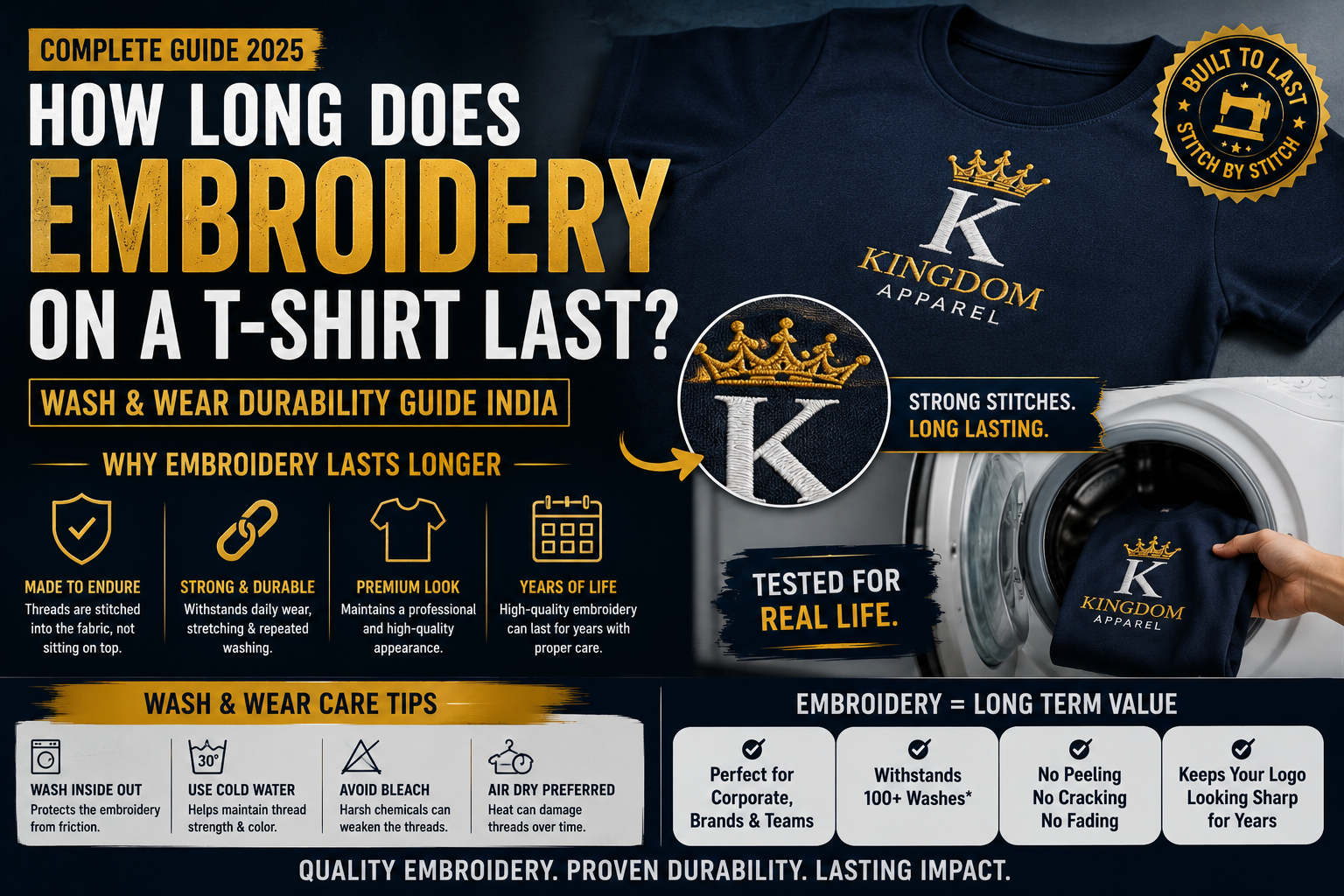
  • How Long Does Embroidery on a T-Shirt Last? Wash & Wear Durability Guide India

    How Long Does Embroidery on a T-Shirt Last? Wash & Wear Durability Guide India

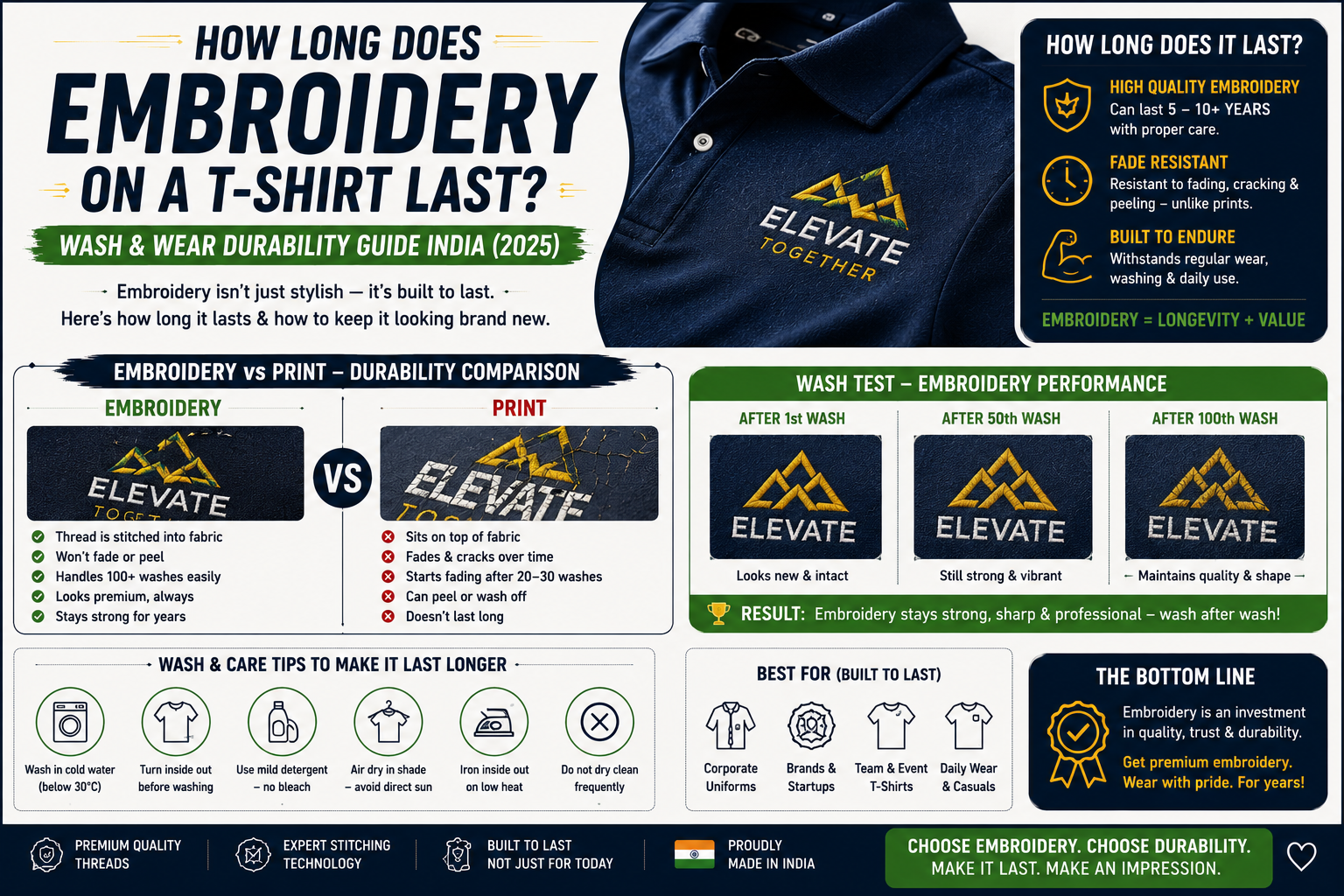
    One of the biggest reasons businesses, startups, schools, sports teams, and fashion brands choose embroidery over printing is durability. While printed designs can fade, crack, or peel over time, embroidery is known for maintaining its appearance even after years of regular use.

    However, many buyers still ask:

    “How long does embroidery on a t-shirt actually last?”

    The answer depends on several factors, including thread quality, fabric type, stitch density, washing habits, and garment construction. When done properly, embroidery can outlast the t-shirt itself.

    If you’re searching for how long embroidery tshirt last India, this comprehensive guide explains everything you need to know about embroidery lifespan, durability, maintenance, and how to maximize the life of your embroidered apparel in 2025.

    Why Embroidery Is Known for Durability

    Unlike printing, embroidery does not sit on top of the fabric.

    Instead, the design is stitched directly into the garment using durable threads.

    This creates:

    • Strong logo attachment
    • Better resistance to wear
    • Long-term color retention
    • Superior wash performance

    Many companies investing in <mark>custom embroidered t-shirts India</mark> choose embroidery specifically because of its longevity.

    How Long Does Embroidery Typically Last?

    A professionally embroidered logo can often last:

    Regular Usage

    3–5 Years

    With normal wear and washing, embroidery generally remains intact and visually appealing.

    Corporate Uniforms

    2–4 Years

    Daily office wear may shorten garment lifespan, but the embroidery itself usually remains in excellent condition.

    Premium Apparel

    5–10+ Years

    High-quality embroidery on premium cotton garments can remain intact for many years.

    In many cases, the fabric wears out before the embroidery does.

    This is one reason businesses choose <mark>embroidered company logo t-shirts India</mark> for long-term branding.

    What Makes Embroidery Last So Long?

    Several factors contribute to embroidery durability.

    1. Thread Strength

    Modern embroidery threads are highly durable.

    Common options include:

    Polyester Thread

    Benefits:

    • Fade resistant
    • Strong tensile strength
    • Excellent wash durability

    Rayon Thread

    Benefits:

    • Attractive shine
    • Premium appearance

    Most <mark>professional embroidery services India</mark> use high-quality polyester threads for maximum durability.

    2. Stitch Construction

    Embroidery is mechanically stitched into the garment.

    Unlike prints that adhere to the fabric surface, stitches become part of the garment structure.

    This makes embroidery resistant to:

    • Peeling
    • Cracking
    • Chipping

    3. Color Retention

    Embroidery threads are designed to resist fading.

    High-quality thread can maintain color consistency even after hundreds of washes.

    This advantage makes <mark>premium embroidered apparel India</mark> highly popular among businesses and brands.

    Embroidery vs Printing: Which Lasts Longer?

    Many buyers compare embroidery with printing before placing an order.

    FeatureEmbroideryPrinting
    Peeling ResistanceExcellentModerate
    Crack ResistanceExcellentModerate
    Fade ResistanceExcellentGood
    Wash DurabilityExcellentGood
    Premium AppearanceExcellentGood
    Lifespan3–10+ Years1–5 Years

    While modern printing technologies are highly durable, embroidery generally provides superior long-term performance.

    Winner: Embroidery

    For durability and longevity, embroidery remains the preferred choice.

    Does Fabric Quality Affect Embroidery Lifespan?

    Absolutely.

    Embroidery durability depends not only on the stitches but also on the fabric supporting them.

    180 GSM Cotton

    Good durability.

    Suitable for:

    • Employee uniforms
    • Promotional apparel

    220 GSM Cotton

    Excellent durability.

    Ideal for:

    • Premium merchandise
    • Startup apparel
    • Corporate branding

    240 GSM Cotton

    Exceptional durability.

    Often used for:

    • Luxury apparel
    • Heavyweight fashion garments

    Many suppliers producing <mark>220 GSM embroidered t-shirts India</mark> recommend this fabric because it balances comfort and longevity.

    How Washing Affects Embroidery

    Although embroidery is highly durable, improper washing can reduce garment lifespan.

    Good News

    The embroidery itself rarely gets damaged by washing.

    Potential Issues

    Poor washing habits can affect:

    • Thread appearance
    • Fabric quality
    • Overall garment condition

    Proper care helps maintain both the embroidery and the t-shirt.

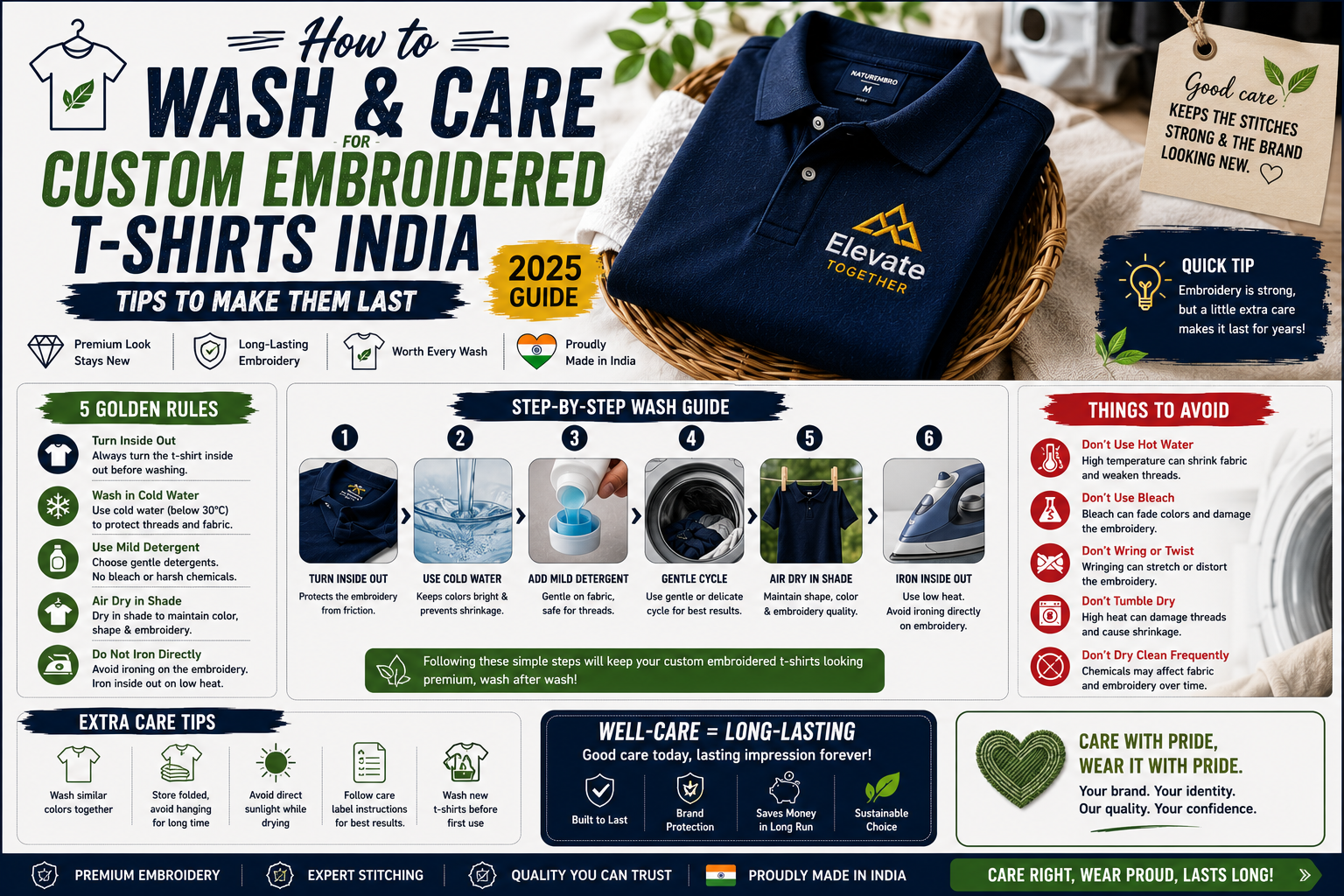
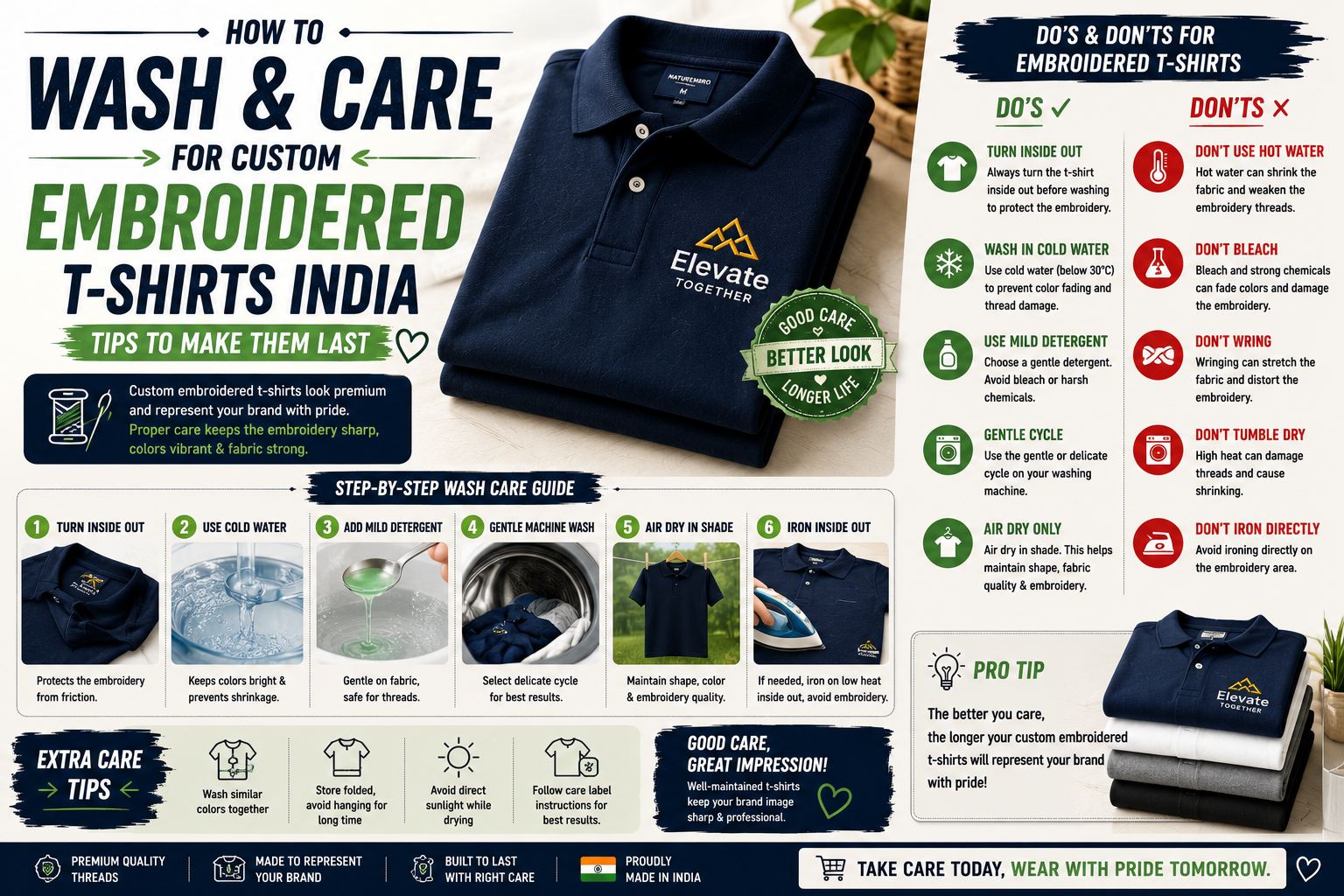
    Best Washing Practices for Embroidered T-Shirts

    Turn the T-Shirt Inside Out

    This minimizes friction during washing.

    Use Cold or Mild Water

    Recommended temperature:

    • 20°C–30°C

    Choose Gentle Detergents

    Avoid harsh chemicals whenever possible.

    Use Gentle Wash Cycles

    Aggressive washing can stress the garment fabric.

    Many owners of <mark>custom logo embroidered t-shirts India</mark> follow these simple practices to extend garment life.

    Drying Tips for Maximum Durability

    Drying methods can impact garment longevity.

    Recommended

    • Air drying
    • Shade drying
    • Flat drying when possible

    Avoid

    • Excessive heat
    • Prolonged direct sunlight
    • Overdrying

    Heat affects fabric far more than embroidery thread.

    Can Embroidery Fade Over Time?

    High-quality embroidery threads are extremely fade resistant.

    However, fading may occur if:

    • Low-quality thread is used
    • Garments are exposed to strong sunlight regularly
    • Harsh chemicals are used repeatedly

    Premium <mark>corporate embroidered uniforms India</mark> typically use threads specifically designed for color stability.

    Can Embroidery Come Loose?

    Properly produced embroidery rarely comes loose.

    Potential causes include:

    Poor Digitization

    Incorrect stitch settings can weaken embroidery.

    Low-Quality Production

    Inexperienced operators may create weak stitch structures.

    Fabric Damage

    If the fabric tears, embroidery may also be affected.

    Choosing a reputable supplier significantly reduces these risks.

    Does Frequent Wear Damage Embroidery?

    Normal daily wear generally has minimal impact on embroidery.

    Embroidery is designed to withstand:

    • Movement
    • Folding
    • Washing
    • Routine use

    This durability is one reason <mark>corporate uniform embroidery India</mark> remains popular across multiple industries.

    How Many Washes Can Embroidery Handle?

    There is no exact universal number because quality varies.

    However, professionally embroidered logos commonly withstand:

    50–100 Washes

    With little visible change.

    100–200+ Washes

    With proper care and high-quality thread.

    Many embroidered garments continue looking professional long after reaching these milestones.

    Common Mistakes That Reduce Embroidery Lifespan

    Using Bleach

    Bleach can weaken thread fibers and affect fabric quality.

    High-Heat Ironing Directly on Embroidery

    Heat may flatten or damage thread texture.

    Poor Fabric Selection

    Low-quality fabrics may deteriorate before the embroidery.

    Overloading Washing Machines

    Excessive friction can stress garments unnecessarily.

    Avoiding these mistakes helps preserve <mark>long-lasting embroidered t-shirts India</mark>.

    How to Store Embroidered T-Shirts Properly

    Good storage practices contribute to garment longevity.

    Recommended

    • Fold neatly
    • Store in dry environments
    • Avoid prolonged compression

    Avoid

    • Damp storage areas
    • Excessive sunlight exposure

    These simple habits help maintain appearance and quality.

    Best Applications for Long-Lasting Embroidery

    Embroidery performs exceptionally well for:

    Corporate Uniforms

    Professional and durable.

    Startup Merchandise

    Premium branding with long-term value.

    Polo T-Shirts

    One of the most popular embroidery applications.

    Fashion Apparel

    Adds premium visual appeal.

    Many brands producing <mark>high-quality embroidered t-shirts India</mark> rely on embroidery specifically because of its long lifespan.

    Is Embroidery Worth the Extra Cost?

    Although embroidery usually costs more than printing, the durability often justifies the investment.

    Benefits include:

    • Longer lifespan
    • Better brand perception
    • Reduced replacement frequency
    • Premium appearance

    For businesses planning long-term apparel usage, embroidery often delivers stronger value over time.

    Final Verdict: How Long Embroidery TShirt Last India

    If you’re wondering how long embroidery tshirt last India, the answer is reassuring: professionally embroidered t-shirts can remain attractive and functional for 3 to 10 years or more, depending on fabric quality, thread quality, and maintenance practices.

    Unlike many printing methods, embroidery does not crack, peel, or wear away easily. In fact, the embroidery often outlasts the garment itself. High-quality polyester thread, proper digitization, premium cotton fabrics, and correct washing habits all contribute to exceptional durability.

    For startups, businesses, schools, sports teams, and D2C brands looking for long-lasting custom apparel, embroidery remains one of the most durable and professional customization methods available in India. When cared for properly, an embroidered logo can continue representing your brand effectively through hundreds of wears and washes, making it a smart long-term investment.

  • How to Send Your Logo for Custom Embroidery T-Shirt Order India (File Format Guide)

    How to Send Your Logo for Custom Embroidery T-Shirt Order India (File Format Guide)

    Ordering custom embroidered t-shirts for your business, startup, event, or brand is an excellent way to create a professional and premium appearance. However, many embroidery projects experience delays, additional charges, or poor-quality results because customers submit logos in the wrong format.

    A logo that looks perfect on a website or social media page may not be suitable for embroidery without proper preparation. Understanding how to send your artwork correctly can save time, reduce costs, and ensure your embroidered t-shirts look exactly as expected.

    If you’re searching for how to send logo embroidery tshirt India, this complete guide explains everything you need to know about logo file formats, artwork requirements, embroidery digitization, common mistakes, and best practices for custom embroidery orders in 2025.

    Why Logo File Format Matters for Embroidery

    Embroidery is very different from printing.

    Printing reproduces artwork using ink, while embroidery recreates your logo using thousands of stitches.

    Before production begins, your logo must be converted into an embroidery machine file through a process called digitization.

    Submitting the correct artwork helps:

    • Improve embroidery quality
    • Reduce production delays
    • Minimize digitization costs
    • Ensure accurate logo reproduction
    • Speed up order approval

    Many suppliers offering <mark>custom embroidered t-shirts India</mark> request specific file formats before processing an order.

    What Is Embroidery Digitization?

    Embroidery machines cannot directly read standard image files.

    A digitizer converts your logo into a stitch pattern that tells the machine:

    • Stitch direction
    • Stitch density
    • Thread colors
    • Stitch sequence
    • Needle movements

    This process is known as digitization.

    Even the best logo requires digitization before embroidery can begin.

    Most <mark>logo embroidery services India</mark> include digitization as part of the setup process.

    Best File Formats for Embroidery Logos

    Some file types work much better than others.

    Vector Files (Recommended)

    AI (Adobe Illustrator)

    The preferred format for embroidery artwork.

    Benefits:

    • Scalable without quality loss
    • Clean design elements
    • Easy digitization

    EPS

    Another excellent vector format.

    Advantages:

    • Professional quality
    • Compatible with most design software

    SVG

    Popular for modern logo design.

    Benefits:

    • Editable
    • High-quality scaling

    Many embroidery providers prefer <mark>vector logo files for embroidery</mark> because they produce the most accurate results.

    High-Resolution Image Files

    If vector files are unavailable, high-resolution image files can often be used.

    PNG

    Recommended when:

    • Background is transparent
    • Resolution is high

    Minimum recommendation:

    • 1000 pixels wide or larger

    JPG/JPEG

    Acceptable if:

    • High resolution
    • Clear logo visibility

    However, JPG files may require additional editing before digitization.

    Many businesses placing <mark>custom logo embroidery orders India</mark> submit PNG files successfully.

    Embroidery Machine File Formats

    After digitization, embroidery machines use specialized formats.

    Common formats include:

    • DST
    • EMB
    • PES
    • JEF
    • EXP

    Customers generally do not need to create these files themselves.

    The embroidery provider typically generates them after digitization.

    Best Logo Specifications for Embroidery

    Not every logo translates perfectly into embroidery.

    Ideal Characteristics

    • Simple design
    • Bold lines
    • Clear shapes
    • Limited detail

    Embroidery works best when logos remain easy to read at small sizes.

    Many <mark>corporate embroidery t-shirt India</mark> projects use simplified logo versions specifically for embroidery.

    Recommended Logo Size for T-Shirts

    The most common embroidery placement is the left chest area.

    Standard Left-Chest Logo

    Size:

    • 3 to 4 inches wide

    Benefits:

    • Professional appearance
    • Affordable stitch count
    • Excellent readability

    Sleeve Logo

    Size:

    • 2 to 3 inches wide

    Back Neck Logo

    Size:

    • 2 to 3 inches wide

    Large Front Embroidery

    Size:

    • 5 to 8 inches wide

    Larger logos generally increase embroidery costs.

    How to Prepare Your Logo Before Sending

    Step 1: Use Original Artwork

    Always submit the highest-quality version available.

    Avoid:

    • Screenshots
    • Social media profile images
    • Low-resolution files

    Step 2: Convert Text to Outlines

    For vector artwork:

    • Convert fonts to outlines
    • Embed all design elements

    This prevents font compatibility issues.

    Step 3: Remove Unnecessary Backgrounds

    Transparent backgrounds help digitizers work more efficiently.

    PNG files are ideal for this purpose.

    Step 4: Specify Brand Colors

    Provide:

    • Pantone colors
    • Hex codes
    • RGB values

    Accurate color references improve thread matching.

    Many <mark>custom embroidery companies India</mark> request color information during order submission.

    Information You Should Send Along With Your Logo

    Providing additional details helps avoid misunderstandings.

    Include:

    • Logo file
    • Desired logo size
    • Placement location
    • T-shirt color
    • Thread color preferences
    • Quantity required
    • Fabric type

    The more information provided upfront, the faster production can begin.

    Common Logo Design Problems in Embroidery

    Extremely Small Text

    Tiny text may become unreadable when stitched.

    Solution

    Increase text size or simplify wording.

    Thin Lines

    Very fine lines often disappear during embroidery.

    Solution

    Use thicker design elements.

    Complex Gradients

    Embroidery cannot reproduce gradients the way printing can.

    Solution

    Use solid colors instead.

    Excessive Detail

    Intricate illustrations may lose clarity.

    Solution

    Create an embroidery-friendly logo version.

    These adjustments are common for <mark>embroidered company logo t-shirts</mark>.

    Should You Send a Vector File or PNG?

    Best Option

    Vector File (AI, EPS, SVG)

    Benefits:

    • Faster digitization
    • Better quality
    • More accurate scaling

    Second Best Option

    High-resolution PNG

    Benefits:

    • Easy to provide
    • Good quality when resolution is high

    Avoid

    • Screenshots
    • Low-resolution JPGs
    • Compressed social media images

    How Embroidery Digitization Affects Pricing

    Digitization is typically a one-time setup charge.

    Typical Costs in India

    Logo ComplexityDigitization Cost
    Simple Logo₹300–₹800
    Medium Logo₹800–₹1,500
    Complex Logo₹1,500–₹3,000+

    Many suppliers waive digitization fees on large bulk orders.

    Businesses ordering <mark>bulk embroidered t-shirts India</mark> often benefit from this.

    Questions to Ask Before Approving Production

    Before embroidery begins, request:

    Digital Mockup

    Shows logo placement.

    Stitch Preview

    Displays embroidery appearance.

    Sample Photo

    Confirms actual stitching quality.

    Reviewing these materials can prevent costly mistakes.

    Best Practices for Startup and Corporate Logos

    For startups and corporate branding:

    Recommended Approach

    • Use simplified logos
    • Limit small details
    • Keep text readable
    • Choose 220 GSM fabric for premium results

    Many brands creating <mark>startup merchandise t-shirts India</mark> maintain separate logo versions specifically for embroidery.

    Quick Checklist Before Sending Your Logo

    ✅ AI, EPS, SVG, or high-resolution PNG file

    ✅ Transparent background

    ✅ Brand color references

    ✅ Logo placement details

    ✅ Required logo size

    ✅ Quantity information

    ✅ Fabric preference

    ✅ Contact information

    Following this checklist can significantly speed up production.

    Final Verdict: How to Send Logo Embroidery TShirt India

    Understanding how to send logo embroidery tshirt India orders correctly is one of the easiest ways to ensure professional embroidery results. The best approach is to provide a vector file (AI, EPS, or SVG), clear color references, desired placement details, and accurate sizing information.

    If a vector file isn’t available, a high-resolution PNG with a transparent background is usually the next best option. Avoid low-quality screenshots, compressed images, and overly detailed designs that may not translate well into embroidery.

    By preparing your logo properly and working closely with your embroidery provider, you can reduce production delays, avoid unnecessary digitization issues, and ensure your custom embroidered t-shirts look premium, durable, and true to your brand identity.

    For businesses, startups, and D2C brands in 2025, submitting the right artwork from the beginning is one of the most important steps toward achieving high-quality embroidered apparel that makes a lasting impression.

  • Custom Printed T-Shirt vs Embroidered T-Shirt: Which is Worth the Price in India?

    Custom Printed T-Shirt vs Embroidered T-Shirt: Which is Worth the Price in India?

    When investing in custom apparel, one of the biggest decisions businesses, startups, event organizers, and individuals face is choosing between printed t-shirts and embroidered t-shirts.

    At first glance, printed t-shirts appear more affordable. However, embroidered t-shirts often offer a premium look and longer lifespan. The real question is:

    Which option provides better value for money in India?

    The answer depends on your budget, branding goals, usage frequency, and target audience. In this comprehensive guide, we’ll compare custom print vs embroidery tshirt worth India, helping you determine which customization method deserves your investment in 2025.

    Understanding the Difference Between Printing and Embroidery

    Before comparing costs, it’s important to understand how each customization method works.

    Printed T-Shirts

    Printing involves applying designs directly onto fabric using techniques such as:

    • Screen Printing
    • DTF (Direct-to-Film) Printing
    • DTG (Direct-to-Garment) Printing
    • Heat Transfer Printing

    These methods allow highly detailed artwork and multiple colors.

    Many businesses choose <mark>custom printed t-shirts India</mark> because they are versatile and cost-effective.

    Embroidered T-Shirts

    Embroidery uses thread stitched directly into the fabric to create logos, text, or designs.

    The process involves:

    • Digitizing artwork
    • Machine stitching
    • Thread color matching
    • Precision embroidery techniques

    Brands looking for premium apparel often invest in <mark>custom embroidered t-shirts India</mark> for a more professional appearance.

    Cost Comparison: Printing vs Embroidery

    Price is often the first factor buyers consider.

    Average Pricing in India (2025)

    Customization TypeSingle Piece PriceBulk Price (50+ Units)
    Printed T-Shirt₹299 – ₹799₹150 – ₹400
    Embroidered T-Shirt₹499 – ₹1,499₹350 – ₹800

    Printing generally has a lower entry cost, especially for large and colorful designs.

    Embroidery typically costs more because of:

    • Stitch count
    • Digitization setup
    • Thread quality
    • Production time

    For budget-conscious buyers, printing may initially appear to be the better option.

    Which Offers Better Durability?

    Durability is where embroidery gains a major advantage.

    Printed T-Shirts

    High-quality printing can last a long time, but over years of use, prints may:

    • Fade
    • Crack
    • Peel
    • Lose vibrancy

    This depends heavily on the printing method and garment quality.

    Embroidered T-Shirts

    Embroidery is stitched directly into the fabric.

    Benefits include:

    • Excellent wash resistance
    • No cracking or peeling
    • Superior longevity
    • Better shape retention

    Many companies investing in <mark>long-lasting custom t-shirts</mark> prefer embroidery because it remains intact even after repeated washing.

    Winner: Embroidery

    For long-term durability, embroidery clearly outperforms printing.

    Professional Appearance and Brand Perception

    Brand image is critical for businesses.

    Printed T-Shirts

    Printed designs offer:

    • Bold graphics
    • Large artwork
    • Full-color creativity
    • Promotional flexibility

    They work exceptionally well for events and marketing campaigns.

    Embroidered T-Shirts

    Embroidery delivers:

    • Premium appearance
    • Luxury feel
    • Corporate professionalism
    • Higher perceived value

    Businesses seeking <mark>professional corporate uniforms India</mark> often choose embroidery because customers associate embroidered logos with quality.

    Winner: Embroidery

    For premium branding and professional presentation, embroidery stands out.

    Design Flexibility

    Not every design works equally well with embroidery.

    Printing Advantages

    Printing allows:

    • Photographs
    • Detailed illustrations
    • Gradients
    • Unlimited color combinations
    • Large artwork

    This makes <mark>custom logo printing t-shirts</mark> ideal for creative campaigns.

    Embroidery Limitations

    Embroidery works best with:

    • Logos
    • Text
    • Monograms
    • Icons
    • Minimalist designs

    Very detailed graphics may lose clarity when converted into stitches.

    Winner: Printing

    For design freedom and visual complexity, printing is the better choice.

    Comfort and Wearability

    Comfort matters, especially for daily use.

    Printed T-Shirts

    Large prints can sometimes:

    • Feel heavier
    • Reduce breathability
    • Trap heat

    This depends on print size and technology.

    Embroidered T-Shirts

    Embroidery adds minimal weight but may create slight thickness around logo areas.

    For small chest logos, most users find embroidery extremely comfortable.

    Winner: Tie

    Both methods provide excellent comfort when executed properly.

    Best Option for Corporate Uniforms

    Corporate uniforms require professionalism and durability.

    Why Companies Choose Embroidery

    Benefits include:

    • Premium appearance
    • Durable logos
    • Better employee presentation
    • Stronger brand perception

    Many businesses ordering <mark>corporate embroidered polo t-shirts</mark> view embroidery as a long-term investment.

    Why Some Choose Printing

    Printing may be suitable for:

    • Temporary campaigns
    • Promotional events
    • Seasonal uniforms

    Winner: Embroidery

    For most corporate environments, embroidery offers superior value.

    Best Option for Startups and D2C Brands

    Startups need apparel that reflects their brand identity.

    Printing Works Best For

    • Merchandise collections
    • Creative graphics
    • Marketing campaigns
    • Product launches

    Embroidery Works Best For

    • Team uniforms
    • Premium merchandise
    • Brand-building apparel
    • Investor meetings

    Many startups creating <mark>premium startup merchandise India</mark> combine both techniques for maximum impact.

    Maintenance and Washing

    Printed T-Shirts

    Recommended care:

    • Wash inside out
    • Avoid high heat drying
    • Use mild detergents

    Poor maintenance can shorten print lifespan.

    Embroidered T-Shirts

    Embroidery generally requires less special care.

    Benefits include:

    • Better resistance to wear
    • Minimal fading
    • Long-lasting appearance

    This makes <mark>premium embroidered apparel India</mark> easier to maintain over time.

    Winner: Embroidery

    Embroidery requires less maintenance and typically lasts longer.

    ROI: Which Delivers Better Long-Term Value?

    When calculating value, consider:

    Printing

    Pros

    • Lower upfront cost
    • Unlimited creativity
    • Great for short-term campaigns

    Cons

    • May require replacement sooner
    • Potential fading over time

    Embroidery

    Pros

    • Exceptional durability
    • Premium brand image
    • Higher perceived value

    Cons

    • Higher initial investment
    • Less suitable for complex graphics

    For long-term branding, embroidery often delivers a stronger return on investment.

    When Should You Choose Printing?

    Printing is the right choice if you need:

    • Event t-shirts
    • Promotional apparel
    • Graphic-heavy designs
    • Full-color artwork
    • Large quantity orders on a tight budget

    Businesses searching for <mark>bulk printed t-shirts India</mark> often prioritize affordability and visual impact.

    When Should You Choose Embroidery?

    Embroidery is ideal when you need:

    • Corporate uniforms
    • Premium merchandise
    • Startup branding
    • Luxury apparel
    • Long-lasting logos

    Brands investing in <mark>high-quality embroidered t-shirts India</mark> often see improved brand perception and customer trust.

    Can You Combine Both?

    Absolutely.

    Many successful brands use a hybrid approach:

    Front Chest

    Embroidered logo

    Back Design

    Printed artwork

    This combination delivers:

    • Premium branding
    • Creative freedom
    • Enhanced visual appeal

    It has become increasingly popular among <mark>custom apparel brands India</mark> in 2025.

    Common Mistakes Buyers Make

    Choosing Based Only on Price

    Cheaper isn’t always better value.

    Ignoring Fabric Quality

    Even premium embroidery won’t look great on low-quality fabric.

    Overcomplicating Embroidery Designs

    Simple logos generally produce the best results.

    Using Printing for Permanent Uniforms

    Long-term employee uniforms often benefit more from embroidery.

    Final Verdict: Custom Print vs Embroidery TShirt Worth India

    When evaluating custom print vs embroidery tshirt worth India, the best choice depends on your goals.

    Printed t-shirts offer affordability, unlimited design flexibility, and vibrant graphics, making them ideal for events, promotions, merchandise launches, and creative branding campaigns.

    Embroidered t-shirts, however, provide superior durability, a premium appearance, stronger corporate branding, and better long-term value. While the initial investment is higher, embroidery often proves more cost-effective over time because it lasts longer and maintains a professional look.

    If your priority is eye-catching artwork and budget-friendly customization, printing is the better option. If you want premium branding, professional uniforms, or long-lasting apparel that reflects quality, embroidery is worth every extra rupee.

    For most businesses, startups, and D2C brands in 2025, embroidery delivers the strongest combination of durability, professionalism, and return on investment—making it the smarter long-term choice for custom t-shirts in India.

  • How to Pick the Right Embroidery Thread Count for Your Logo on T-Shirts India

    How to Pick the Right Embroidery Thread Count for Your Logo on T-Shirts India

    Embroidery has become one of the most popular customization methods for corporate uniforms, startup merchandise, D2C apparel, polo shirts, and premium branded t-shirts. However, many businesses focus on logo design and fabric quality while overlooking one of the most important factors in embroidery quality: thread count, often referred to as stitch count.

    Choosing the wrong thread count can result in logos that appear bulky, distorted, uncomfortable, or unnecessarily expensive. On the other hand, selecting the right stitch density creates a professional, durable, and visually appealing embroidered logo.

    If you’re searching for guidance on embroidery thread count logo tshirt India, this complete guide will help you understand how thread count affects pricing, appearance, durability, and overall branding success.

    What Is Embroidery Thread Count?

    In embroidery, thread count generally refers to the number of stitches required to create a design.

    Unlike fabric thread count used in bedsheets, embroidery thread count measures:

    • Total stitch quantity
    • Design complexity
    • Embroidery density
    • Production time

    The higher the stitch count, the more thread is used and the longer the embroidery process takes.

    Most embroidery companies in India calculate pricing based on stitch count.

    Why Thread Count Matters for Logo Embroidery

    Thread count directly affects:

    Visual Appearance

    A well-balanced stitch count creates sharp, professional logos.

    Durability

    Proper stitching helps logos withstand repeated washing.

    Comfort

    Overly dense embroidery can make a t-shirt feel stiff.

    Cost

    Higher stitch counts increase embroidery pricing.

    Businesses investing in <mark>custom logo embroidery India</mark> should understand thread count before approving production.

    Understanding Common Stitch Count Ranges

    Most logo embroidery projects fall into one of these categories:

    Stitch CountDesign Type
    3,000–5,000Small Text or Simple Logo
    5,000–8,000Standard Corporate Logo
    8,000–12,000Medium Detailed Design
    12,000–20,000Complex Logo Design
    20,000+Large Premium Embroidery

    The ideal range depends on logo size, design complexity, and garment type.

    Best Stitch Count for Corporate Logos

    Corporate logos are typically embroidered on:

    • Polo shirts
    • Employee uniforms
    • Corporate merchandise
    • Event apparel

    Recommended Range

    5,000–8,000 stitches

    Benefits:

    • Professional appearance
    • Affordable production
    • Comfortable wear
    • Excellent durability

    Many companies ordering <mark>corporate embroidered polo shirts India</mark> use logos within this stitch range.

    Best Stitch Count for Startup and D2C Brands

    Startups often seek premium branding without excessive embroidery costs.

    Recommended Range

    6,000–10,000 stitches

    This range provides:

    • Better logo visibility
    • Premium finish
    • Strong brand perception

    Many businesses creating <mark>startup merchandise t-shirts India</mark> find this range ideal.

    How Logo Size Affects Thread Count

    The size of your logo significantly impacts stitch count.

    Small Left-Chest Logo

    Size:

    • 3–4 inches wide

    Typical Count:

    • 4,000–8,000 stitches

    Medium Logo

    Size:

    • 4–5 inches wide

    Typical Count:

    • 8,000–12,000 stitches

    Large Embroidered Design

    Size:

    • 6+ inches wide

    Typical Count:

    • 12,000–20,000+ stitches

    Many brands seeking <mark>embroidered logo t-shirts India</mark> achieve the best results with small chest logos.

    Why More Stitches Are Not Always Better

    A common misconception is that higher stitch counts automatically create better embroidery.

    In reality:

    Excessive Stitch Density Can Cause

    • Fabric puckering
    • Stiff garments
    • Increased costs
    • Reduced comfort

    Professional digitizers focus on optimal density rather than maximum density.

    The goal is clean embroidery, not simply adding more stitches.

    Choosing the Right Stitch Density

    Thread density determines how closely stitches are placed together.

    Low Density

    Pros:

    • Lightweight
    • Comfortable

    Cons:

    • Reduced coverage

    High Density

    Pros:

    • Premium appearance
    • Better coverage

    Cons:

    • Increased fabric tension

    Most professional <mark>custom embroidery services India</mark> use balanced densities for optimal results.

    Best Fabric GSM for Different Stitch Counts

    Fabric weight plays an important role in embroidery quality.

    180 GSM Cotton

    Best for:

    • 3,000–8,000 stitches

    Ideal for:

    • Corporate uniforms
    • Promotional apparel

    220 GSM Cotton

    Best for:

    • 6,000–15,000 stitches

    Ideal for:

    • Premium branding
    • Startup merchandise

    240 GSM Cotton

    Best for:

    • 10,000+ stitches

    Ideal for:

    • Luxury apparel
    • Streetwear collections

    Many brands investing in <mark>220 GSM embroidered t-shirts India</mark> find it offers the perfect balance of comfort and stitch support.

    Thread Types Used in T-Shirt Embroidery

    Different thread materials affect appearance and durability.

    Polyester Thread

    Most common option.

    Benefits:

    • Fade resistant
    • Strong durability
    • Cost-effective

    Rayon Thread

    Benefits:

    • High shine
    • Luxury appearance

    Often used in premium apparel.

    Cotton Thread

    Benefits:

    • Natural appearance
    • Soft finish

    Less commonly used for corporate branding.

    Many suppliers offering <mark>premium embroidery t-shirts India</mark> prefer polyester due to its durability.

    Embroidery Placement and Stitch Count

    Placement affects both appearance and thread requirements.

    Left Chest Logo

    Most common.

    Recommended:

    • 5,000–8,000 stitches

    Sleeve Logo

    Recommended:

    • 3,000–6,000 stitches

    Back Neck Logo

    Recommended:

    • 2,000–5,000 stitches

    Full Back Embroidery

    Recommended:

    • 12,000–20,000+ stitches

    However, full-back embroidery is uncommon due to cost and comfort considerations.

    How Stitch Count Impacts Pricing in India

    Embroidery pricing is often calculated based on:

    • Stitch count
    • Number of colors
    • Logo size
    • Garment quantity

    Typical Pricing Structure

    Stitch CountAdditional Cost Per Piece
    3,000–5,000₹20–₹50
    5,000–8,000₹40–₹80
    8,000–12,000₹70–₹150
    12,000–20,000₹150–₹300+

    Many businesses searching for <mark>custom embroidery pricing India</mark> discover that simplifying logo designs can significantly reduce costs.

    Common Logo Design Mistakes

    Extremely Small Text

    Tiny lettering often loses clarity during embroidery.

    Excessive Detail

    Complex artwork may not translate well into stitches.

    Thin Lines

    Very fine elements can disappear during production.

    Large Solid Areas

    These increase stitch count and may cause puckering.

    The best embroidery logos are usually simple, bold, and scalable.

    Tips for Getting the Best Embroidery Results

    Simplify Your Logo

    Clean designs embroider better.

    Use High-Resolution Artwork

    Vector files provide the best results.

    Choose Appropriate Fabric

    220 GSM cotton is often ideal.

    Request a Stitch Preview

    Always approve a digital embroidery proof before production.

    Work With Experienced Digitizers

    Professional digitization has a major impact on final quality.

    Ideal Thread Count Recommendations

    Corporate Uniforms

    5,000–8,000 stitches

    Startup Merchandise

    6,000–10,000 stitches

    Fashion Brands

    8,000–12,000 stitches

    Premium Streetwear

    10,000–15,000 stitches

    Luxury Collections

    12,000–20,000 stitches

    These ranges provide excellent branding while maintaining comfort and durability.

    Final Verdict: Embroidery Thread Count Logo TShirt India

    Choosing the right embroidery thread count logo tshirt India is about finding the perfect balance between appearance, durability, comfort, and cost.

    For most businesses, startups, and D2C brands, a logo embroidery range of 5,000 to 8,000 stitches delivers the best value. It provides a clean, professional appearance without adding unnecessary weight or production costs.

    If you’re creating premium merchandise or fashion apparel, moving into the 8,000–12,000 stitch range can enhance brand perception and create a more luxurious finish.

    Remember that successful embroidery isn’t about using the highest stitch count possible—it’s about using the right stitch count for your logo, fabric, and branding goals. When combined with quality cotton fabric and professional digitization, the correct thread count will help your custom t-shirts look premium, last longer, and represent your brand at its best.

Clothing