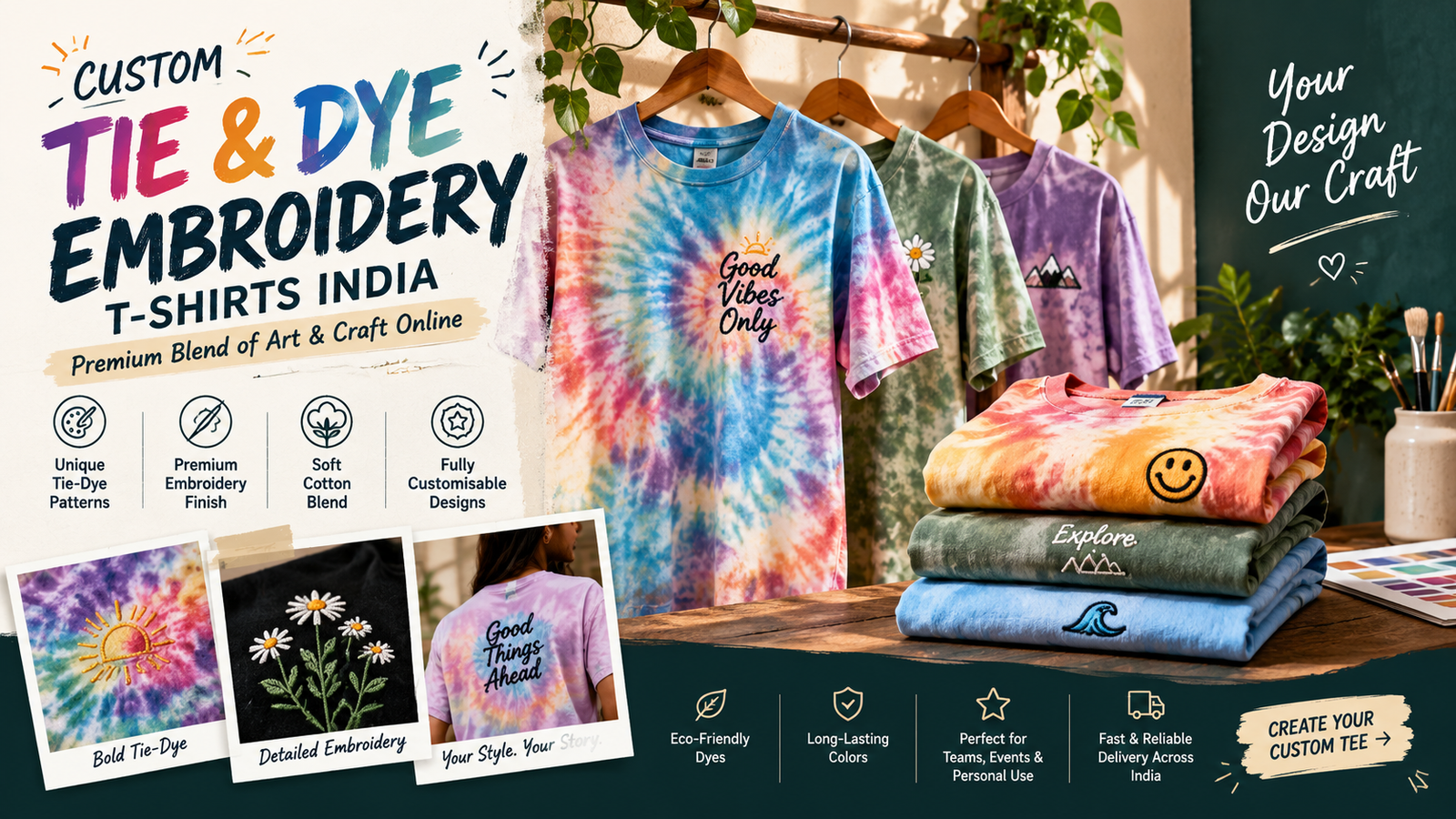
Fashion becomes more interesting when creativity meets craftsmanship. Tie-dye brings colour, texture, and artistic patterns to clothing, while embroidery adds a tactile detail that can make a simple T-shirt feel more personal and distinctive.
That’s what makes custom tie dye embroidery T-shirts in India an appealing option for people who want something beyond ordinary printed apparel. Whether you prefer colourful patterns, subtle embroidered logos, oversized streetwear, or personalised designs, combining these two techniques creates plenty of opportunities for self-expression.
From independent clothing brands to fashion enthusiasts and personalised-gifting businesses, custom tie-dye and embroidered T-shirts can suit a wide range of styles and occasions.
In this guide, we’ll explore how to choose a premium tie-dye T-shirt, select the right embroidery design, understand fabric options, and create a personalised garment that balances visual appeal with everyday comfort.
What Are Custom Tie-Dye Embroidery T-Shirts?
Custom tie-dye embroidery T-shirts combine two different decorative techniques.
Tie-dye creates distinctive colour patterns through the application of dyes to fabric. Depending on the process, the result may feature spirals, irregular colour transitions, abstract shapes, or softer tonal effects.
Embroidery uses stitches to create lettering, logos, symbols, illustrations, or decorative details directly on the garment.
Together, these techniques create a combination of colourful fabric and textured artwork.
For example, a washed-blue tie-dye T-shirt with a small embroidered white flower can offer a subtle artistic appearance. A black-and-grey tie-dye oversized T-shirt with embroidered lettering can create a more contemporary streetwear look.
The design possibilities depend on the fabric, dye treatment, embroidery complexity, and placement.
Why Choose Custom Tie-Dye and Embroidery T-Shirts?
1. Every Pattern Has Its Own Character
Tie-dye creates visual variation that makes each garment feel distinctive. Depending on the production process, individual pieces may differ slightly in colour distribution and pattern.
2. Embroidery Adds Texture
Unlike a flat printed graphic, embroidery creates a raised, stitched finish that can add depth to a design.
3. Personalisation Makes the T-Shirt More Meaningful
You can add initials, names, logos, symbols, or short phrases to create apparel that reflects your personality or brand.
4. Suitable for Modern Streetwear
Tie-dye and embroidery work well with relaxed silhouettes, oversized fits, cargo trousers, denim, and casual footwear.
5. Useful for Clothing Brands
Independent labels can combine signature dye patterns with consistent embroidery details to develop a recognisable collection.
Popular Custom Tie-Dye Embroidery T-Shirt Designs
The most effective designs balance the garment’s pattern with the embroidered detail.
Minimal Chest Embroidery
A small embroidered logo, flower, initial, or symbol on the left chest works particularly well on tie-dye garments with busy patterns.
Oversized Tie-Dye Streetwear
Pair an oversized T-shirt with a subtle embroidered word or emblem for a relaxed streetwear aesthetic.
Nature-Inspired Embroidery
Leaves, flowers, mountains, waves, and other original nature-inspired motifs can complement earthy or pastel tie-dye colours.
Personalised Name Embroidery
Add a name or initials to create a more individual design. This option can work for gifts, group apparel, and personal fashion.
Abstract Embroidery
Geometric shapes, line art, and small abstract symbols can create an artistic look without overwhelming the tie-dye pattern.
Premium Logo Embroidery
Clothing brands can combine a signature tie-dye colour palette with a consistently positioned embroidered logo.
Front Embroidery and Back Artwork
Use small embroidery on the front and a larger graphic on the back. This combination can work well for streetwear collections, although the back graphic may require a separate printing technique.
Best Tie-Dye Colour Combinations for Embroidered T-Shirts
Colour selection can influence how visible and attractive the embroidery appears.
Black and Grey
A monochrome combination creates a subdued, versatile look. White, silver, or muted embroidery can provide contrast.
Blue and White
Blue tie-dye pairs well with white, navy, or carefully chosen neutral embroidery.
Purple and Pink
These colours can create a playful, expressive appearance, particularly when paired with minimal white or dark embroidery.
Earthy Brown and Beige
Earthy tones work well with nature-inspired artwork, cream lettering, and minimalist designs.
Green and Black
This combination can suit contemporary streetwear and outdoor-inspired apparel.
Pastel Multicolour
Soft shades of pink, lavender, mint, and blue can work with small embroidered flowers, initials, or delicate symbols.
Before finalising your design, check the embroidery thread against an actual fabric sample. Thread colours can appear different depending on the surrounding dye pattern and lighting.
Which Fabric Is Best for Tie-Dye Embroidery T-Shirts?
Fabric selection affects comfort, dye absorption, garment structure, and the final embroidery result.
Cotton
Cotton is widely used for T-shirts and can be suitable for many tie-dye and embroidery applications. Its suitability depends on the fabric construction, dye process, and garment quality.
Cotton Jersey
Cotton jersey is a common T-shirt fabric with a soft, flexible structure. Because it stretches, embroidery may require suitable stabilisation to prevent puckering.
Cotton Blends
Blended fabrics can provide different combinations of softness, stretch, durability, and drying characteristics. However, not every blend responds equally to every dyeing process.
Heavyweight Cotton
Heavier cotton T-shirts can provide a structured silhouette for oversized streetwear. The fabric should also be stable enough to support the intended embroidery.
Pro tip: Before ordering in bulk, test the exact garment with the planned dyeing and embroidery techniques. A sample helps reveal shrinkage, colour variation, puckering, and other production issues.
How to Choose the Right GSM
GSM stands for grams per square metre and indicates fabric weight.
| Fabric weight | Typical characteristics |
|---|---|
| 160 GSM | Lightweight and suitable for many casual T-shirts |
| 180 GSM | Versatile for everyday wear |
| 200–220 GSM | More substantial feel with a potentially structured drape |
| 240 GSM and above | Heavyweight feel often associated with oversized streetwear |
These are general guidelines, not quality grades. Construction, yarn quality, fabric composition, and finishing also affect how a T-shirt feels and performs.
For hot Indian weather, a lighter fabric may be more comfortable. For a structured premium streetwear look, a heavier garment may be preferable.
Embroidery vs Printing: Which Is Better?
Embroidery and printing serve different purposes, so the right option depends on your artwork.
Embroidery
Embroidery is particularly suitable for:
- Small brand logos
- Initials and names
- Simple lettering
- Small symbols
- Minimal chest designs
- Textured decorative details
It can create a distinctive tactile finish, but very small lettering and intricate artwork may require simplification.
Printing
Printing is often more suitable for:
- Large graphics
- Detailed illustrations
- Photographic artwork
- Complex multicolour designs
- Large back graphics
Combining Both Techniques
One effective approach is to use tie-dye as the fabric treatment, embroidery for a small front detail, and printing for a larger back design.
This approach combines colour, texture, and graphic detail without forcing one technique to do everything.
Best Embroidery Placements for Tie-Dye T-Shirts
Left Chest
A classic location for logos, initials, and small symbols.
Centre Chest
Suitable for short words or compact motifs.
Sleeve
Useful for small decorative details or secondary brand marks.
Upper Back
Works well for a small logo positioned below the neckline.
Lower Hem
A subtle location for a small emblem or initials, depending on the garment construction.
Front and Sleeve Combination
A small chest design paired with sleeve embroidery can create a coordinated, brand-focused appearance.
Avoid placing embroidery directly over seams or areas where the fabric cannot lie flat during production.
Custom Tie-Dye Embroidery T-Shirts for Clothing Brands
For clothing brands, combining tie-dye and embroidery can help create a distinctive product identity.
A collection might feature:
- Signature tie-dye colourways
- Consistent embroidered logos
- Original nature-inspired motifs
- Oversized cotton T-shirts
- Minimalist chest embroidery
- Limited-edition colour combinations
- Personalised streetwear designs
The goal is to maintain a recognisable design language across different garments.
For example, a brand could use three different tie-dye colourways while keeping the same embroidered logo position and thread colour. This creates variety without losing visual consistency.
Before production, confirm minimum order quantities, fabric specifications, dyeing consistency, embroidery digitisation, sample approval, and delivery timelines with the manufacturer.
Personalised Tie-Dye Embroidery T-Shirts for Gifting
Custom embroidered T-shirts can also make thoughtful gifts because the details can be selected for a particular person.
Consider these ideas:
- Initials embroidered on a tie-dye T-shirt
- A small floral motif in a favourite colour
- Matching T-shirts for friends
- Personalised couple T-shirts
- Custom designs for birthdays
- Group T-shirts for trips
- Special-edition family apparel
- Personalised merchandise for celebrations
For a gift, the design doesn’t need to be complicated. A well-chosen colour combination and a small embroidered detail can create a personal result.
Custom Tie-Dye Embroidery T-Shirts for Businesses and Events
These T-shirts can also be used for creative merchandise and team apparel.
Potential applications include:
- Clothing brand launches
- College festivals
- Creative workshops
- Music and cultural events
- Team merchandise
- Boutique promotional apparel
- Community groups
- Personalised corporate gifts
For business orders, consider a tie-dye colour scheme that complements the brand identity. Keep embroidery simple enough to reproduce consistently across the required size range.
How to Order Custom Tie-Dye Embroidery T-Shirts Online in India
Step 1: Select Your Design Style
Choose a tie-dye pattern, colour palette, embroidery motif, and garment fit.
Step 2: Choose the Fabric
Confirm the composition, GSM, garment construction, and intended use.
Step 3: Prepare the Embroidery Artwork
Simple, clear artwork generally translates more reliably into embroidery than very fine details or complex gradients.
Step 4: Confirm Thread Colours
Select thread colours that remain visible against the garment’s tie-dye pattern.
Step 5: Approve a Sample
Inspect the actual garment for colour consistency, embroidery placement, stitching quality, and overall fit.
Step 6: Confirm Production Details
Discuss quantities, sizes, pricing, packaging, production time, and shipping before placing the order.
Step 7: Follow Care Instructions
Follow the manufacturer’s washing instructions. Turning the garment inside out and using a gentle wash cycle may help protect the fabric and embroidery, depending on the care label.
How to Maintain Tie-Dye and Embroidered T-Shirts
Proper care can help preserve the appearance of the garment.
- Follow the care label.
- Wash with similar colours when recommended.
- Avoid unnecessarily harsh washing conditions.
- Turn the garment inside out when appropriate.
- Avoid ironing directly over embroidered details.
- Store the garment in a clean, dry place.
- Check any special instructions supplied for the dyeing process.
Because tie-dye techniques vary, there is no single washing instruction that applies to every garment. Follow the supplier’s guidance for the specific fabric and dye treatment.
Common Mistakes to Avoid
Choosing Overly Complicated Embroidery
Tiny details may not translate well into stitching. Simplify artwork when necessary.
Ignoring Fabric Stretch
Stretchy jersey can pucker during embroidery without appropriate stabilisation.
Using Low-Contrast Thread
An embroidered logo may disappear against a busy tie-dye pattern if the colours are too similar.
Skipping Sample Approval
A digital mock-up cannot fully show fabric texture, dye variation, or embroidery quality.
Choosing GSM Without Considering Comfort
Heavier fabric is not automatically better. Select a weight that suits the climate, fit, and intended use.
Overloading the Design
Tie-dye already creates visual interest. A small embroidered motif may look more balanced than multiple large decorative elements.
Frequently Asked Questions
What is a custom tie-dye embroidery T-shirt?
It is a T-shirt that combines a tie-dye fabric pattern with embroidered details such as logos, names, lettering, or decorative motifs.
Can I customise tie-dye T-shirts with my own logo?
Yes. Many custom apparel suppliers can embroider logos on suitable garments. Confirm artwork requirements, embroidery placement, and minimum order quantities with the supplier.
Is embroidery suitable for tie-dye fabric?
It can be, provided the fabric and garment construction support the embroidery process. Stretchy fabrics may require suitable stabilisation to minimise puckering.
Which fabric is best for premium tie-dye embroidery T-shirts?
Cotton is a common choice, but the best fabric depends on the desired feel, dyeing process, garment construction, and embroidery design.
Are oversized tie-dye embroidered T-shirts suitable for streetwear?
Yes. Oversized fits, distinctive colour patterns, and small embroidered logos can work well together in streetwear-inspired designs.
Can I order custom tie-dye embroidered T-shirts in bulk in India?
Availability varies by supplier. Request information about minimum quantities, sample approval, dyeing consistency, embroidery quality, and delivery timelines.
Is embroidery better than printing for custom T-shirts?
Neither is universally better. Embroidery works well for smaller textured details, while printing is often more practical for large, detailed, multicolour artwork.
How do I care for embroidered tie-dye T-shirts?
Follow the garment’s care label and any supplier instructions for the dye treatment. Gentle washing and avoiding direct ironing over embroidery may help preserve the finished design.
Conclusion
Custom tie-dye embroidery T-shirts bring together the artistic character of dyed fabric and the tactile appeal of stitched details. From minimalist embroidered logos to oversized streetwear designs, this combination offers plenty of room for personal expression and creative branding.
If you’re exploring custom tie dye embroidery T-shirts in India for a premium look, focus on fabric quality, thoughtful colour selection, appropriate embroidery placement, and reliable sample testing.
For personal wear, gifts, or a clothing brand, the best design is one in which the pattern and stitching complement each other rather than compete for attention.
A distinctive tie-dye finish paired with well-executed embroidery can transform a simple T-shirt into a memorable piece of wearable art.
Leave a Reply