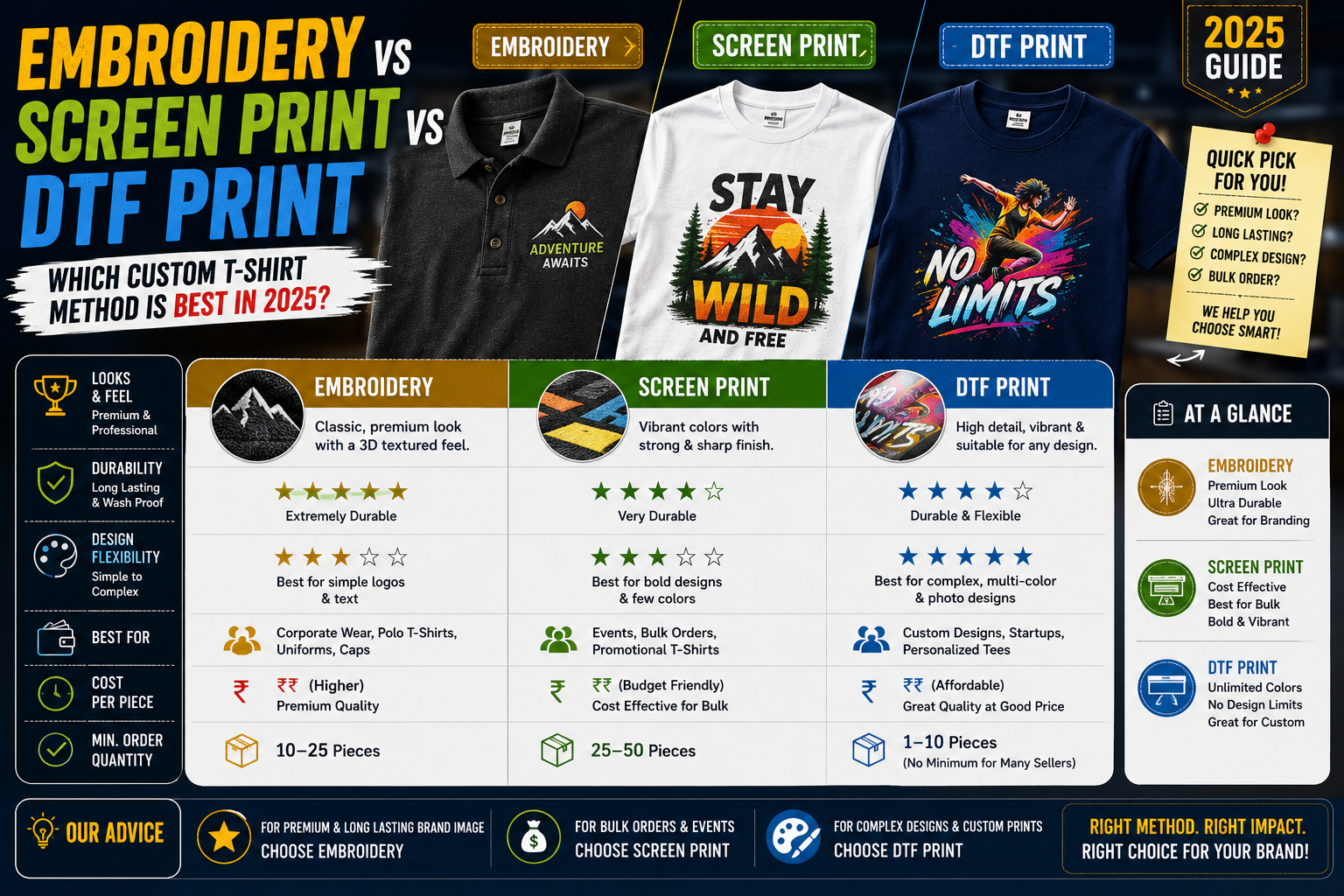
Choosing the right customization method can make a huge difference to the final look, comfort, durability, and cost of a custom t-shirt.
Whether you’re creating company uniforms, college event shirts, sportswear, merchandise, promotional clothing, or personalised gifts, three popular options often come up: embroidery, screen printing, and DTF printing.
But which one should you choose?
The answer isn’t simply that one method is better than the others. Each technique has different strengths. Embroidery can create a premium, professional appearance, screen printing is highly effective for larger bulk orders, and DTF is versatile for detailed, colourful artwork.
If you’re comparing embroidery vs screen print vs DTF t-shirt options, this guide breaks down the differences in cost, durability, design flexibility, fabric compatibility, appearance, and ideal use cases.
Quick Comparison: Embroidery vs Screen Print vs DTF
| Feature | Embroidery | Screen Print | DTF |
|---|---|---|---|
| Best For | Logos & premium branding | Bulk graphic designs | Detailed colourful artwork |
| Durability | Excellent | Very Good | Very Good |
| Small Orders | Good | Less economical | Excellent |
| Large Orders | Excellent | Excellent | Good |
| Photo Designs | Not ideal | Limited | Excellent |
| Small Text | Good with proper digitization | Can be challenging | Very Good |
| Multiple Colours | Possible | More setup | Excellent |
| Corporate Logos | Excellent | Good | Excellent |
| Sportswear | Good | Good | Excellent depending on fabric |
| Texture | Raised/stitch effect | Flat | Slight surface feel |
The right option depends on your design and intended use.
1. Embroidery
Embroidery uses thread stitched directly into the garment.
It’s one of the most popular choices for professional corporate apparel.
Why Choose Embroidery?
Embroidery creates a textured, premium appearance that works especially well for:
- Company logos
- Brand marks
- Employee names
- Initials
- Polo shirts
- Caps
- Jackets
For businesses looking for custom embroidered t-shirts India, embroidery is often the first option to consider.
Advantages
- Premium appearance
- Excellent durability
- Professional look
- Good for repeated washing
- Ideal for small logos
- Suitable for corporate uniforms
Limitations
Embroidery isn’t ideal for every type of artwork.
Very detailed photographs, gradients, and extremely small elements can be difficult to reproduce accurately using thread.
The final result also depends heavily on digitization quality and stitch density.
2. Screen Printing
Screen printing is a traditional printing method that pushes ink through a prepared screen onto the garment.
It’s particularly popular for larger orders.
Why Choose Screen Printing?
Screen printing works well for:
- Event t-shirts
- College merchandise
- Promotional campaigns
- Brand merchandise
- Simple illustrations
- Large graphics
If you’re ordering hundreds or thousands of similar shirts, screen printing can be highly cost-effective.
Advantages
- Excellent for bulk production
- Strong colour output
- Good durability when properly produced
- Suitable for bold designs
- Cost-effective at larger quantities
Limitations
Screen printing generally requires setup for each colour and design.
This means it may not be the most economical option for:
- One-off orders
- Very small quantities
- Complex photographic artwork
- Designs requiring many colours
For businesses researching bulk t-shirt printing India, screen printing remains an important option.
3. DTF Printing
DTF stands for Direct-to-Film printing.
The artwork is printed onto a special transfer film and then transferred onto the garment using heat and pressure.
DTF has become popular because it can reproduce detailed, colourful designs without the same type of screen setup required for traditional screen printing.
Why Choose DTF?
DTF works well for:
- Full-colour graphics
- Detailed illustrations
- Logos
- Names
- Small orders
- Custom gifts
- Merchandise
It’s particularly useful when every shirt needs a different name or design.
Advantages
- Excellent colour detail
- Suitable for complex artwork
- Works well for small orders
- No traditional screen setup
- Useful for personalised designs
- Can work across various garment types when properly produced
Limitations
The printed area can have a different feel from the surrounding fabric.
Large solid transfers may also feel less breathable than an unprinted section of the garment.
Quality varies significantly depending on the film, inks, powder, transfer settings, and production process.
Embroidery vs Screen Print vs DTF: Durability
Durability depends on the quality of production and garment care.
Embroidery
Generally highly durable because the design consists of stitched thread.
It’s particularly suitable for uniforms that need frequent washing.
Screen Printing
High-quality screen printing can last through many washes when properly cured and cared for.
DTF
Good-quality DTF transfers can also provide strong wash durability when correctly applied.
However, washing instructions still matter.
For all three methods, garment quality and production quality are just as important as the customization method itself.
Which Method Looks Most Premium?
If your priority is a sophisticated corporate appearance, embroidery is usually the strongest choice.
A small embroidered logo on a polo shirt can create a clean and professional uniform.
For fashion and streetwear, the choice is broader.
A large screen-printed graphic or detailed DTF design can create a stronger visual statement.
Which Method Is Best for Logos?
Small Corporate Logo
Embroidery
Best when you want a premium, professional appearance.
Detailed Multicolour Logo
DTF
Useful when the logo contains gradients, fine details, or many colours.
Large Simple Logo
Screen Printing
A good option for bulk orders with a bold design.
Which Method Is Best for Photos?
For photographs, DTF is generally the most suitable of these three options.
Embroidery cannot reproduce photographic detail efficiently, while screen printing can reproduce images but may require more complex colour separation and setup.
DTF allows detailed colour reproduction and is particularly useful for personalised photo t-shirts.
Which Method Is Best for Bulk Orders?
For large quantities of the same design:
Screen Printing
Often the strongest choice for cost efficiency.
Embroidery
Excellent for bulk corporate uniforms and logo apparel.
DTF
Useful when designs vary between garments or when order quantities are smaller.
For bulk custom t-shirts India, always request a quotation based on the actual quantity, artwork, number of print locations, and garment type.
Which Method Is Best for Small Orders?
DTF and embroidery can be practical for small quantities.
Screen printing may be less economical when setup costs are spread over only a few garments.
For a single personalised t-shirt, DTF is often more flexible for complex artwork.
Fabric Compatibility
The garment fabric should also influence your choice.
Cotton
Works well with:
- Embroidery
- Screen printing
- DTF
Cotton remains one of the most popular choices for custom cotton t-shirts India.
Polyester
Works well with:
- DTF with suitable materials/process
- Screen printing with appropriate inks
- Embroidery
Polyester is particularly common in sportswear.
Blended Fabrics
Many blends can accommodate different customization methods, but always confirm compatibility with the supplier.
Cost Comparison
There isn’t one fixed price for embroidery, screen printing, or DTF.
Pricing can depend on:
- T-shirt quality
- GSM
- Quantity
- Design size
- Number of colours
- Embroidery stitch count
- Number of print locations
- Personalization
- Packaging
- Delivery
Generally:
Small order + detailed design → DTF can be practical
Large order + simple graphic → Screen printing can be economical
Small logo + premium corporate apparel → Embroidery can offer strong value
Don’t choose purely based on the cheapest quote. Consider the garment, intended use, appearance, and expected lifespan.
Embroidery vs Screen Print vs DTF for Corporate Uniforms
For corporate clothing, appearance and durability are usually more important than extremely low production cost.
Best Choice: Embroidery
Ideal for:
- Company logos
- Polo uniforms
- Employee names
- Hospitality staff
- Sales teams
- Office teams
A logo embroidery polo t-shirt can provide a polished corporate appearance.
Alternative: DTF
Useful when the corporate design includes:
- Detailed graphics
- Multiple colours
- Larger artwork
- Individual employee personalization
Embroidery vs Screen Print vs DTF for Events
For events, consider the quantity and design.
Small Event
DTF can work well for personalised shirts.
Large Event
Screen printing may provide better production efficiency for a consistent design.
Premium Event
Embroidery can create a more upscale appearance, particularly on polos.
Embroidery vs Screen Print vs DTF for Startups
Startups often need apparel that serves both branding and employee use.
For a small chest logo:
Choose embroidery.
For a large creative graphic:
Choose DTF or screen printing.
For hundreds of identical promotional shirts:
Consider screen printing.
A combination can also work—for example, an embroidered company logo on the front and a printed campaign graphic on the back.
What About Comfort?
Customization can influence how the garment feels.
Embroidery
Adds stitched texture but usually affects only the embroidered area.
Screen Printing
Can feel relatively smooth depending on the ink and printing technique.
DTF
The transfer can create a noticeable surface layer, especially for large designs.
For large artwork, consider both appearance and how much printed area you want against the skin.
How to Choose the Right Method
Use this simple decision guide:
Choose Embroidery If:
- You want a premium logo
- You’re creating corporate uniforms
- The design is relatively simple
- Durability is a priority
- You’re customizing polos or caps
Choose Screen Printing If:
- You’re ordering in bulk
- Your artwork is bold and simple
- You want strong colours
- You’re producing event merchandise
Choose DTF If:
- Your artwork is detailed
- You need many colours
- You’re ordering smaller quantities
- You want personalised designs
- You’re printing photographs
Can You Combine Different Methods?
Absolutely.
Using two methods can sometimes produce a better result.
For example:
Front: Embroidered company logo
Back: Screen-printed company campaign
Or:
Front: Small embroidered logo
Back: Detailed DTF artwork
This approach allows each technique to be used where it performs best.
5 Mistakes to Avoid
1. Choosing Based Only on Price
The cheapest method may not deliver the appearance or durability you need.
2. Ignoring the Artwork
A method suitable for a simple logo may not work equally well for a photograph.
3. Forgetting Fabric Compatibility
Always confirm that your chosen technique works with the garment fabric.
4. Using Poor-Quality Artwork
Low-resolution files can produce disappointing results.
5. Skipping a Sample for Bulk Orders
Always approve a sample when the order is large or the branding is important.
Frequently Asked Questions
Is embroidery better than DTF?
Neither is universally better. Embroidery is excellent for small logos and premium branding, while DTF is more versatile for detailed, colourful artwork.
Is screen printing cheaper than DTF?
For large quantities of the same design, screen printing can be more cost-effective because setup costs are distributed across many garments. For small or highly personalised orders, DTF can be more practical.
Which lasts longer: embroidery or printing?
High-quality embroidery is generally very durable. However, properly produced screen printing and DTF can also last through many washes when the garment is cared for correctly.
Which method is best for cotton t-shirts?
Cotton works well with all three methods. The best choice depends on the design, quantity, and desired appearance.
Which method is best for a company logo?
For a small, professional company logo, embroidery is often the preferred choice. DTF or screen printing can be better when the logo is large, highly detailed, or contains many colours.
Which printing method is best for one t-shirt?
DTF is often a practical choice for a single detailed custom t-shirt because it supports complex artwork without traditional screen setup.
Final Verdict
When comparing embroidery vs screen print vs DTF t-shirt customization, there isn’t one winner for every project.
Choose embroidery when your priority is a premium, professional, durable logo—especially for corporate uniforms and polo shirts.
Choose screen printing when you’re ordering a large number of shirts with the same bold design and want efficient bulk production.
Choose DTF when you need detailed, colourful artwork, photographs, personalization, or smaller quantities.
For many businesses, the smartest solution isn’t choosing just one method. Combining techniques—for example, an embroidered chest logo with a printed back design—can give you the best balance of branding, appearance, and flexibility.
Before ordering, compare the garment fabric, GSM, design complexity, quantity, customization method, and total per-piece cost. Most importantly, request a sample for large orders so you can check the actual print or embroidery quality before production.
Leave a Reply