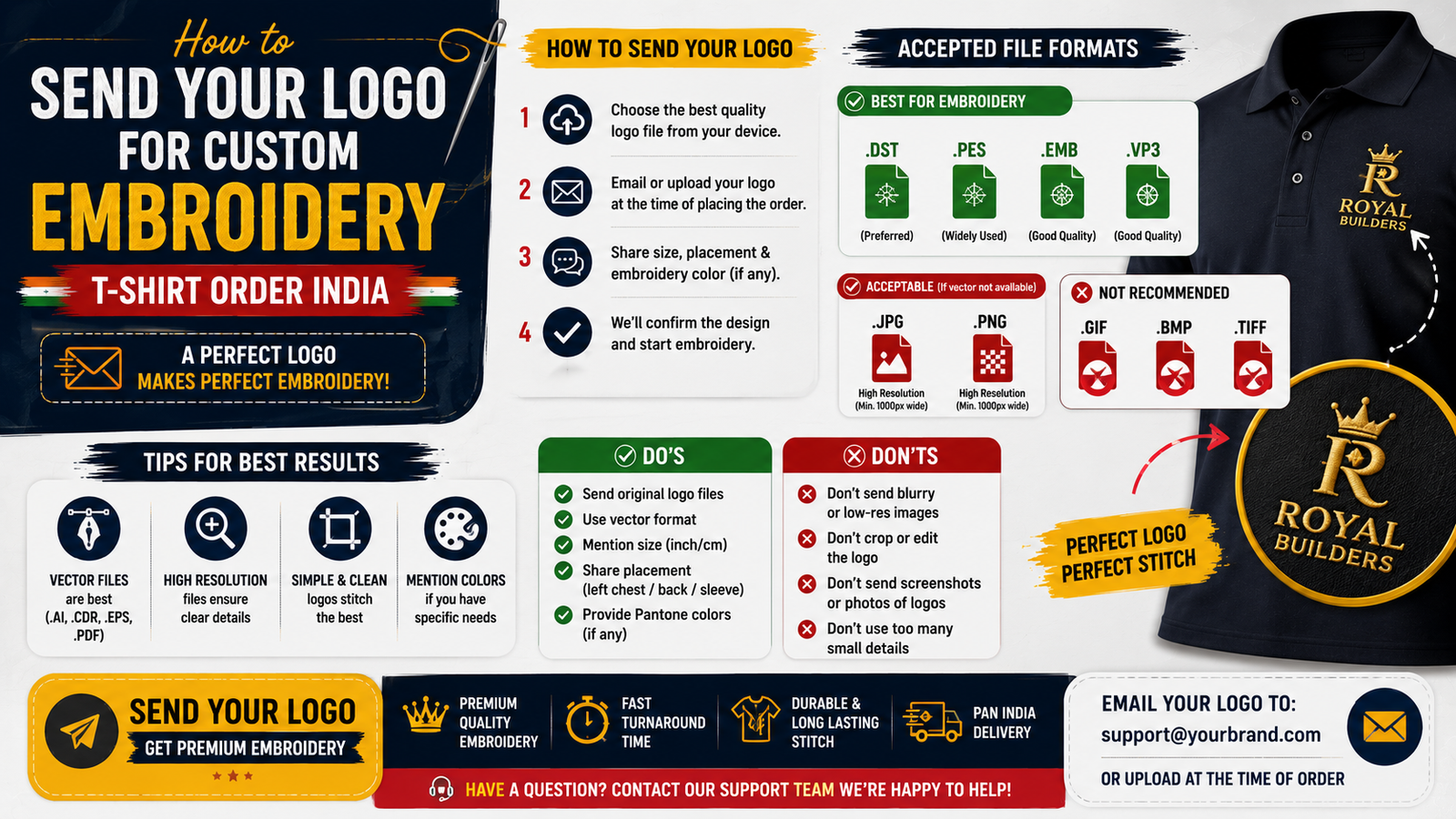
Ordering custom embroidered t-shirts for your business, startup, event, or brand is an excellent way to create a professional and premium appearance. However, many embroidery projects experience delays, additional charges, or poor-quality results because customers submit logos in the wrong format.
A logo that looks perfect on a website or social media page may not be suitable for embroidery without proper preparation. Understanding how to send your artwork correctly can save time, reduce costs, and ensure your embroidered t-shirts look exactly as expected.
If you’re searching for how to send logo embroidery tshirt India, this complete guide explains everything you need to know about logo file formats, artwork requirements, embroidery digitization, common mistakes, and best practices for custom embroidery orders in 2025.
Why Logo File Format Matters for Embroidery
Embroidery is very different from printing.
Printing reproduces artwork using ink, while embroidery recreates your logo using thousands of stitches.
Before production begins, your logo must be converted into an embroidery machine file through a process called digitization.
Submitting the correct artwork helps:
- Improve embroidery quality
- Reduce production delays
- Minimize digitization costs
- Ensure accurate logo reproduction
- Speed up order approval
Many suppliers offering <mark>custom embroidered t-shirts India</mark> request specific file formats before processing an order.
What Is Embroidery Digitization?
Embroidery machines cannot directly read standard image files.
A digitizer converts your logo into a stitch pattern that tells the machine:
- Stitch direction
- Stitch density
- Thread colors
- Stitch sequence
- Needle movements
This process is known as digitization.
Even the best logo requires digitization before embroidery can begin.
Most <mark>logo embroidery services India</mark> include digitization as part of the setup process.
Best File Formats for Embroidery Logos
Some file types work much better than others.
Vector Files (Recommended)
AI (Adobe Illustrator)
The preferred format for embroidery artwork.
Benefits:
- Scalable without quality loss
- Clean design elements
- Easy digitization
EPS
Another excellent vector format.
Advantages:
- Professional quality
- Compatible with most design software
SVG
Popular for modern logo design.
Benefits:
- Editable
- High-quality scaling
Many embroidery providers prefer <mark>vector logo files for embroidery</mark> because they produce the most accurate results.
High-Resolution Image Files
If vector files are unavailable, high-resolution image files can often be used.
PNG
Recommended when:
- Background is transparent
- Resolution is high
Minimum recommendation:
- 1000 pixels wide or larger
JPG/JPEG
Acceptable if:
- High resolution
- Clear logo visibility
However, JPG files may require additional editing before digitization.
Many businesses placing <mark>custom logo embroidery orders India</mark> submit PNG files successfully.
Embroidery Machine File Formats
After digitization, embroidery machines use specialized formats.
Common formats include:
- DST
- EMB
- PES
- JEF
- EXP
Customers generally do not need to create these files themselves.
The embroidery provider typically generates them after digitization.
Best Logo Specifications for Embroidery
Not every logo translates perfectly into embroidery.
Ideal Characteristics
- Simple design
- Bold lines
- Clear shapes
- Limited detail
Embroidery works best when logos remain easy to read at small sizes.
Many <mark>corporate embroidery t-shirt India</mark> projects use simplified logo versions specifically for embroidery.
Recommended Logo Size for T-Shirts
The most common embroidery placement is the left chest area.
Standard Left-Chest Logo
Size:
- 3 to 4 inches wide
Benefits:
- Professional appearance
- Affordable stitch count
- Excellent readability
Sleeve Logo
Size:
- 2 to 3 inches wide
Back Neck Logo
Size:
- 2 to 3 inches wide
Large Front Embroidery
Size:
- 5 to 8 inches wide
Larger logos generally increase embroidery costs.
How to Prepare Your Logo Before Sending
Step 1: Use Original Artwork
Always submit the highest-quality version available.
Avoid:
- Screenshots
- Social media profile images
- Low-resolution files
Step 2: Convert Text to Outlines
For vector artwork:
- Convert fonts to outlines
- Embed all design elements
This prevents font compatibility issues.
Step 3: Remove Unnecessary Backgrounds
Transparent backgrounds help digitizers work more efficiently.
PNG files are ideal for this purpose.
Step 4: Specify Brand Colors
Provide:
- Pantone colors
- Hex codes
- RGB values
Accurate color references improve thread matching.
Many <mark>custom embroidery companies India</mark> request color information during order submission.
Information You Should Send Along With Your Logo
Providing additional details helps avoid misunderstandings.
Include:
- Logo file
- Desired logo size
- Placement location
- T-shirt color
- Thread color preferences
- Quantity required
- Fabric type
The more information provided upfront, the faster production can begin.
Common Logo Design Problems in Embroidery
Extremely Small Text
Tiny text may become unreadable when stitched.
Solution
Increase text size or simplify wording.
Thin Lines
Very fine lines often disappear during embroidery.
Solution
Use thicker design elements.
Complex Gradients
Embroidery cannot reproduce gradients the way printing can.
Solution
Use solid colors instead.
Excessive Detail
Intricate illustrations may lose clarity.
Solution
Create an embroidery-friendly logo version.
These adjustments are common for <mark>embroidered company logo t-shirts</mark>.
Should You Send a Vector File or PNG?
Best Option
Vector File (AI, EPS, SVG)
Benefits:
- Faster digitization
- Better quality
- More accurate scaling
Second Best Option
High-resolution PNG
Benefits:
- Easy to provide
- Good quality when resolution is high
Avoid
- Screenshots
- Low-resolution JPGs
- Compressed social media images
How Embroidery Digitization Affects Pricing
Digitization is typically a one-time setup charge.
Typical Costs in India
| Logo Complexity | Digitization Cost |
|---|---|
| Simple Logo | ₹300–₹800 |
| Medium Logo | ₹800–₹1,500 |
| Complex Logo | ₹1,500–₹3,000+ |
Many suppliers waive digitization fees on large bulk orders.
Businesses ordering <mark>bulk embroidered t-shirts India</mark> often benefit from this.
Questions to Ask Before Approving Production
Before embroidery begins, request:
Digital Mockup
Shows logo placement.
Stitch Preview
Displays embroidery appearance.
Sample Photo
Confirms actual stitching quality.
Reviewing these materials can prevent costly mistakes.
Best Practices for Startup and Corporate Logos
For startups and corporate branding:
Recommended Approach
- Use simplified logos
- Limit small details
- Keep text readable
- Choose 220 GSM fabric for premium results
Many brands creating <mark>startup merchandise t-shirts India</mark> maintain separate logo versions specifically for embroidery.
Quick Checklist Before Sending Your Logo
✅ AI, EPS, SVG, or high-resolution PNG file
✅ Transparent background
✅ Brand color references
✅ Logo placement details
✅ Required logo size
✅ Quantity information
✅ Fabric preference
✅ Contact information
Following this checklist can significantly speed up production.
Final Verdict: How to Send Logo Embroidery TShirt India
Understanding how to send logo embroidery tshirt India orders correctly is one of the easiest ways to ensure professional embroidery results. The best approach is to provide a vector file (AI, EPS, or SVG), clear color references, desired placement details, and accurate sizing information.
If a vector file isn’t available, a high-resolution PNG with a transparent background is usually the next best option. Avoid low-quality screenshots, compressed images, and overly detailed designs that may not translate well into embroidery.
By preparing your logo properly and working closely with your embroidery provider, you can reduce production delays, avoid unnecessary digitization issues, and ensure your custom embroidered t-shirts look premium, durable, and true to your brand identity.
For businesses, startups, and D2C brands in 2025, submitting the right artwork from the beginning is one of the most important steps toward achieving high-quality embroidered apparel that makes a lasting impression.
Leave a Reply