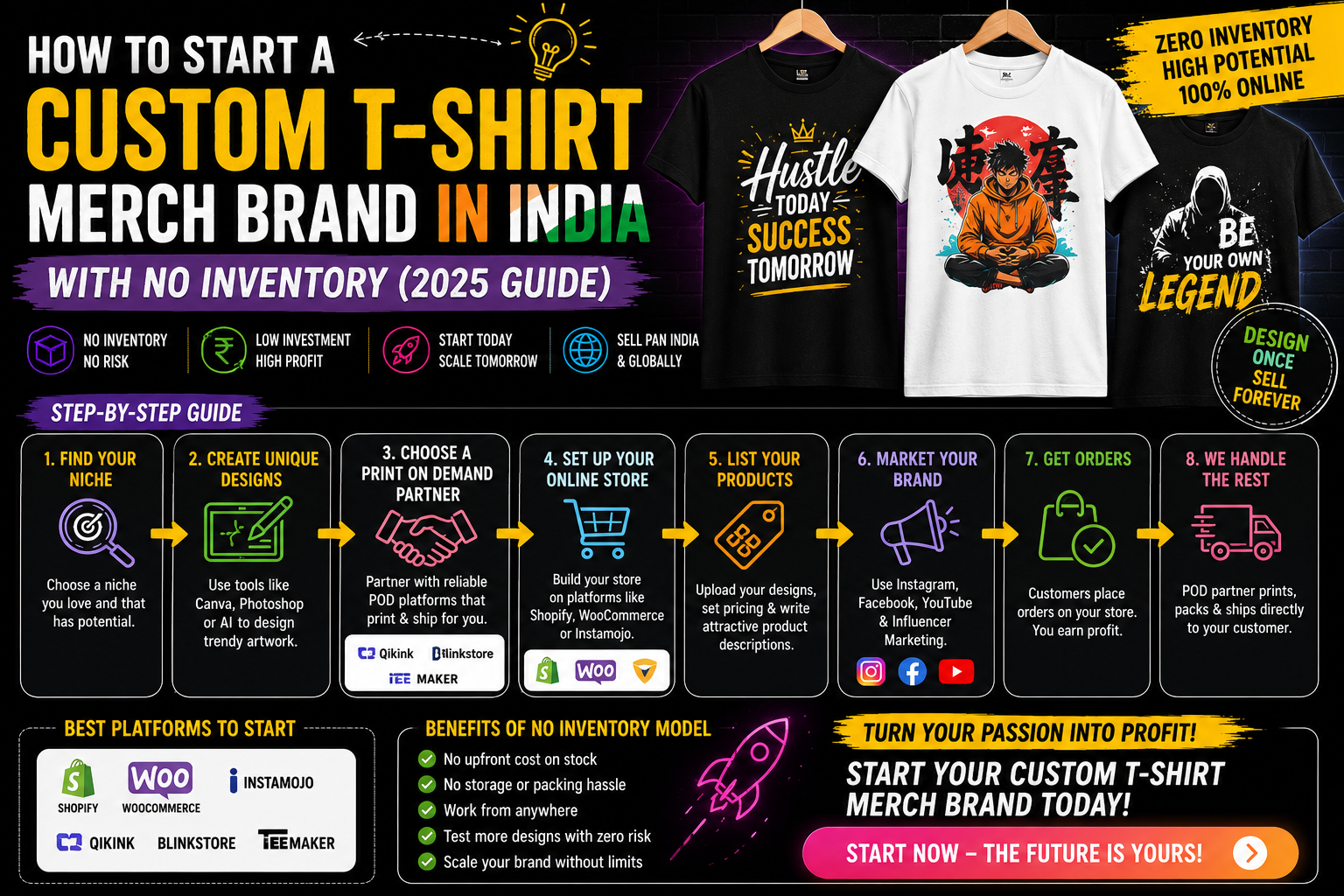
The Indian creator economy is growing faster than ever. From YouTubers and Instagram creators to startups, artists, colleges, gaming communities, and D2C entrepreneurs, everyone is launching branded merchandise. The best part? You no longer need to invest lakhs of rupees in inventory to start your own t-shirt brand.
Thanks to Print-on-Demand (POD) and reliable custom apparel manufacturers, anyone can build a profitable clothing business with minimal investment. Instead of buying hundreds of t-shirts upfront, you can produce each order only after a customer makes a purchase.
If you’re searching for start custom tshirt merch brand India, this detailed guide will walk you through every step—from choosing your niche and creating designs to finding suppliers, pricing your products, marketing your brand, and scaling your business without holding inventory.
Why Start a No-Inventory T-Shirt Brand?
Traditional clothing businesses require:
- Large upfront inventory
- Warehouse space
- Inventory management
- Higher financial risk
A no-inventory model allows you to:
- Launch with minimal investment
- Test multiple designs
- Sell nationwide
- Reduce financial risk
- Scale as orders grow
Many entrepreneurs entering the <mark>custom t-shirt business India</mark> now choose Print-on-Demand because of its flexibility.
What Is a Print-on-Demand (POD) Business?
Print-on-Demand is a business model where products are printed only after an order is placed.
How It Works
- Customer places an order.
- The order is sent to your printing partner.
- The t-shirt is printed or embroidered.
- The supplier ships it directly to your customer.
- You earn the profit margin.
You don’t need to stock inventory or manage packaging in most cases.
Benefits of Starting Without Inventory
Launching a no-inventory brand offers several advantages:
- Low startup costs
- No unsold stock
- Easy product testing
- Faster business launch
- Flexible design updates
- Nationwide shipping
This model is especially suitable for <mark>startup merchandise India</mark> and creator brands.
Step 1: Choose a Profitable Niche
Instead of selling generic t-shirts, focus on a specific audience.
Popular niches include:
- Fitness
- Gaming
- Anime
- Travel
- Startups
- Entrepreneurs
- Pet lovers
- Coding
- College students
- Coffee enthusiasts
- Motorcycling
- Motivational quotes
- Regional language designs
A niche helps your brand stand out in a competitive market.
Step 2: Build Your Brand Identity
A memorable brand is more than just a logo.
Define:
- Brand name
- Logo
- Color palette
- Typography
- Brand voice
- Target audience
Ask yourself:
- What problem does my brand solve?
- Why should customers choose my designs?
- What emotions do I want my products to create?
Strong branding builds trust and encourages repeat purchases.
Step 3: Create High-Quality Designs
Design is the heart of any merch business.
Popular design categories include:
- Minimalist graphics
- Typography
- Illustrations
- Pop culture-inspired themes
- Abstract artwork
- Vintage styles
- Humorous quotes
You don’t have to be a professional designer.
You can:
- Hire freelancers
- Use online design tools
- Collaborate with artists
- Purchase commercial design assets
Many successful <mark>custom graphic t-shirts India</mark> focus on originality rather than complexity.
Step 4: Choose the Right T-Shirt Fabric
Fabric quality directly impacts customer satisfaction.
Common GSM options:
| GSM | Best For |
|---|---|
| 160 GSM | Promotional apparel |
| 180 GSM | Everyday custom t-shirts |
| 200 GSM | Premium casual wear |
| 220 GSM | Luxury merchandise |
| 240 GSM | Streetwear collections |
For most new brands, 180 GSM or 220 GSM biowash cotton provides the best balance of comfort and quality.
Step 5: Select the Right Customization Method
Your design style determines the best production method.
DTF Printing
Best for:
- Multi-color graphics
- Small order quantities
- Detailed artwork
Screen Printing
Best for:
- Large bulk orders
- Simple designs
Embroidery
Best for:
- Premium logos
- Polo t-shirts
- Corporate branding
Many new brands begin with <mark>DTF printing India</mark> because it supports low minimum order quantities.
Step 6: Find a Reliable Print Partner
Your supplier is one of the most important business decisions.
Look for:
- Consistent print quality
- Fast turnaround times
- No minimum order quantity
- Nationwide shipping
- Quality fabrics
- Responsive customer support
Before committing, order samples to evaluate:
- Fabric
- Printing
- Packaging
- Delivery speed
A dependable supplier becomes a long-term business partner.
Step 7: Set Up Your Online Store
You don’t need a physical shop.
Popular selling channels include:
- Your own website
- Online marketplaces
- Social commerce platforms
- Messaging-based sales
Your store should include:
- Product images
- Size charts
- Fabric details
- Care instructions
- Return policy
- Customer reviews
A professional online presence builds credibility.
Step 8: Price Your Products Correctly
Pricing should cover:
- Product cost
- Printing cost
- Packaging
- Shipping
- Marketing
- Platform fees
- Desired profit
Example
| Expense | Cost |
|---|---|
| Blank T-Shirt | ₹220 |
| DTF Printing | ₹80 |
| Packaging | ₹25 |
| Shipping | ₹70 |
| Total Cost | ₹395 |
Selling Price: ₹799
Estimated Gross Margin: ₹404
Don’t compete only on price—customers often pay more for unique designs and premium quality.
Step 9: Build Your Brand Online
Marketing is essential for growth.
Effective channels include:
- Search engine optimization (SEO)
- Instagram content
- YouTube Shorts
- Influencer collaborations
- Email marketing
- Community building
- Referral programs
Publish valuable content alongside your products to attract organic traffic.
For example:
- T-shirt styling tips
- Behind-the-scenes production
- Fabric guides
- Design inspiration
- Customer stories
This approach helps establish authority in the <mark>custom apparel India</mark> market.
Step 10: Focus on Customer Experience
Happy customers become repeat buyers.
Deliver:
- Accurate product descriptions
- Fast shipping
- Quality packaging
- Responsive support
- Easy exchanges
- Consistent sizing
Small improvements in customer experience often generate stronger long-term growth than aggressive advertising.
Common Mistakes New Merch Brands Make
Avoid these frequent errors:
Choosing Generic Designs
Originality helps your brand stand out.
Ignoring Fabric Quality
A great design can’t compensate for poor-quality material.
Overpricing Without Value
Premium pricing should be supported by premium products.
Skipping Sample Orders
Always verify quality before selling.
Neglecting Branding
Customers remember brands—not just products.
Avoiding these mistakes improves your chances of long-term success.
How to Scale Your Merch Business
Once sales become consistent, consider expanding into:
- Hoodies
- Sweatshirts
- Polo t-shirts
- Oversized t-shirts
- Caps
- Tote bags
- Mugs
- Stickers
You can also introduce:
- Limited editions
- Seasonal collections
- Artist collaborations
- Corporate merchandise
Scaling gradually reduces risk while increasing revenue opportunities.
Future Trends in India’s Merch Industry
The Indian custom apparel market is evolving rapidly.
Emerging trends include:
- AI-assisted design creation
- Sustainable cotton fabrics
- On-demand manufacturing
- Premium heavyweight apparel
- Personalized products
- Creator-led merchandise brands
Businesses that combine quality products with strong storytelling are likely to perform best.
Frequently Asked Questions (FAQs)
Can I start a t-shirt brand with no inventory?
Yes. Print-on-Demand allows you to produce t-shirts only after receiving customer orders, eliminating the need for upfront inventory.
How much money do I need to start?
Many entrepreneurs begin with ₹10,000–₹50,000, depending on branding, website, marketing, and sample costs.
Which printing method is best for beginners?
DTF printing is an excellent choice because it supports low-volume production and detailed designs.
Is the t-shirt business profitable in India?
Yes. With quality products, effective marketing, and a defined niche, custom t-shirt brands can achieve healthy profit margins.
Should I register my brand?
As your business grows, registering your brand name and trademark can help protect your identity and build long-term value.
Final Verdict: Start Custom TShirt Merch Brand India
If you’re planning to start custom tshirt merch brand India, there’s never been a better time. Print-on-Demand and no-inventory business models have made it possible to launch a professional apparel brand with minimal investment and significantly lower financial risk.
The key to success lies in choosing a profitable niche, building a memorable brand, offering high-quality fabrics, creating original designs, partnering with reliable printing providers, and delivering an excellent customer experience. Rather than competing only on price, focus on creating products that resonate with a specific audience and reflect a consistent brand identity.
As India’s creator economy and e-commerce ecosystem continue to grow in 2025, entrepreneurs who combine creativity, quality, and smart digital marketing have a strong opportunity to build profitable and scalable custom t-shirt brands—without ever filling a warehouse with unsold inventory.
Leave a Reply