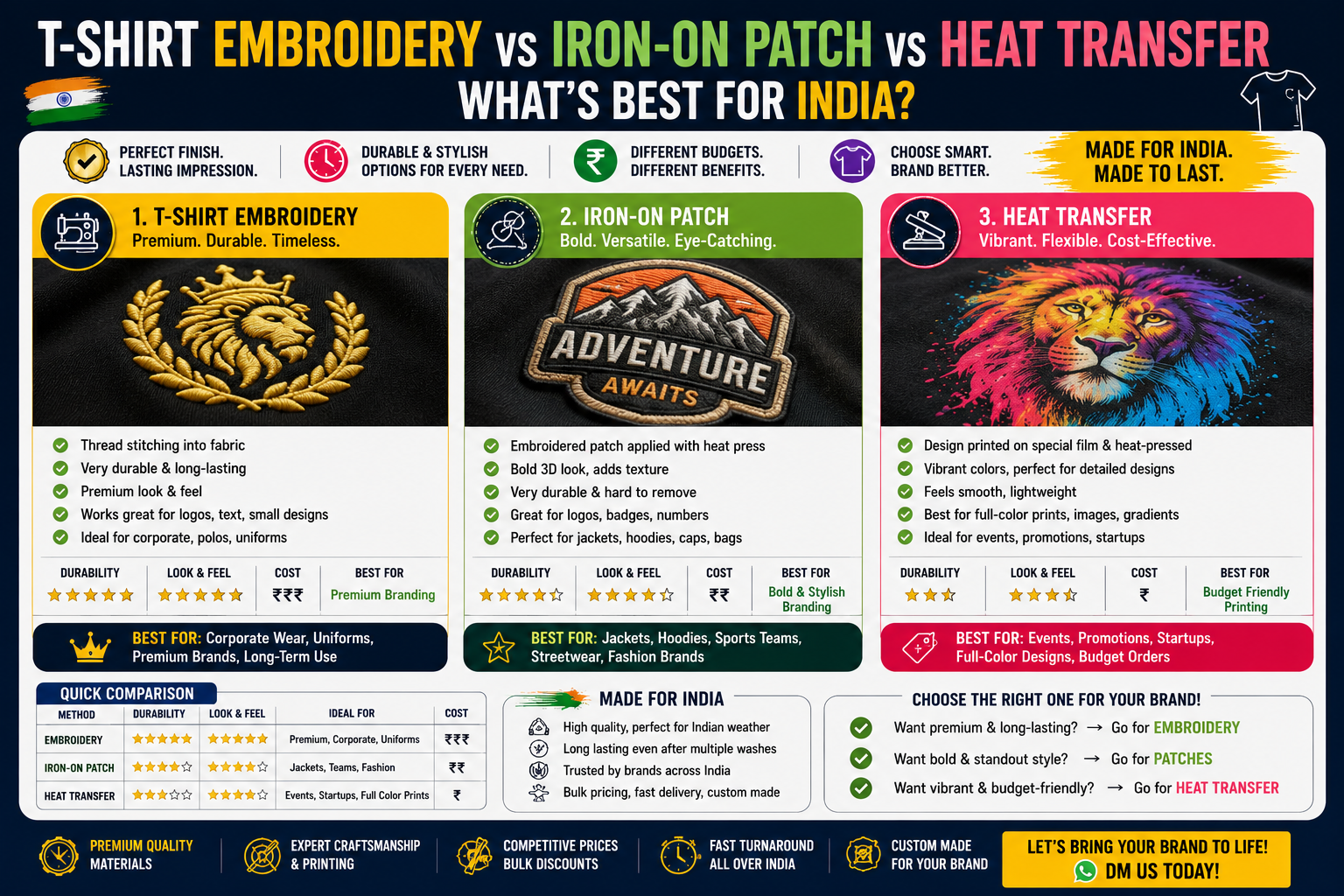
When creating custom t-shirts for your business, startup, school, sports team, event, or clothing brand, choosing the right customization method is just as important as selecting the fabric itself.
Three popular options dominate the Indian custom apparel market:
- Embroidery
- Iron-On Patches
- Heat Transfer Printing
Each method offers unique advantages in terms of appearance, durability, pricing, comfort, and branding impact.
If you’re searching for embroidery vs iron patch vs heat transfer India, this comprehensive guide will help you understand which option delivers the best value for your specific needs in 2025.
Understanding the Three Customization Methods
Before comparing them, let’s understand how each technique works.
What Is Embroidery?
Embroidery uses specialized machines to stitch logos, text, and artwork directly onto the fabric using thread.
The design becomes part of the garment itself.
Common applications:
- Corporate uniforms
- Startup branding
- Polo t-shirts
- Premium merchandise
Many businesses choose <mark>custom embroidery t-shirts India</mark> because of their premium appearance and long lifespan.
What Is an Iron-On Patch?
An iron-on patch is a separate embroidered or printed patch attached to the garment using heat-activated adhesive.
The patch is created first and then applied to the t-shirt.
Common uses include:
- Fashion apparel
- Club uniforms
- Motorcycle groups
- Sports teams
Many fashion brands use <mark>custom logo patches India</mark> for a distinctive look.
What Is Heat Transfer Printing?
Heat transfer printing involves printing artwork onto transfer material and applying it to fabric using heat and pressure.
Popular methods include:
- DTF Printing
- Vinyl Transfer
- PU Heat Transfer
- Digital Heat Transfer
Many suppliers offering <mark>custom printed t-shirts India</mark> rely on heat transfer technology.
Quick Comparison Overview
Customization Method Comparison
Relative performance across key factors for custom t-shirts.036912EmbroideryHeat TransferIron-On Patch
Overall comparison based on durability, branding value, appearance, and long-term performance.
Embroidery vs Iron-On Patch vs Heat Transfer
| Feature | Embroidery | Iron-On Patch | Heat Transfer |
|---|---|---|---|
| Premium Appearance | Excellent | Very Good | Good |
| Durability | Excellent | Good | Very Good |
| Wash Resistance | Excellent | Good | Very Good |
| Comfort | Very Good | Moderate | Good |
| Small Logo Quality | Excellent | Good | Excellent |
| Complex Artwork | Moderate | Good | Excellent |
| Bulk Cost Efficiency | Good | Moderate | Excellent |
| Corporate Branding | Excellent | Moderate | Good |
| Fashion Appeal | Good | Excellent | Very Good |
Which Option Looks Most Professional?
Embroidery
Embroidery is widely considered the most premium customization method.
It creates:
- Texture
- Depth
- Luxury appearance
- Professional branding
Most <mark>corporate uniform t-shirts India</mark> use embroidery because it immediately communicates quality.
Best For
- Corporate uniforms
- Employee apparel
- Hospitality staff
- Premium startup merchandise
Winner: Embroidery
Which Option Lasts the Longest?
Durability is often the deciding factor.
Embroidery
Typical lifespan:
- 3–10+ years
- Hundreds of washes
Embroidery rarely:
- Cracks
- Peels
- Fades significantly
Heat Transfer
Modern DTF printing can withstand:
- 50–100+ washes
However, extremely old or low-quality transfers may eventually show wear.
Iron-On Patches
The patch itself is durable, but adhesive can weaken over time.
Especially under:
- Frequent washing
- High heat exposure
Winner: Embroidery
For long-term durability, embroidery remains the industry leader.
Which Is Best for Detailed Artwork?
Complex designs require high-resolution reproduction.
Heat Transfer
Excels at:
- Photographs
- Gradients
- Multi-color graphics
- Intricate illustrations
Many <mark>DTF printed t-shirts India</mark> feature artwork that would be impossible to reproduce with embroidery.
Embroidery
Works best with:
- Simple logos
- Bold text
- Clean graphics
Winner: Heat Transfer
Which Is More Comfortable?
Comfort matters, especially in India’s warm climate.
Heat Transfer
Modern DTF transfers are relatively lightweight.
Minimal fabric stiffness.
Embroidery
Small chest logos are comfortable.
Large embroidered designs may feel heavier.
Iron-On Patches
Patches create an additional layer on the fabric.
This can feel slightly bulky.
Winner: Heat Transfer
Which Is Most Cost-Effective?
Pricing varies depending on quantity and design complexity.
Average Cost Comparison (2025)
| Customization Method | Typical Cost Impact |
|---|---|
| Heat Transfer | Lowest |
| Iron-On Patch | Moderate |
| Embroidery | Highest |
Businesses comparing <mark>custom t-shirt price India</mark> often find heat transfer printing to be the most affordable solution.
Winner: Heat Transfer
Best Option for Corporate Uniforms
Corporate apparel requires:
- Professional appearance
- Long lifespan
- Consistent branding
Recommended Choice
Embroidery
Advantages:
- Premium image
- Durable logos
- Long-term value
Best Option for Startup Merchandise
Startups need a balance between quality and affordability.
Small Logos
Embroidery works exceptionally well.
Large Artwork
Heat transfer provides better flexibility.
Best Option for Fashion Brands
Fashion apparel often prioritizes visual impact.
Iron-On Patches
Create a trendy streetwear aesthetic.
Popular for:
- Oversized t-shirts
- Varsity designs
- Urban fashion
Heat Transfer
Excellent for:
- Graphic tees
- Artistic collections
- Limited editions
Winner: Depends on Design Style
Best Option for Events and Promotions
Events usually require:
- Fast production
- Affordable pricing
- Large quantities
Recommended Choice
Heat Transfer Printing
Benefits:
- Fast turnaround
- Low setup costs
- Excellent color reproduction
Maintenance Comparison
Embroidery
Easy maintenance.
- Wash-resistant
- Fade-resistant
- Long lifespan
Heat Transfer
Requires:
- Gentle washing
- Moderate heat exposure
Iron-On Patches
Need extra care because adhesive can weaken over time.
Winner: Embroidery
Common Misconceptions
Myth 1: Heat Transfer Always Peels
Modern DTF transfers are highly durable when properly applied.
Myth 2: Embroidery Is Always Better
Not necessarily.
Complex graphics often look better with heat transfer.
Myth 3: Iron-On Patches Are Low Quality
High-quality patches can be extremely durable and visually appealing.
Which Method Should You Choose?
Choose Embroidery If:
- You want premium branding
- You need long-term durability
- You’re creating corporate uniforms
- Your logo is relatively simple
Choose Heat Transfer If:
- You need detailed artwork
- You want vibrant colors
- You’re ordering small quantities
- Budget matters
Choose Iron-On Patches If:
- You want a fashion-focused look
- You prefer a raised logo effect
- You’re creating streetwear apparel
Future Trends in India
The custom apparel market is increasingly adopting:
- Premium embroidery
- Advanced DTF printing
- Hybrid customization techniques
- Sustainable production methods
Many brands now combine embroidery and heat transfer to create unique, premium products.
Final Verdict: Embroidery vs Iron Patch vs Heat Transfer India
When comparing embroidery vs iron patch vs heat transfer India, there is no single solution that fits every project.
Embroidery remains the best choice for corporate uniforms, premium branding, and maximum durability. It delivers a professional appearance and often lasts longer than the garment itself.
Heat Transfer Printing, especially DTF technology, is ideal for detailed artwork, vibrant graphics, lower order quantities, and budget-conscious projects. It offers excellent versatility and strong value for money.
Iron-On Patches provide a distinctive fashion-forward look that works particularly well for streetwear brands, clubs, and lifestyle apparel.
For most Indian businesses, startups, and corporate uniforms in 2025, embroidery continues to offer the strongest long-term branding value. However, for graphic-heavy merchandise and modern apparel collections, heat transfer printing is often the most practical and cost-effective option.
The best choice ultimately depends on your design, budget, branding goals, and expected garment lifespan.
Leave a Reply