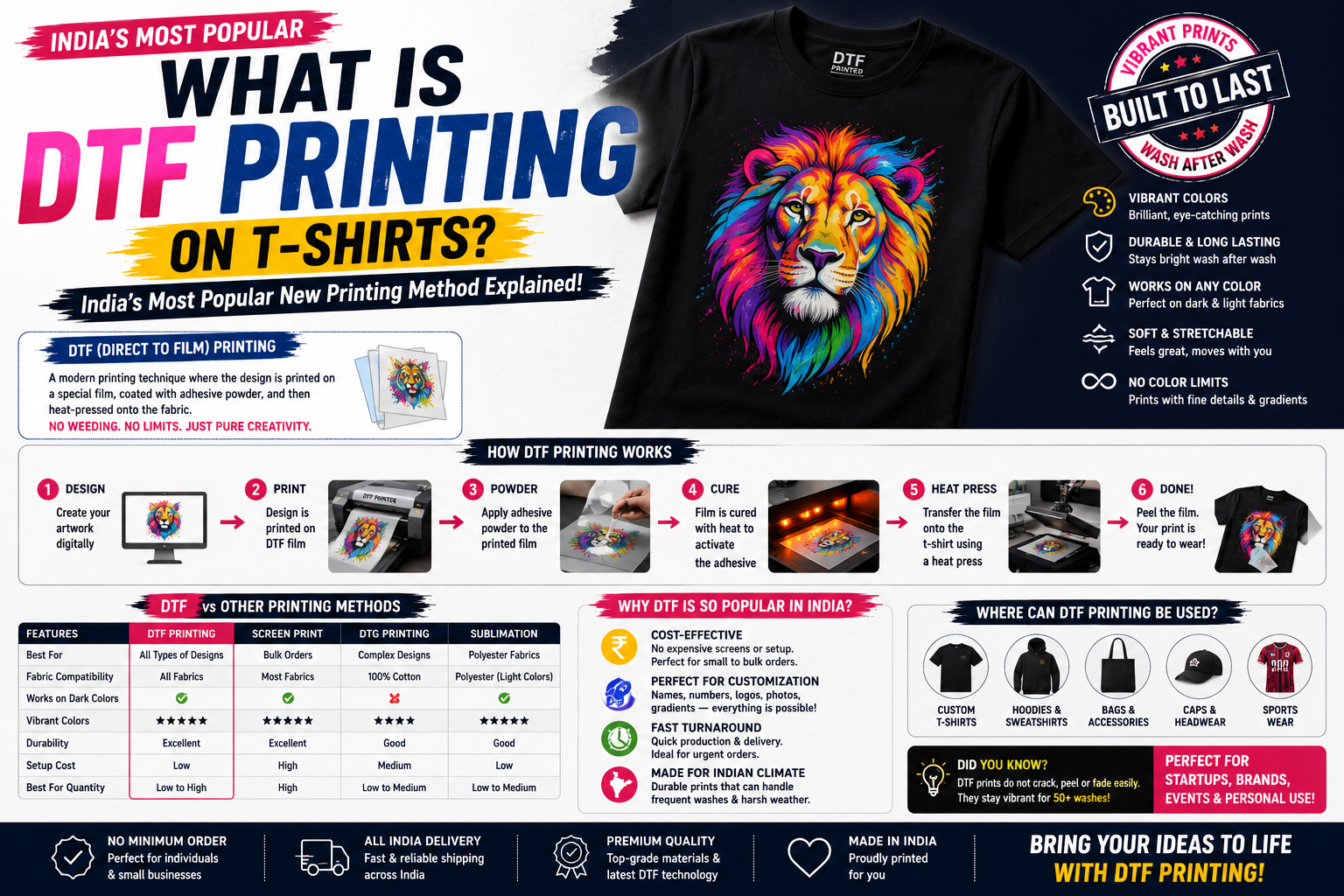
If you’ve searched for custom t-shirts online in India, you’ve probably come across the term DTF printing.
DTF stands for Direct-to-Film printing, a digital apparel printing technique that allows detailed, colourful designs to be transferred onto t-shirts and other garments.
Unlike traditional screen printing, DTF doesn’t require a separate screen for every colour. The artwork is printed digitally onto a special film, coated with adhesive powder, and then transferred onto the fabric using heat and pressure.
This makes DTF particularly useful for custom apparel businesses, personalized t-shirts, small-batch merchandise, corporate clothing, college event apparel, and detailed graphic designs.
So, what is DTF printing t-shirt India, and why has it become such a popular customization option?
Let’s break it down.
What Does DTF Stand For?
DTF = Direct to Film.
The name describes the basic process.
Instead of printing directly onto the t-shirt, the design is first printed onto a special transfer film.
The transfer is then applied to the garment using a heat press.
The basic process looks like this:
Digital artwork → DTF film → Special ink → Adhesive powder → Heat curing → Heat press → Finished t-shirt
This process allows manufacturers to create highly detailed designs without producing traditional printing screens.
How Does DTF T-Shirt Printing Work?
Although the process involves specialized equipment, the basic concept is straightforward.
Step 1: Create the Artwork
The design is prepared digitally.
It can contain:
- Text
- Logos
- Illustrations
- Multiple colours
- Gradients
- Detailed graphics
The artwork is prepared according to the required print size and garment placement.
Step 2: Print the Design on Film
A specialized DTF printer prints the artwork onto a coated PET transfer film.
DTF printers typically use CMYK colours along with white ink.
The white layer helps create a strong base, particularly when the design is applied to darker garments.
Step 3: Apply Adhesive Powder
A special hot-melt adhesive powder is applied to the printed transfer.
This adhesive is important because it helps the printed design bond to the fabric during heat pressing.
Step 4: Cure the Transfer
The powder-coated film is heated to activate the adhesive.
The result is a prepared transfer that can be applied to the garment.
Step 5: Heat Press the Design
The prepared film is positioned on the t-shirt.
A heat press applies controlled heat and pressure.
The design bonds to the fabric.
Step 6: Peel the Film
After the appropriate pressing process, the film is removed according to the transfer specifications.
The printed design remains attached to the t-shirt.
This creates the finished DTF printed t-shirt India.
Why Has DTF Printing Become Popular in India?
DTF has several characteristics that make it attractive for India’s growing custom apparel market.
1. Detailed Designs
DTF can reproduce complex artwork more easily than some traditional printing methods.
This makes it suitable for:
- Illustrations
- Detailed logos
- Multi-colour graphics
- Character artwork
- Small text
- Gradient effects
2. Works on Many Colours
DTF can be used on both light and dark garments.
The white ink layer allows the artwork to maintain visibility on darker fabrics.
3. Suitable for Small Orders
One of DTF’s major advantages is that you don’t necessarily need a large production run.
It can be useful for:
- One custom t-shirt
- Birthday gifts
- Couple t-shirts
- Small teams
- Creator merchandise
- Small businesses
This makes custom DTF t-shirts India accessible to buyers who don’t need hundreds of shirts.
4. Personalization
DTF is convenient when every garment needs a slightly different design.
For example, a sports team might require:
Player Name + Number
on each shirt.
Or a company might want employee names added individually.
What Fabrics Can Be Used for DTF Printing?
One reason DTF is popular is its versatility.
Depending on the transfer and production process, DTF can be applied to various textile materials.
Common options include:
- Cotton
- Polyester
- Cotton blends
- Hoodies
- Sweatshirts
- Tote bags
- Some performance garments
However, not every garment behaves identically under heat.
Always confirm that the selected DTF transfer is suitable for the specific fabric.
For DTF printing on cotton t-shirts India, cotton garments are a common choice, but the exact result depends on fabric construction and pressing conditions.
Is DTF Printing Good for Cotton T-Shirts?
Yes.
Cotton t-shirts are commonly used for DTF printing.
The combination can work particularly well for:
- Personalized apparel
- Graphic t-shirts
- Corporate merchandise
- College merchandise
- Event clothing
- Small clothing brands
However, garment quality still matters.
A high-quality transfer cannot compensate for a poor-quality t-shirt.
DTF vs Screen Printing
Both methods can produce excellent results, but they’re suited to different requirements.
DTF Printing
Best for:
- Detailed graphics
- Multiple colours
- Gradients
- Personalized designs
- Small orders
- Variable artwork
Screen Printing
Best for:
- Large quantities
- Simple designs
- Limited colours
- Repeated artwork
- High-volume production
For example, if you need 20 shirts with different names, DTF may be convenient.
If you need 500 shirts with the same two-colour logo, screen printing may be worth comparing.
For DTF vs screen printing India, quantity and artwork complexity are two of the biggest considerations.
DTF vs Embroidery
DTF and embroidery create completely different visual effects.
DTF
Creates a printed surface.
Best for:
- Detailed graphics
- Photographic artwork
- Large colourful designs
- Gradients
Embroidery
Uses stitched thread.
Best for:
- Logos
- Names
- Initials
- Small symbols
- Premium branding
If your artwork contains a detailed illustration, DTF may be more practical.
If you’re putting a small company logo on a polo shirt, embroidery may provide a more premium appearance.
Is DTF Printing Durable?
The durability of a DTF print depends on several factors:
- Transfer quality
- Ink quality
- Adhesive quality
- Fabric
- Heat-press settings
- Washing method
- Drying method
A properly produced DTF print can be durable enough for regular clothing use.
However, no printed garment is completely immune to wear.
To maximize longevity:
- Turn the shirt inside out before washing.
- Use a gentle wash cycle.
- Avoid excessive heat.
- Follow the supplier’s care instructions.
- Avoid harsh chemicals where possible.
For DTF t-shirt durability India, production quality and garment care are just as important as the printing technology itself.
Does DTF Printing Crack or Peel?
Poor-quality transfers or incorrect application can increase the risk of cracking, peeling, or premature deterioration.
The result depends on:
- Transfer formulation
- Adhesive quality
- Press temperature
- Press duration
- Pressure
- Fabric compatibility
- Washing conditions
A professionally produced transfer should be properly tested for the intended garment.
If you’re ordering in bulk, asking for a physical sample can help you assess the print before approving full production.
How Much Does DTF Printing Cost in India?
There isn’t one fixed DTF printing price India.
The final cost can depend on:
- T-shirt quality
- Fabric
- Print dimensions
- Artwork complexity
- Number of print locations
- Quantity
- Personalization
- Supplier
- Packaging
- Delivery
A small chest logo and a large full-front design require different amounts of transfer material.
Likewise, printing 10 shirts and printing 500 shirts can involve different production economics.
Instead of asking only for the printing price, request the complete finished t-shirt price.
What Size DTF Print Should You Use?
Common placement options include:
Left Chest
Good for small logos and branding.
Centre Chest
Suitable for medium-sized artwork.
Full Front
Useful for graphic designs.
Back
Good for large illustrations or event branding.
Sleeve
Suitable for small logos or secondary details.
For custom DTF t-shirt design India, the print size should match the garment size.
A graphic that looks balanced on an XL shirt may look too large on a small shirt.
Can DTF Print Photos?
Yes, DTF is capable of reproducing detailed, multi-colour artwork, which makes it useful for photo-inspired designs.
Potential uses include:
- Pet photos
- Family photographs
- Artwork
- Illustrations
- Portrait-style graphics
- Travel memories
However, the quality of the source artwork matters.
A low-resolution image can still look poor after printing.
Is DTF Good for Bulk T-Shirt Orders?
It can be.
DTF is especially useful when:
- Designs are detailed.
- Colours are numerous.
- Multiple designs are required.
- Personalization is involved.
- Quantities are small or medium.
For very large quantities of identical simple artwork, compare DTF with screen printing.
The most economical method depends on the complete production requirements.
DTF Printing for Corporate T-Shirts
Companies can use DTF for:
- Employee merchandise
- Team outings
- Product launches
- Promotional campaigns
- Startup merchandise
- Event apparel
For a simple corporate logo, embroidery may be another option.
For a colourful event graphic, DTF can provide more design flexibility.
DTF Printing for College Events
College events often need creative and colourful designs.
DTF can work well for:
- Freshers parties
- College festivals
- Student clubs
- Department events
- Graduation merchandise
Students can also personalize designs with names, batch years, or numbers.
DTF Printing for Small Clothing Brands
For emerging apparel brands, DTF can reduce the need to commit to extremely large quantities of one design.
A brand can experiment with:
- Multiple designs
- Limited drops
- Graphic collections
- Personalized products
- Small-batch merchandise
This can make DTF interesting for businesses testing new product concepts.
How to Care for a DTF Printed T-Shirt
Proper care can help preserve the print.
Wash Inside Out
This reduces direct friction against the printed surface.
Use Mild Washing
Avoid unnecessarily aggressive cycles.
Avoid Excessive Heat
Very high heat can affect printed transfers.
Don’t Iron Directly Over the Print
If ironing is necessary, follow the garment supplier’s instructions and avoid direct high heat on the design.
Follow the Care Label
The garment manufacturer’s instructions should take priority.
Advantages and Disadvantages of DTF Printing
Advantages
- Detailed colour reproduction
- Good for complex artwork
- Suitable for small orders
- Works across many garment colours
- Supports personalization
- Useful for variable designs
- No traditional screen setup for each colour
Disadvantages
- Print has a noticeable surface feel
- Large prints can feel less breathable than unprinted fabric
- Quality varies significantly between suppliers
- Incorrect heat application can affect durability
- Very large bulk orders may warrant comparison with screen printing
Understanding both sides helps you decide whether DTF is appropriate for your project.
How to Choose a DTF Printing Service in India
Before ordering, ask the supplier:
- What DTF transfer quality do you use?
- Which fabrics are supported?
- What is the expected production time?
- Can I see a physical sample?
- What t-shirt GSM is available?
- What are the washing instructions?
- Is the quoted price inclusive of the garment?
- Is GST included?
- Is delivery included?
- What happens if the print has a production defect?
For larger orders, request a sample before approving the entire production run.
Common DTF Printing Mistakes
Using Low-Resolution Artwork
The final print can only be as good as the source design.
Choosing an Unsuitable Fabric
Always confirm compatibility.
Ignoring Print Size
An oversized transfer can affect comfort.
Comparing Only Printing Prices
The garment, production, packaging, and shipping can all affect the final cost.
Skipping a Sample
A physical sample gives you a much better idea of the actual finish.
Frequently Asked Questions
What is DTF printing on t-shirts?
DTF, or Direct-to-Film printing, involves printing a design onto a special transfer film, applying adhesive powder, curing the transfer, and heat-pressing it onto a garment.
Is DTF printing good for t-shirts?
Yes. DTF is particularly useful for colourful, detailed, personalized, and small-batch t-shirt designs.
Is DTF better than screen printing?
Neither is universally better. DTF offers greater flexibility for detailed and personalized artwork, while screen printing can be highly efficient for large quantities of simple, repeated designs.
Is DTF better than embroidery?
They serve different purposes. DTF is better suited to detailed printed artwork, while embroidery is ideal for tactile logos, names, and premium branding.
Does DTF printing last?
A properly produced DTF print can provide good durability with appropriate garment care. Print quality, application, fabric, and washing practices all affect longevity.
Can DTF be printed on cotton?
Yes. DTF is commonly used on cotton garments, although the exact transfer and application process should be matched to the fabric.
Is DTF expensive in India?
The cost varies according to garment quality, print size, artwork, quantity, and supplier. Small prints and larger production runs can have different per-piece economics.
Can I print a photo using DTF?
Yes. DTF can reproduce detailed, multi-colour artwork, making it suitable for many photo-inspired designs.
Final Verdict
So, what is DTF printing t-shirt India?
DTF, or Direct-to-Film printing, is a digital transfer method in which artwork is printed onto a special film and then heat-pressed onto a garment.
Its biggest strengths are detailed artwork, colour flexibility, personalization, and suitability for small-to-medium production runs.
For a simple logo on a corporate polo, embroidery may still be the better option. For hundreds of identical simple designs, screen printing may offer better production economics. But when you need a colourful, detailed, personalized design without committing to a large quantity, DTF can be an excellent choice.
Before ordering, compare the t-shirt fabric, GSM, print dimensions, transfer quality, production process, total price, and care requirements.
Most importantly, ask for a sample when quality matters. A professional DTF print should look clean, adhere properly, and complement the garment rather than overpowering it.
Leave a Reply